
Opening your dashboard
Class 9 Chemistry Chapter 4 Atomic Structure and Chemical Bonding: Practice Questions
44 questions on Chapter 4, each worked through on its own page with the AI tutor. Class 9 Chemistry, ICSE 2026-27.
44 questions
1–5 marks · Mixed difficulty
- 11 mark
Question 1
Bloom's level: Remember
The idea that matter is made of the smallest indivisible particles called parmanu was given by:
- 21 mark
Question 2
Bloom's level: Remember
The mass of an electron is about:
- 31 mark
Question 3
Bloom's level: Understand
Unlike cathode rays, the charge-to-mass ratio of anode rays changes when the gas in the discharge tube is changed. This is because anode rays:
- 41 mark
Question 4
Bloom's level: Analyse
In an alpha-particle scattering experiment with a thin gold foil, out of every 100 000 alpha particles about 99 970 pass straight through, about 20 are deflected by small angles and about 10 bounce back. Which conclusion do these results support?
- 51 mark
Question 5
Bloom's level: Apply
The electrons of an atom Y occupy three shells, and its outermost shell needs just two more electrons to complete an octet. The atomic number of Y is:
- 61 mark
Question 6
Bloom's level: Understand
According to Bohr's model, when an electron jumps from the L shell to the K shell, it:
- 71 mark
Question 7
Bloom's level: Apply
The aluminium ion contains:
- 81 mark
Question 8
Bloom's level: Understand
Which pair of atoms are isobars?
- 91 mark
Question 9
Bloom's level: Apply
Element A has atomic number 13 and element B has atomic number 8. The formula of the compound formed between them is:
- 101 mark
Question 10
Bloom's level: Understand
Assertion (A): Covalent compounds such as methane have low melting and boiling points.
Reason (R): The molecules of covalent compounds are held together by weak forces of attraction.
- 111 mark
Question 11
Bloom's level: Evaluate
Assertion (A): Solid sodium chloride conducts electricity.
Reason (R): Sodium chloride is made up of sodium ions and chloride ions.
- 121 mark
Question 12
Bloom's level: Analyse
Assertion (A): The sodium ion and the fluoride ion both have the electronic configuration 2, 8.
Reason (R): Both ions are formed when the atom gains one electron.
- 132 marks
Question 13
Bloom's level: Remember
Match each scientist with his contribution to the structure of the atom:
Scientist Contribution (a) J.J. Thomson (p) discovered the neutron (b) Goldstein (q) proposed fixed energy levels (shells) for electrons (c) Rutherford (r) discovered the electron through cathode rays (d) Chadwick (s) discovered the nucleus (e) Niels Bohr (t) discovered positive (anode) rays - 142 marks
Question 14
Bloom's level: Remember
(a) Define the covalency of an atom.
(b) State the covalency of nitrogen and of carbon.
- 152 marks
Question 15
Bloom's level: Understand
Explain how the positively charged particles of anode rays are produced in a discharge tube, and why hydrogen gas in the tube gives the lightest such particle, the proton.
- 162 marks
Question 16
Bloom's level: Understand
According to classical physics, an electron moving round a nucleus should lose energy and fall into the nucleus. Explain how Bohr's postulates account for the stability of the atom.
- 172 marks
Question 17
Bloom's level: Understand
A piece of zinc is ground into smaller and smaller particles. Explain, using this example, what is meant by saying that an atom is the smallest particle of an element that shows all the properties of that element.
- 182 marks
Question 18
Bloom's level: Apply
Write the electronic configuration of each of the following, and name the noble gas whose configuration it matches (if any):
(a) (Z = 12)
(b) (Z = 16)
(c) Ca (Z = 20)
- 192 marks
Question 19
Bloom's level: Apply
Naturally occurring boron is 19.9% boron-10 and 80.1% boron-11. Calculate the average atomic mass of boron.
- 202 marks
Question 20
Bloom's level: Apply
An atom has mass number 39, and its nucleus contains one more neutron than protons. Find its atomic number, its number of electrons and its electronic configuration, and identify the element.
- 212 marks
Question 21
Bloom's level: Apply
Magnesium (Z = 12) burns in oxygen (Z = 8) to form magnesium oxide.
(a) Write the equations for the changes in the magnesium atom and in the oxygen atom, and name each change as oxidation or reduction.
(b) Name the oxidising agent and the reducing agent.
- 222 marks
Question 22
Bloom's level: Analyse
Ammonia () and nitrogen () both contain three shared pairs of electrons per molecule. Compare the two molecules to show how the shared pairs are arranged differently, and state the type of bond(s) in each.
- 234 marks
Question 23
Bloom's level: Apply
Silicon is used to make computer chips. A sample of silicon contains three isotopes: (92.2%), (4.7%) and (3.1%).
(a) State the number of protons and neutrons in the nucleus of each isotope.
(b) Calculate the average atomic mass of silicon in the sample.
(c) The chip maker does not separate the isotopes before use. Explain why all three isotopes behave the same way in chemical reactions.
- 244 marks
Question 24
Bloom's level: Analyse
At a science museum, Kabir watches a discharge-tube demonstration. With air at normal pressure, nothing happens. When the pressure is lowered to about 0.01 mm of mercury and 10 000 volts are applied, a beam from the cathode makes the glass opposite glow greenish-yellow, turns a tiny paddle wheel placed in its path, and bends towards a positively charged plate held near the tube.
(a) Name the rays and the particles they are made of.
(b) State what each of the three observations (glow, paddle wheel, bending) tells us about these particles.
(c) The demonstrator replaces the air with neon and repeats the experiment. Predict whether the charge-to-mass ratio of the particles changes, and state what this shows.
- 254 marks
Question 25
Bloom's level: Evaluate
Thomson pictured the atom as a sphere of uniform positive charge with electrons embedded in it (the 'plum-pudding' model). Evaluate this model against the results of Rutherford's alpha-particle scattering experiment: which results does it explain, which does it fail to explain, and how does Rutherford's model do better?
- 265 marks
Question 26
Bloom's level: Create
Design a three-dimensional model of an atom of , based on Bohr's model, for your class exhibition. Your plan should include:
(a) the number of each sub-atomic particle and exactly where each will be placed;
(b) the materials and colours you will use for the nucleus, the particles and the shells, with a key;
(c) a short label card for visitors that states two ways in which your model is not like a real atom.
- 275 marks
Question 27
Bloom's level: Analyse
Study the particles present in five species, A to E:
Species Protons Neutrons Electrons A 17 18 17 B 17 20 18 C 18 22 18 D 20 20 18 E 19 21 19 (a) Find the mass number of each, and identify the species that are ions, giving the charge on each.
(b) Which species are isotopes of the same element, and which are isobars?
(c) Which species have the same electronic configuration? Explain why C is chemically unreactive while A is not.
- 285 marks
Question 28
Bloom's level: Evaluate
In a laboratory, Meena tests two white solids, X and Y:
Test Solid X Solid Y Melting point 801 °C 80 °C Conducts electricity as a solid? No No Conducts when melted? Yes No Dissolves in water? Yes, and the solution conducts No Dissolves in kerosene? No Yes Her partner says, "Neither solid conducts electricity, so both must be covalent compounds."
(a) Classify X and Y as electrovalent or covalent, giving two reasons for each.
(b) Evaluate her partner's statement.
(c) Explain, in terms of the particles present, why X conducts electricity when melted but not as a solid.
- 295 marks
Question 29
Bloom's level: Create
Design three 'molecule challenge' cards for a class quiz using only the atoms H, C, N, O and Cl. Card 1 must need a molecule with only single covalent bonds, card 2 a molecule containing a double bond, and card 3 a molecule containing a triple bond. For each card write the clue, and on the back give the answer: the molecular formula, the structural formula, the number of shared pairs, and how each atom reaches a duplet or an octet. (Atomic numbers: H 1, C 6, N 7, O 8, Cl 17)
- 304 marks
Question 30
Bloom's level: Apply
An atom of phosphorus is represented as .
(a) State the number of protons, neutrons and electrons in it.
(b) Write its electronic configuration and the number of valence electrons.
(c) Phosphorus combines with hydrogen. State the type of bond formed, the formula of the compound and the number of shared pairs in one molecule.
- 311 mark
Question 31
Identify the electrovalent compound among the four substances listed.
- 321 mark
Question 32
Using the rule, find the capacity of the fourth shell of an atom (the N shell). How many electrons can it take at the most?
- 334 marks
Question 33
Fill in the blanks.
(a) Atoms that have the same atomic number but different mass numbers are called ________.
(b) Atoms of different elements that have the same mass number but different atomic numbers are called ________.
(c) In the symbol , the lower number 11 is the ________ of sodium.
(d) Anode rays, which led to the discovery of the proton, were first observed by ________.
- 345 marks
Question 34
Complete each statement.
(a) The protons and neutrons of an atom are packed together in its ________.
(b) The electrons in the last occupied shell are known as ________ electrons.
(c) The ________ number of an element tells us how many protons each of its atoms has.
(d) An atom of argon has ________ electrons in its outermost shell.
(e) An atom with 7 protons, 7 electrons and 7 neutrons is represented by the symbol ________.
- 351 mark
Question 35
In Rutherford's experiment a beam of fast α-particles was directed at a very thin gold foil. A very small number of the α-particles were turned back, almost along the path by which they came. This observation shows that :
- 361 mark
Question 36
The ion of an element X contains 18 electrons and 16 neutrons. The number of valence electrons in a neutral atom of X is :
- 371 mark
Question 37
Assertion (A): Atoms of and differ in mass.
Reason (R): The nuclei of the two atoms contain different numbers of neutrons.
- 382 marks
Question 38
Two observations made on cathode rays in a discharge tube are given below. State the conclusion drawn from each observation.
(i) A light paddle wheel placed in the path of the rays starts rotating.
(ii) When the rays pass between two oppositely charged plates, they bend towards the positive plate.
- 392 marks
Question 39
An atom of fluorine is represented as .
(i) State the number of protons, neutrons and electrons in this atom.
(ii) The atom forms an ion which has 10 electrons. Write the symbol of this ion and state whether it is a cation or an anion.
- 402 marks
Question 40
A sample of neon gas contains two isotopes. 90% of its atoms are and 10% are .
(i) Calculate the average atomic mass of neon in this sample.
(ii) State the number of neutrons in one atom of each isotope.
- 412 marks
Question 41
According to Bohr's model, the electrons of an atom revolve round the nucleus in the shells K, L, M and N.
(i) Which of these four shells has the least energy ? State what happens to the energy of an electron as long as it keeps revolving in that shell.
(ii) State what must happen for an electron to move from the K shell to the L shell.
- 423 marks
Question 42
The diagram shows the structure of a particle X. Its nucleus contains 12 protons (p) and 12 neutrons (n), and its electrons are shown as dots on the shells.
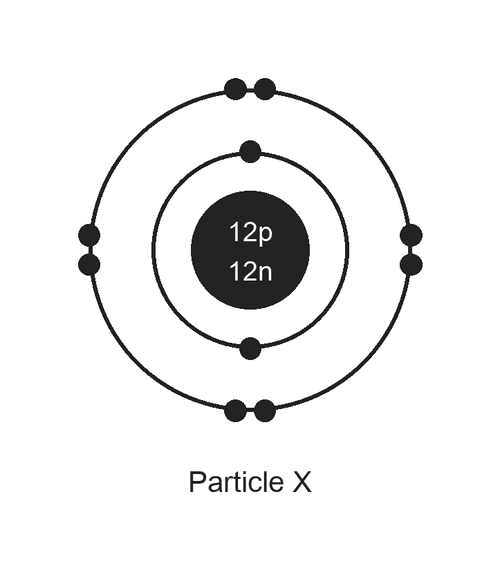
(i) Is X an atom or an ion ? Give a reason, and write the charge on X, if any.
(ii) Write the electronic configuration of the neutral atom of this element, and state its valency.
(iii) The M shell can hold a maximum of 18 electrons. Explain why the electronic configuration of potassium (atomic number 19) is 2, 8, 8, 1 and not 2, 8, 9.
- 434 marks
Question 43
Sodium (electronic configuration 2, 8, 1) combines with sulphur (electronic configuration 2, 8, 6) to form the electrovalent compound sodium sulphide.
(i) Write one equation to show how a sodium atom forms its ion, and one equation to show how a sulphur atom forms its ion.
(ii) Write the formula of sodium sulphide. Explain, in terms of the electrons transferred, why the two elements combine in this ratio.
(iii) Solid sodium sulphide does not conduct electricity, but molten sodium sulphide does. Give a reason.
- 444 marks
Question 44
Hydrogen (atomic number 1) and oxygen (atomic number 8) combine to form water.
(i) Draw the electron dot diagram of a molecule of water.
(ii) State the number of shared pairs of electrons and the number of lone pairs of electrons in one molecule of water, and name the type of bond present.
(iii) The bonds in a water molecule are said to be polar. Explain why.