
Question 784 marksMedium
Draw the orbit structure diagram of :
(a) sodium chloride (NaCl), (b) calcium oxide (CaO).
[Atomic numbers Na = 11, Ca = 20, Cl = 17, O = 8].
Confirming your payment
Sign up now and get 250 free tokens.
Atomic Structure and Chemical Bonding · Question 78 of 122
Draw the orbit structure diagram of :
(a) sodium chloride (NaCl), (b) calcium oxide (CaO).
[Atomic numbers Na = 11, Ca = 20, Cl = 17, O = 8].
Solution:
Concept: In an electrovalent compound the metal atom transfers its valence electron(s) to the non-metal atom, and both reach a noble gas configuration. In the diagrams, the metal's electrons are crosses and the non-metal's are dots.
Step 1 — (a) Electron transfer in sodium chloride.
Sodium (2, 8, 1) loses its one valence electron and chlorine (2, 8, 7) gains it:
Step 2 — (a) Draw the orbit structure.
The diagram shows (2, 8) and (2, 8, 8), held together by electrostatic attraction.

Step 3 — (b) Electron transfer in calcium oxide.
Calcium (2, 8, 8, 2) loses its two valence electrons and oxygen (2, 6) gains both:
Step 4 — (b) Draw the orbit structure.
The diagram shows (2, 8, 8) and (2, 8).
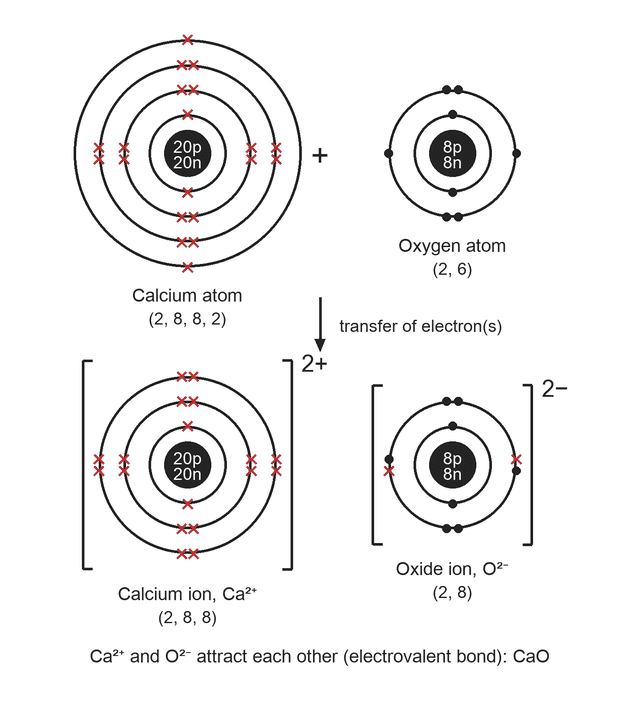
Watch out: The nucleus does not change when an ion forms; only the outer electrons move.
Therefore, NaCl forms by transfer of one electron from Na to Cl, and CaO by transfer of two electrons from Ca to O, as shown in the orbit diagrams.