Solution:
Concept: Both molecules are formed by sharing electron pairs; each atom ends up with an octet like the nearest noble gas.
Step 1 — (a)(i) Oxygen molecule.
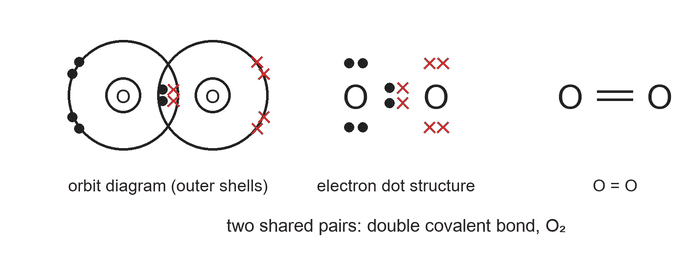
Each oxygen atom (2, 6) gets 8 outer electrons, 2, 8, like neon.
Step 2 — (a)(ii) Carbon tetrachloride.
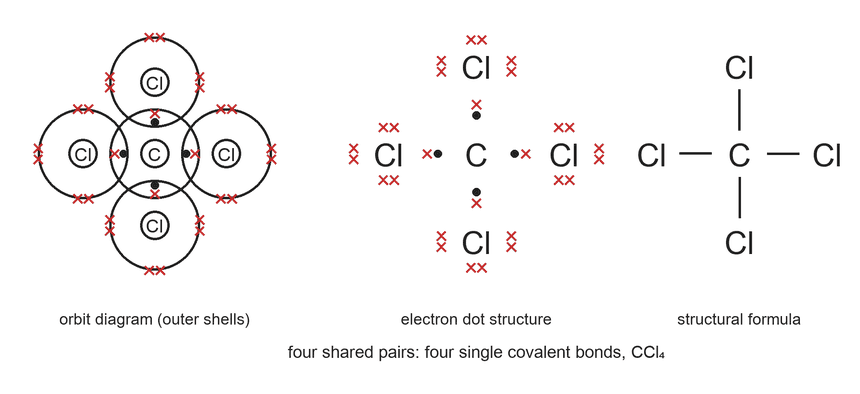
Carbon (2, 4) reaches 2, 8 (neon), and each chlorine (2, 8, 7) reaches 2, 8, 8 (argon).
Step 3 — (b) Electrons shared.
No electrons are transferred in either molecule. Count the shared electrons (2 per pair):
| Molecule | Shared pairs | Electrons shared |
|---|
| O2 | 2 | 4 |
| CCl4 | 4 (one per Cl) | 8 |
Step 4 — (c) Type of bonds.
O2 has one double covalent bond (non-polar). CCl4 has four single covalent bonds.
Step 5 — (d)(i) Orbital diagram of oxygen.
The two oxygen atoms share two pairs in the overlap of their outer shells.
Step 6 — (d)(ii) Orbital diagram of carbon tetrachloride.
Carbon shares one pair with each of the four chlorine atoms.
Therefore, O₂ shares 4 electrons in one double bond (each O like neon), and CCl₄ shares 8 electrons in four single bonds (C like neon, each Cl like argon).
