
Opening your dashboard
Class 9 Chemistry Chapter 4 Atomic Structure and Chemical Bonding: Competency-Based Questions (CBQ)
40 questions on Chapter 4, each worked through on its own page with the AI tutor. Class 9 Chemistry, ICSE 2026-27.
40 questions
1–5 marks · Mixed difficulty
- 11 mark
Question 1
Cognitive domain: Understanding
At a science centre, a beam of cathode rays makes a bright spot at the centre of the screen of a discharge tube. The demonstrator then does two things.
- She fixes one metal plate above the beam and one below it, and connects the upper plate to the positive terminal of a battery. The spot moves upwards.
- She places a very light paddle wheel in the path of the beam. The wheel begins to turn.
Which conclusion do these two observations support?
- 21 mark
Question 2
Cognitive domain: Analysis
Tara uses a computer simulation of Rutherford's experiment. She fires 10 000 alpha particles at a thin foil made of each of three imaginary kinds of atom, P, Q and R. The atoms of P, Q and R are all of the same size.
Foil Passed straight through Deflected slightly Turned back P 9 900 99 1 Q 9 600 391 9 R 10 000 0 0 Which conclusion fits her results?
- 31 mark
Question 3
Cognitive domain: Application
Milk and curd are rich in calcium (atomic number 20). In her notebook, Ritu writes the electronic configuration of a calcium atom as 2, 8, 10. Her teacher marks it wrong.
Which statement points out Ritu's mistake correctly and gives the right configuration?
- 41 mark
Question 4
Cognitive domain: Application
Engineers of a city water board suspect that a water main is leaking somewhere under a two-kilometre stretch of road. Instead of digging up the whole road, they mix a small, safe amount of a radioactive isotope into the water and then walk along the road with a radiation detector.
How will they find the leak?
- 51 mark
Question 5
Cognitive domain: Understanding
Assertion (A): When a sodium atom, , changes into a sodium ion, , its mass number remains 23.
Reason (R): An ion is formed from an atom by the loss or gain of electrons only; the protons and neutrons in its nucleus are not disturbed.
- 61 mark
Question 6
Cognitive domain: Understanding
Assertion (A): In a molecule of water, the oxygen atom has eight electrons in its outermost shell.
Reason (R): In a molecule of water, each hydrogen atom transfers its electron completely to the oxygen atom.
- 71 mark
Question 7
Cognitive domain: Recall
A discharge tube containing hydrogen gas at very low pressure is fitted with a perforated cathode. When a high voltage is applied, a glow is seen on a zinc sulphide screen placed behind the cathode.

Fill in the blanks.
The rays that pass through the holes of the cathode and reach the screen are called ________ rays. They are made up of ________ charged particles. When the gas in the tube is hydrogen, each of these particles is a ________.
- 81 mark
Question 8
Cognitive domain: Application
Packets of potato chips are filled with a gas that keeps the chips fresh. The same gas makes up about 78% of the air. Each atom of this gas has 5 electrons in its outermost shell, and two such atoms complete their octets by sharing electrons with each other.
Name the gas, and state how many pairs of electrons are shared between the two atoms in one molecule of it.
- 91 mark
Question 9
Cognitive domain: Application
A few crystals of common salt and a small piece of candle wax (a covalent substance) are placed side by side on a tawa. The tawa is heated gently for one minute.
Predict what is seen, and give the reason in terms of the forces between the particles.
- 102 marks
Question 10
Cognitive domain: Understanding
To explain Bohr's model of the atom, a teacher uses a staircase. A ball can rest on any step, but never between two steps. Energy is needed to lift the ball to a higher step, and the ball gives out energy when it drops to a lower step.
(a) What do the steps and the ball stand for in an atom?
(b) Use the comparison to state what happens to the energy of an electron while it stays in the M shell, and when it jumps from the M shell to the L shell.
- 112 marks
Question 11
Cognitive domain: Application
Silver anklets slowly turn black because a thin layer of silver sulphide forms on them. Silver sulphide contains sulphide ions, . An atom of sulphur is written as .
(a) State the number of protons, neutrons and electrons in one sulphide ion.
(b) Write the electronic configuration of the sulphide ion, and explain why a sulphur atom forms this ion instead of losing the electrons of its outermost shell.
- 122 marks
Question 12
Cognitive domain: Analysis
The table shows the largest number of electrons that each of the first four shells of an atom can hold.
Shell K L M N Shell number, 1 2 3 4 Largest number of electrons 2 8 18 32 (a) Find the rule that connects the largest number of electrons with , and use it to predict the number for the fifth shell.
(b) An atom of the gas krypton has 36 electrons arranged as 2, 8, 18, 8. Its N shell has room for 32 electrons, yet it holds only 8. Which rule does this arrangement follow, and what does it tell you about the reactivity of krypton?
- 134 marks
Question 13
Cognitive domain: Analysis
The orange-red glow of an old-style shop sign comes from neon gas (atomic number 10) sealed in a glass tube at low pressure. Riya's uncle repairs such signs. He shows her the supplier's test report for a cylinder of neon. It says that the gas is a mixture of two kinds of neon atoms. A third kind is present in so small an amount that the report leaves it out.
Kind of atom Mass number Percentage of atoms Neon-20 20 90% Neon-22 22 10% (a) What are such atoms of the same element called? Find the number of neutrons in each kind, and explain why both kinds are equally unreactive.
(b) Calculate the average atomic mass of the neon in this cylinder.
(c) The report for a second cylinder gives an average atomic mass of 20.5. Find the percentage of neon-22 atoms in it. Which of the two cylinders contains the denser gas at the same temperature and pressure? Give a reason.
- 144 marks
Question 14
Cognitive domain: Evaluation
During the monsoon, Farah's mother hangs a moisture-absorber pouch in the cupboard to keep the clothes dry. The label says that the white granules in it are calcium chloride, a compound of calcium (atomic number 20) and chlorine (atomic number 17). The granules take in water vapour from the damp air. After some weeks they have dissolved in the water they absorbed, and a clear liquid has collected in the lower part of the pouch. Farah's brother Imran says, "The granules are made of ions, so the dry solid must be a good conductor of electricity. The liquid at the bottom is only water, so it will not conduct."
(a) Write the electronic configurations of a calcium atom and a chlorine atom. Which ion does each form, and which noble gas configuration does each ion have?
(b) Show, by the transfer of electrons, why the formula of calcium chloride is . State which atom is oxidised and which is reduced.
(c) Evaluate both parts of Imran's statement.
- 155 marks
Question 15
Cognitive domain: Creativity
For the school science exhibition, you want visitors to understand how Rutherford could work out what is inside an atom without ever seeing it. You are given:
- a square wooden board, 60 cm wide, raised a few centimetres above a table on four corner blocks;
- a cloth to hang round the board so that nobody can see under it;
- 100 marbles;
- a small round box 3 cm wide and a large round box 20 cm wide, one of which will be fixed to the table under the centre of the board.
Design the model. Your plan should show:
(a) what each item stands for in Rutherford's experiment;
(b) what the visitors will do and what they will record;
(c) the results you expect with the small box, how they would change with the large box, and what the visitors should conclude about the atom;
(d) one way in which your model is not like the real experiment.
- 161 mark
Question 16
Cognitive domain: Understanding
A teacher gives three pure white-grey solids, P, Q and R, to a group of students and asks them to find out which of the solids is an element. The students heat each solid strongly and then pass an electric current through the melted solid. (Hypothetical data.)
Solid On strong heating On passing electricity through the melt P Melts, and nothing simpler is formed A silvery metal at one electrode and a greenish-yellow gas at the other Q Melts, and nothing simpler is formed The melt conducts, but nothing simpler is formed R Gives off a colourless gas and leaves a white solid Not tested Which conclusion is correct?
- 171 mark
Question 17
Cognitive domain: Analysis
A student fills a discharge tube in turn with three gases at very low pressure and applies a high voltage. She measures the charge-to-mass ratio, , of two kinds of rays, X and Y, produced in the tube. Her results are shown in arbitrary units in which the ratio for rays Y in the hydrogen tube is 1. (Hypothetical data.)
Gas in the tube Rays X Rays Y Hydrogen 1837 1 Helium 1837 0.25 Neon 1837 0.05 Which conclusion fits the results?
- 181 mark
Question 18
Cognitive domain: Evaluation
Assertion (A): According to Bohr's model, an electron that keeps revolving in the same shell neither loses nor gains energy.
Reason (R): According to Bohr's model, a shell farther from the nucleus has more energy than a shell nearer to the nucleus.
- 191 mark
Question 19
Cognitive domain: Evaluation
While discussing Rutherford's experiment, Ravi says, "The few alpha particles that bounced back from the gold foil must have collided with electrons in the gold atoms."
Which reply to Ravi is correct?
- 201 mark
Question 20
Cognitive domain: Analysis
The figure shows three particles, P, Q and R. Each dot is an electron, and the numbers in the nucleus give the protons (p) and neutrons (n).

Which statement about P, Q and R is correct?
- 211 mark
Question 21
Cognitive domain: Application
An electrician wants a gas to fill an electric bulb so that the hot filament does not react with it. A chemist gives him the electronic configurations of the atoms of four gases, P, Q, R and S.
Gas Electronic configuration of its atoms P 1 Q 2, 6 R 2, 7 S 2, 8, 8 Which gas should he choose, and why?
- 221 mark
Question 22
Cognitive domain: Analysis
The figure shows the outermost-shell electrons in a molecule formed when hydrogen combines with an element X. Only the electrons of the outermost shell of X are drawn. The atom of X has three shells.
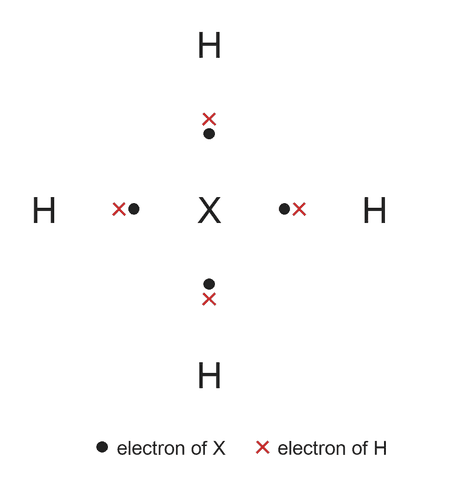
What are the atomic number of X and the covalency of X?
- 231 mark
Question 23
Cognitive domain: Analysis
Copper (atomic number 29) is used for electric wires in every home. Natural copper is a mixture of two kinds of copper atoms. The bar chart shows the percentage of each kind. (The percentages are rounded. Take the mass of each kind of atom, in u, as equal to its mass number.)

Which statement is correct?
- 241 mark
Question 24
Cognitive domain: Analysis
Assertion (A): A helium atom has only 2 protons, yet its mass is about 4 u and not 2 u.
Reason (R): The nucleus of a helium atom also contains 2 neutrons, and the mass of a neutron is almost equal to the mass of a proton.
- 251 mark
Question 25
Cognitive domain: Analysis
In a model of an atom, the energies of the electron shells K, L and M are given in arbitrary units. (Hypothetical data.)
Shell K L M Energy 10 40 60 An electron makes three jumps one after the other: K to M, then M to L, and then L to K.
Which statement describes the energy changes correctly?
- 262 marks
Question 26
Cognitive domain: Application
The mass of an electron is of the mass of a hydrogen atom, and a hydrogen atom has a mass of about 1 u. A carbon atom, , has 6 electrons and a mass of 12 u.
(a) Calculate the total mass, in u, of the electrons in one carbon atom.
(b) What percentage of the mass of the atom is this? What does your answer show about the place where the mass of an atom is found?
- 272 marks
Question 27
Cognitive domain: Evaluation
A student writes: "Anode rays are the same as cathode rays. They are called canal rays only because the cathode rays pass through the holes in the perforated cathode and travel on to the screen."
(a) Point out two mistakes in her statement.
(b) Describe how a pair of oppositely charged metal plates could be used to show that the two kinds of rays are different, and state the result expected for each kind.
- 282 marks
Question 28
Cognitive domain: Evaluation
Riya makes a rule: "The valency of an element is equal to the number of electrons in the outermost shell of its atom." She tests her rule on magnesium (atomic number 12) and oxygen (atomic number 8).
(a) Write the electronic configuration of each atom and check whether the rule works for each.
(b) Correct Riya's rule so that it also works for oxygen.
- 292 marks
Question 29
Cognitive domain: Application
Heavy water is used to slow down neutrons in some nuclear reactors. It is made with deuterium, D, an isotope of hydrogen whose atom has one proton and one neutron.
(a) Write the symbol of deuterium showing its mass number and atomic number, and state the number of electrons in one atom.
(b) Calculate the relative molecular mass of heavy water, (O = 16), and say how it compares with that of ordinary water, .
- 302 marks
Question 30
Cognitive domain: Understanding
Sodium burns in oxygen to form sodium oxide, an electrovalent compound. A tiny crystal of sodium oxide contains 9 000 oxide ions, . The atomic numbers of sodium and oxygen are 11 and 8.
(a) How many sodium ions does the crystal contain? Give the formula of sodium oxide.
(b) Show that the crystal as a whole carries no charge. Take the charge on one electron as 1 unit, so that carries 2 units of negative charge.
- 312 marks
Question 31
Cognitive domain: Analysis
Dry ice, which keeps ice cream frozen while it is carried in a van, is solid carbon dioxide. In a molecule of carbon dioxide, the carbon atom is joined to each of the two oxygen atoms by a double covalent bond, O=C=O. The atomic numbers of carbon and oxygen are 6 and 8.
(a) Find the number of shared pairs and the number of lone pairs of electrons in the outermost shells of one molecule.
(b) Show that each of the three atoms has an octet in its outermost shell.
- 323 marks
Question 32
Cognitive domain: Understanding
Dalton's atomic theory said that atoms cannot be divided and that all atoms of an element are exactly alike. Two later observations are given.
- Observation 1: Discharge tubes filled with different gases all give cathode rays with the same properties.
- Observation 2: Natural chlorine contains atoms of mass numbers 35 and 37, and both kinds have 17 protons.
(a) Which part of Dalton's theory does each observation contradict? Give a reason in each case.
(b) State what the modern view still keeps from Dalton's idea of the atom.
- 333 marks
Question 33
Cognitive domain: Application
Fluorine is a pale yellow gas that is so reactive and poisonous that it is never used in a school laboratory. Yet fluoride ions are found safely in rocks as calcium fluoride, and small amounts of fluoride compounds are added to toothpaste. Calcium fluoride is an electrovalent compound of calcium (atomic number 20) and fluorine (atomic number 9).
(a) Write the electronic configurations of a calcium atom and a fluorine atom. Show how each atom forms its ion, and find the formula of calcium fluoride from the charges on the ions.
(b) Compare a fluorine atom with a fluoride ion: give the number of electrons and the electronic configuration of each. Explain, in terms of electrons, why fluoride ions do not take electrons from other substances the way fluorine does.
- 343 marks
Question 34
Cognitive domain: Analysis
In Rutherford's experiment, alpha particles are fired at a thin gold foil. Three alpha particles, A, B and C, are aimed at one gold atom in the foil as described below.
- A is aimed straight at the centre of the atom.
- B passes very close to the centre of the atom, but not through it.
- C passes through the outer part of the atom, far from the centre.
(a) Predict what happens to each of the particles A, B and C.
(b) Give the reason for each prediction, in terms of the charge and the size of the nucleus.
- 353 marks
Question 35
Cognitive domain: Analysis
A laboratory assistant finds eight bottles of elements whose names have rubbed off. Their labels give only the atomic numbers: 3, 8, 10, 11, 12, 17, 19 and 20.
(a) Write the electronic configuration of each element and the number of electrons in its outermost shell.
(b) Group the labels into sets of elements with similar chemical properties and give the reason.
(c) Which label stands for an element that does not form compounds, and which label stands for an element whose atom forms an ion of charge 1−?
- 363 marks
Question 36
Cognitive domain: Application
A cook's apron has two stains: a patch of dried sweat, which contains common salt, and a patch of cooking oil. Washing in plain water removes the salt but not the oil. A dry-cleaning shop removes the oil with an organic solvent. The oil is made of covalent compounds.
(a) Explain why plain water removes the salt.
(b) Explain why plain water does not remove the oil, but an organic solvent does.
(c) Would the solution of the oil in the solvent conduct electricity? Give a reason.
- 375 marks
Question 37
Cognitive domain: Creativity
For Science Day, Class IX plans to act out how atoms combine. Each atom is shown by one 'core' student, who stands for the nucleus together with all the inner shells, and by one more student for each electron in the outermost shell. Students who stand for the electrons of one atom wear red bands, and those of the other atom wear blue bands. The class has 30 students. (Hypothetical activity.)
(a) Find how many students are needed to show (i) one sodium atom and one chlorine atom, (ii) one chlorine molecule, and (iii) one magnesium atom with two chlorine atoms. Are 30 students enough for each?
(b) Describe the moves that show sodium chloride forming by transfer of an electron and a chlorine molecule forming by sharing, and how the audience can tell the two products apart.
(c) Suggest how the model can show that the sodium and chlorine groups end up charged, and state one thing that this model cannot show.
- 385 marks
Question 38
Cognitive domain: Analysis
While revising the chapter, a student notices that some atoms and ions have the same electronic arrangement. She picks the five particles listed below from her notes, and finds out their atomic numbers and net charges. She remembers that neon is a gas that hardly reacts at all, whereas the sodium ion is always found in salts such as common salt, and she wants to understand why particles with the same arrangement behave so differently.
Particle Atomic number Net charge Oxide ion 8 −2 Fluoride ion 9 −1 Neon atom 10 0 Sodium ion 11 +1 Magnesium ion 12 +2 (a) Find the number of electrons in each particle and write the electronic configuration that they all share.
(b) Which particle is an atom, which are cations and which are anions? Write the formula of the compound formed by the magnesium ion and the oxide ion.
(c) Neon is unreactive, but the sodium ion and the fluoride ion with the same configuration take part in compounds. Explain.
- 394 marks
Question 39
Cognitive domain: Application
At a hospital, a doctor treats a patient whose thyroid gland is overactive with a measured dose of radioactive iodine-131. The thyroid gland takes up iodine from the blood and uses it, so the iodine-131 collects in the gland, where its radiation slowly destroys some of the overactive tissue. Ordinary iodine, which we get from food and iodised salt, is iodine-127. The atomic number of iodine is 53.
Isotope Atomic number Mass number Iodine-127 53 127 Iodine-131 53 131 (a) Find the number of protons, neutrons and electrons in a neutral atom of each isotope.
(b) Explain why the thyroid gland takes up radioactive iodine-131 just as easily as ordinary iodine-127.
(c) Calculate the relative formula mass of sodium iodide, NaI, made with each isotope of iodine (take the mass of sodium as 23).
- 405 marks
Question 40
Cognitive domain: Evaluation
In the school laboratory, a student is given four pure substances, P, Q, R and S, in unlabelled bottles. She wants to decide from her observations alone what kind of bonding each substance has. She heats each to find its melting point and tests its conductivity as a solid and as a liquid. She then adds some to water and tests the conductivity of the mixture. (Hypothetical data.)
Substance Melting point (°C) Conducts as a solid Conducts as a molten liquid Dissolves in water Conducts as a solution in water P 801 No Yes Yes Yes Q −23 No No No Not applicable R −114 No No Yes Yes S 146 No No Yes No (a) Classify P, Q, R and S as electrovalent or covalent, using the data.
(b) Substance R conducts when it is dissolved in water, yet it does not conduct when it is molten. Explain.
(c) The student concludes: "Any substance whose water solution conducts electricity is an electrovalent compound." Evaluate her conclusion, and name a test that separates P from R.