
Question 292 marksEasy
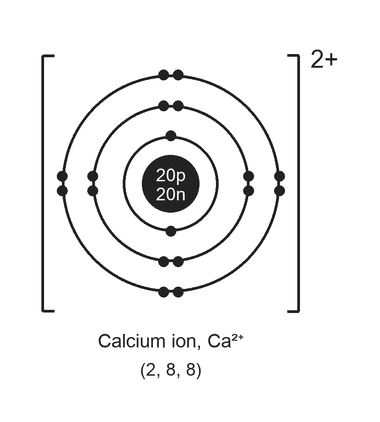
Draw the orbital diagram of ion and state the number of three fundamental particles present in it.
Confirming your payment
Sign up now and get 250 free tokens.
Atomic Structure and Chemical Bonding · Question 29 of 122
Draw the orbital diagram of ion and state the number of three fundamental particles present in it.
Solution:
Concept: An ion has the same nucleus as its atom; only the number of electrons changes. is formed when a calcium atom (2, 8, 8, 2) loses its two outermost electrons.
Step 1 — Count the protons.
The atomic number is 20, so there are 20 protons.
Step 2 — Count the neutrons.
Subtract the atomic number from the mass number:
Step 3 — Count the electrons.
The atom has 20 electrons, and the 2+ charge means 2 have been lost:
They are arranged 2, 8, 8.
Step 4 — Draw the ion.
The diagram shows the nucleus (20p, 20n), three shells holding 2, 8 and 8 electrons, and the ion in brackets with its 2+ charge.
Watch out: A positive ion has fewer electrons than protons; the charge comes from the electrons lost, not from extra protons.
Therefore, Ca²⁺ has 20 protons, 20 neutrons and 18 electrons, arranged 2, 8, 8.