
Question 1095 marksEasy
Covalent bonds can be single, double or triple covalent bond.
(a) How many electrons are shared in each ?
(b) Give an example of each type.
Confirming your payment
Sign up now and get 250 free tokens.
Atomic Structure and Chemical Bonding · Question 109 of 122
Covalent bonds can be single, double or triple covalent bond.
(a) How many electrons are shared in each ?
(b) Give an example of each type.
Solution:
Concept: A shared pair contains 2 electrons, one from each atom. One shared pair makes a single bond, two pairs a double bond and three pairs a triple bond.
Step 1 — (a) Count the electrons shared.
Multiply the number of shared pairs by 2.
| Bond | Shared pairs | Electrons shared |
|---|---|---|
| Single | 1 | 2 |
| Double | 2 | 4 |
| Triple | 3 | 6 |
Step 2 — (b) Single bond — hydrogen.
Two hydrogen atoms share one pair: H–H ( is another example).

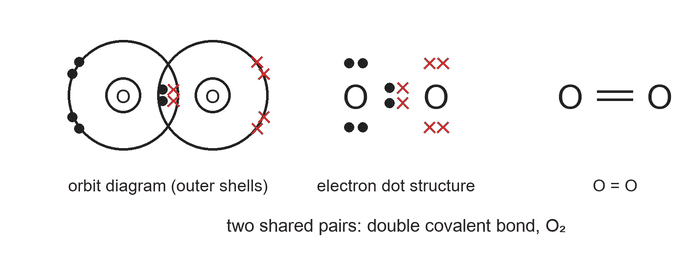
Step 3 — (b) Double bond — oxygen.
Two oxygen atoms (2, 6) each need 2 electrons, so they share two pairs: O = O.
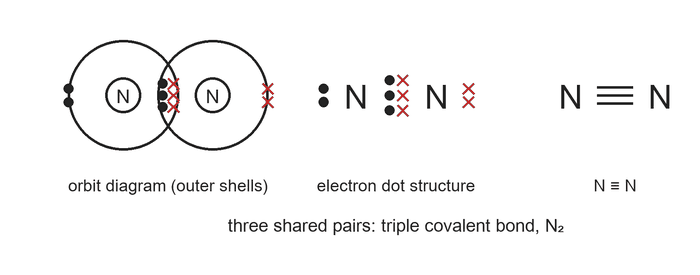
Step 4 — (b) Triple bond — nitrogen.
Two nitrogen atoms (2, 5) each need 3 electrons, so they share three pairs: N ≡ N.
Watch out: Count electrons, not pairs: a double bond shares 4 electrons.
Therefore, single, double and triple covalent bonds share 2, 4 and 6 electrons, as in H₂, O₂ and N₂.