
Question 1005 marksEasy
(a) Define covalent (molecular) bond.
(b) Give an example of covalent bond formed by (i) similar atoms (ii) dissimilar atoms.
Confirming your payment
Sign up now and get 250 free tokens.
Atomic Structure and Chemical Bonding · Question 100 of 122
(a) Define covalent (molecular) bond.
(b) Give an example of covalent bond formed by (i) similar atoms (ii) dissimilar atoms.
Solution:
Concept: Non-metal atoms reach a noble gas configuration by sharing pairs of electrons; each shared pair is one covalent bond.
Step 1 — (a) Define a covalent bond.
A covalent (molecular) bond is the bond formed between two atoms by the mutual sharing of one or more pairs of electrons, each atom contributing one electron to each shared pair.
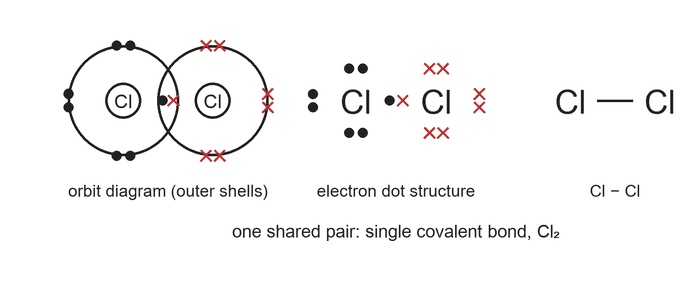
Step 2 — (b)(i) Similar atoms — chlorine.
Two chlorine atoms (2, 8, 7) each need 1 electron, so they share one pair, forming (Cl–Cl). Hydrogen, oxygen and nitrogen molecules are other examples.
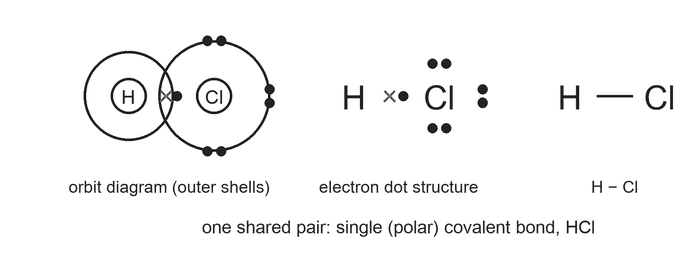
Step 3 — (b)(ii) Dissimilar atoms — hydrogen chloride.
A hydrogen atom (1) and a chlorine atom (2, 8, 7) each need 1 electron, so they share one pair, forming (H–Cl). Water and methane are other examples.
Watch out: In a covalent bond no electron changes owner completely, so no ions are formed.
Therefore, a covalent bond is formed by mutual sharing of electron pairs; Cl₂ is an example between similar atoms and HCl between dissimilar atoms.