
Question 625 marksEasy
Draw diagrams representing the atomic structures of the following :
(a) Sodium atom
(b) Chloride ion
(c) Carbon atom
(d) Oxide ion.
Confirming your payment
Sign up now and get 250 free tokens.
Atomic Structure and Chemical Bonding · Question 62 of 122
Draw diagrams representing the atomic structures of the following :
(a) Sodium atom
(b) Chloride ion
(c) Carbon atom
(d) Oxide ion.
Solution:
Concept: An atomic-structure diagram shows the nucleus (protons p and neutrons n) and the electrons in their shells. An ion has the same nucleus as its atom but a different number of electrons.
Step 1 — (a) Sodium atom.
Sodium has 11 protons and 23 − 11 = 12 neutrons; its 11 electrons are arranged 2, 8, 1.

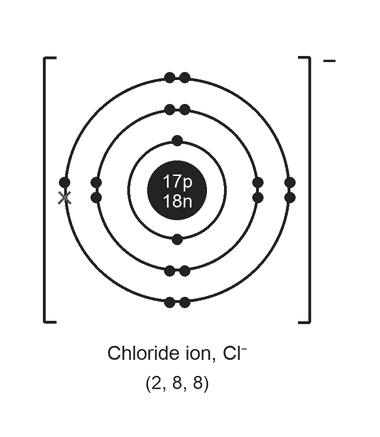
Step 2 — (b) Chloride ion.
The chloride ion has 17 protons and 18 neutrons; it has gained 1 electron (shown as a cross), so its 18 electrons are arranged 2, 8, 8.
Step 3 — (c) Carbon atom.
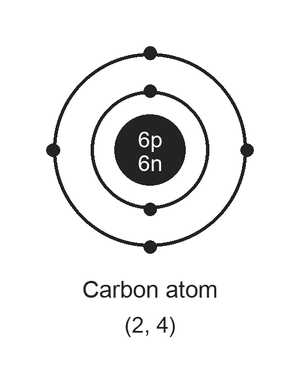
Carbon has 6 protons and 6 neutrons; its 6 electrons are arranged 2, 4.
Step 4 — (d) Oxide ion.
The oxide ion has 8 protons and 8 neutrons; it has gained 2 electrons (crosses), so its 10 electrons are arranged 2, 8.

Watch out: An ion is drawn inside square brackets with its charge; its nucleus is the same as the atom's.
Therefore, the structures are Na 2, 8, 1 (11p, 12n), Cl⁻ 2, 8, 8 (17p, 18n), C 2, 4 (6p, 6n) and O²⁻ 2, 8 (8p, 8n), as drawn.