
Question 1115 marksMedium
Give orbital diagrams of the following :
(a) magnesium chloride
(b) nitrogen
(c) methane
(d) hydrogen chloride
Confirming your payment
Sign up now and get 250 free tokens.
Atomic Structure and Chemical Bonding · Question 111 of 122
Give orbital diagrams of the following :
(a) magnesium chloride
(b) nitrogen
(c) methane
(d) hydrogen chloride
Solution:
Concept: An orbital (orbit) diagram shows how electrons move between or are shared by the atoms. Magnesium chloride forms by transfer; nitrogen, methane and hydrogen chloride form by sharing. One atom's electrons are dots and the other's are crosses.
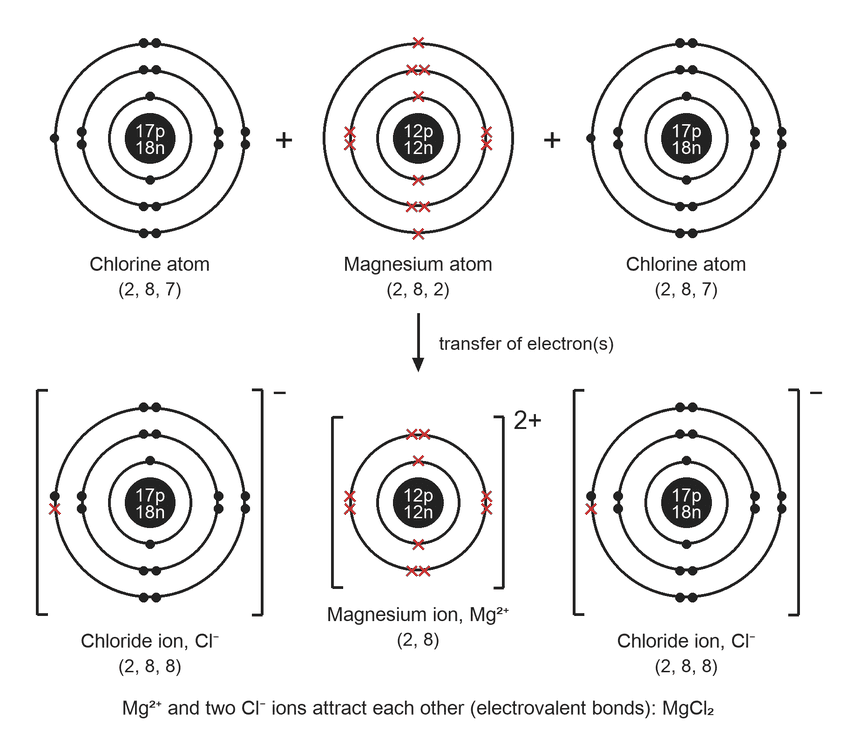
Step 1 — (a) Magnesium chloride.
Magnesium (2, 8, 2) gives one electron to each of two chlorine atoms (2, 8, 7), forming (2, 8) and two ions (2, 8, 8).
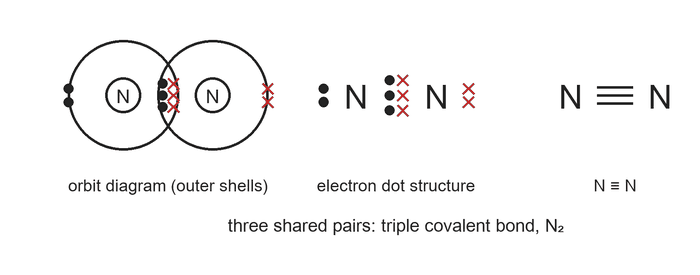
Step 2 — (b) Nitrogen.
Two nitrogen atoms (2, 5) share three electron pairs, forming a triple bond, N ≡ N.
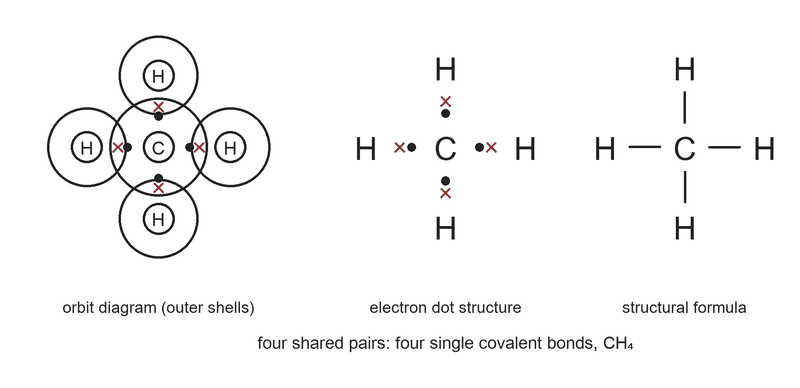
Step 3 — (c) Methane.
Carbon (2, 4) shares one electron pair with each of four hydrogen atoms, forming four C–H single bonds.
Step 4 — (d) Hydrogen chloride.
Hydrogen (1) and chlorine (2, 8, 7) share one electron pair, forming H–Cl.
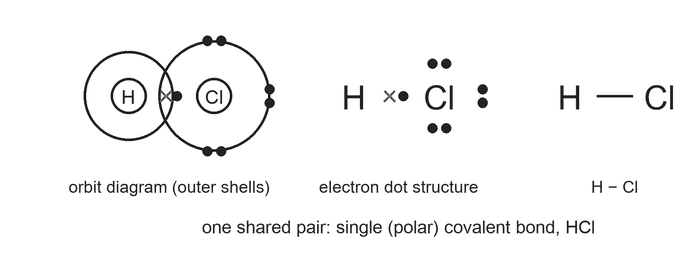
Watch out: The ionic diagram shows brackets and charges; the covalent diagrams show overlapping outer shells with the shared electrons in the overlap.
Therefore, the diagrams show electron transfer in MgCl₂ and electron sharing in N₂ (three pairs), CH₄ (four pairs) and HCl (one pair).