
Opening your dashboard
Class 11 Physics Chapter 6: Newton's Laws of Motion Solutions
74 textbook questions with step-by-step answers, free to read, for ISC 2026-27.
Get talked through Ch 6, not just shown the answer
Reading a finished solution is not the same as being able to do it. The AI tutor takes one question at a time and works it with you, in your own words, until you can.
- Ask it out loud, in your own words
- It gives you the next step, not the answer
- Stuck on part (ii)? Start there
74 questions with solutions
1–5 marks · Mixed difficulty
The first 65 solutions are on this page. This chapter is a long one, so the rest open on their own page to keep this one quick to load.
- 11 mark
Question 1
It is possible to derive Newton's
Solve with AIAnswer
- Correct
(A) third and first laws from the second law
(B) 2nd and 1st laws from the 3rd law.
(C) 2nd and 3rd laws from the 1st law.
(D) any two laws from any one law.
Answer: (A) The third and first laws from the second law
Concept: Newton's second law, , gives both the size and the direction of the change of motion produced by a force. The book treats it as the basic ("real") law and obtains the other two from it.
Step 1 — Obtain the first law. We put in the second law; then , so the velocity stays constant: a body at rest stays at rest and a moving body keeps moving uniformly in a straight line. This is the first law.
Step 2 — Obtain the third law. We take two bodies acting on each other with no external force. The total momentum then stays constant, so ; by the second law this means , so action and reaction are equal and opposite.
Step 3 — Choose the option. Both the first and the third laws are thus obtained from the second law.
- (B) The third law only says that forces come in equal and opposite pairs; it says nothing about how fast a single body's motion changes, so neither the second nor the first law follows from it.
- (C) The first law tells us only what happens when no force acts; it gives no way of measuring a force, so the second and third laws cannot be obtained from it.
- (D) Only the second law is used to obtain the others; the first and third laws are each too narrow to give the rest.
Note: the step from the second law to the third uses the constancy of momentum of an isolated system, which is itself an experimental fact; for this reason many physicists regard the third law as an independent law. The book's answer follows its own treatment of the second law as the real law.
Therefore, the third and first laws can be derived from the second law, option (A).
- 21 mark
Question 2
A man is at rest in the middle of a pond on perfectly smooth ice. He can get himself to the shore by making use of Newton's
Solve with AIAnswer
(A) first law
(B) second law
- Correct
(C) third law
(D) all the laws
Answer: (C) Third law
Concept: Newton's third law: when one body pushes another, the second body pushes back on the first with an equal and opposite force.
Step 1 — See why the man cannot walk. On perfectly smooth ice there is no friction, so the man's feet cannot push backward on the ice and the ice gives the man no forward push.
Step 2 — Find a way to get a push. The man can throw something being carried (or blow air out) away from the shore. The thrown object pushes back on the man with an equal and opposite force, and this reaction sends the man towards the shore.
- (A) The first law explains why the man stays at rest until a force acts, but it does not provide the force that gets the man moving.
- (B) The second law tells how much the man accelerates once a force acts, but the force itself arises only as the reaction described by the third law.
- (D) The method rests on the action–reaction pair; it is the third law that gives the man a way out, not each of the laws equally.
Therefore, the man can reach the shore by making use of Newton's third law, option (C).
- 31 mark
Question 3
Newton's second law gives the measure of
Solve with AIAnswer
(A) acceleration
- Correct
(B) force
(C) momentum
(D) angular momentum
Answer: (B) Force
Concept: Newton's second law states that the rate of change of momentum is proportional to the applied force: , which for a constant mass becomes (with the unit of force chosen to make the constant 1).
Step 1 — See what the law lets us calculate. From the mass of a body and the acceleration it gets, the law gives , so it measures the force acting.
Step 2 — Link it to the unit. One newton is defined from this law as the force that gives a 1 kg mass an acceleration of .
- (A) Acceleration is measured from the change of velocity with time (kinematics); the second law tells what force is needed to produce it.
- (C) Momentum is defined as ; the second law uses its rate of change to measure force.
- (D) Angular momentum belongs to rotation; its change is governed by torque, not by this law of linear motion.
Therefore, Newton's second law gives the measure of force, option (B).
- 41 mark
Question 4
Inertia is that property of a body by virtue of which the body is
Solve with AIAnswer
(A) unable to change by itself the state of rest
(B) unable to change by itself the state of uniform motion
(C) unable to change by itself the direction of motion
- Correct
(D) unable to change by itself the state of rest and of uniform linear motion
Answer: (D) Unable to change by itself its state of rest and of uniform linear motion
Concept: Newton's first law: every body continues in its state of rest or of uniform motion in a straight line unless an external force changes that state. The property behind this is inertia.
Step 1 — Recall the full definition. Inertia covers both cases of the first law: a body cannot by itself start moving from rest, and it cannot by itself change its uniform motion along a straight line (its speed or its direction).
Step 2 — Compare the options. Only option (D) includes both the state of rest and the state of uniform motion in a straight line.
- (A) This is true but describes only inertia of rest, one part of inertia.
- (B) This is true but describes only inertia of motion; it leaves out the state of rest.
- (C) This is true but describes only inertia of direction, which is part of the inertia of uniform motion in a straight line.
Therefore, inertia is the property by which a body cannot by itself change its state of rest or of uniform linear motion, option (D).
- 51 mark
Question 5
A man getting down a running bus falls forward because
Solve with AIAnswer
(A) due to inertia of rest, road is left behind and man reaches forward
- Correct
(B) due to inertia of motion upper part of body continues to be in motion in forward direction while feet come to rest as soon as they touch the road
(C) he leans forward as a matter of habit
(D) of the combined effect of all the three factors stated in (a), (b) and (c)
Answer: (B) The upper part of the body continues moving forward by inertia of motion while the feet stop on the road
Concept: Inertia of motion: a moving body tends to keep moving with the same velocity unless a force stops it.
Step 1 — Find the man's motion before stepping off. While on the running bus, the man moves forward with the speed of the bus.
Step 2 — See what happens on touching the road. Friction from the road stops the man's feet almost at once.
Step 3 — Apply inertia of motion. No such force acts at once on the upper part of the body, which keeps moving forward. So the man tips forward and falls. (Getting down from a moving bus is dangerous: always wait until it has stopped.)
- (A) The man's body is moving, not at rest, at the moment of stepping off, so inertia of rest is the wrong idea; the road is not "left behind" in any way that pushes the man forward.
- (C) Habit is not a physical cause; even a person standing upright falls forward when their feet are stopped suddenly.
- (D) Since the reasons in (A) and (C) are wrong, the fall is not a combined effect of all three.
Therefore, the man falls forward because the feet stop while the upper body continues forward by inertia of motion, option (B).
- 61 mark
Question 6
A rope of length is pulled by a constant force . What is the tension in the rope at a distance from the end where the force is applied?
Solve with AIAnswer
(A)
- Correct
(B)
(C)
(D)
Answer: (B)
Concept: We take the usual meaning of this question: a uniform rope lying on a smooth surface (or in free space) is pulled at one end and nothing is attached to the other end. The whole rope then has one acceleration, and the tension at any point is the force needed to accelerate the part of the rope beyond that point.
Step 1 — Find the acceleration. Let the rope have mass . The only horizontal force on the whole rope is :
Step 2 — Find the mass beyond the point. The rope is uniform, so the part beyond a distance from the pulled end has length and mass:
Step 3 — Find the tension. The tension at the point is the only horizontal force pulling this part forward, so :
Check: At the pulled end, where , this gives ; at the free end, where , it gives , as it must.
- (A) This becomes infinitely large near the pulled end (), where the tension must equal .
- (C) This equals at but grows without limit towards the free end, where the tension must fall to zero.
- (D) This is zero at the pulled end, where the tension must be .
Therefore, the tension at a distance from the pulled end is , option (B).
- 71 mark
Question 7
A boy sitting on the topmost berth in the compartment of a train which is just going to stop on a railway station, drops an apple aiming at the open hand of his brother sitting vertically below his hands at a distance of about 2 metre. The apple will fall
Solve with AIAnswer
(A) precisely on the hand of his brother
- Correct
(B) slightly away from the hand of his brother in the direction of motion of the train
(C) slightly away from the hand of his brother opposite to the direction of motion of the train
(D) none of the above
Answer: (B) Slightly away from the brother's hand, in the direction of motion of the train
Concept: Inertia of motion: once released, the apple keeps the forward velocity it had, because (neglecting air resistance) no horizontal force acts on it.
Step 1 — Find the apple's horizontal motion. At the moment it is dropped, the apple has the same forward speed as the train, and it keeps this speed while it falls.
Step 2 — Find the brother's horizontal motion. The train is about to stop, so it is slowing down. The brother, sitting in the train, slows down with it during the fall.
Step 3 — Compare. During the fall (about for 2 m) the apple moves forward a little more than the brother's hand does, so it lands slightly ahead of the brother's hand.
- (A) This would happen if the train were moving with uniform velocity (or at rest), when the apple and the hand keep the same horizontal speed.
- (C) This would happen if the train were speeding up, so that the hand moved forward faster than the apple.
- (D) Option (B) describes what happens, so "none of the above" is wrong.
Therefore, the apple falls slightly away from the brother's hand in the direction of motion of the train, option (B).
- 81 mark
Question 8
A cannon after firing recoils due to
Solve with AIAnswer
(A) conservation of energy
(B) backward thrust of gases produced
- Correct
(C) Newton's third law of motion
(D) Newton's first law of motion
Answer: (C) Newton's third law of motion
Concept: Newton's third law: when the cannon pushes the shell forward, the shell (through the expanding gases) pushes the cannon backward with an equal and opposite force. In terms of momentum, the backward momentum of the cannon equals the forward momentum of the shell.
Step 1 — Identify the action. On firing, the expanding gases push the shell forward out of the barrel.
Step 2 — Identify the reaction. At the same time the gases push back on the cannon with an equal and opposite force, so the cannon moves backward. This backward motion is the recoil.
- (A) Energy is conserved, but conservation of energy alone does not fix any direction, so it cannot explain why the cannon moves backward.
- (B) The gases do push back on the cannon, and that push is exactly the reaction force; but this describes the force, while the law that explains the recoil is the third law.
- (D) The first law says the cannon would stay at rest unless a force acts; it does not explain where the backward force comes from.
Note: option (B) names the force through which the recoil happens, so it can be argued; the expected answer gives the law behind it, Newton's third law.
Therefore, a cannon recoils because of Newton's third law of motion, option (C).
- 91 mark
Question 9
A body of mass 2 kg is acted upon by two forces each of magnitude 1 newton, making an angle of 60° with each other. The net acceleration of the body (in m/s) is
Solve with AIAnswer
(A) 0.5
(B) 1.0
- Correct
(C)
(D)
Answer: (C)
Concept: The resultant of forces and at angle is ; then Newton's second law gives .
Step 1 — Find the resultant force. We substitute , and , with :
Step 2 — Find the acceleration. We divide by the mass, 2 kg:
- (A) 0.5 is the acceleration that one 1 N force alone would give the 2 kg body; it ignores the second force.
- (B) 1.0 comes from adding the forces as plain numbers (2 N), which is right only if they act in the same direction.
- (D) is even less than the 0.5 that one force alone gives, which is impossible when two forces only 60° apart help each other.
Therefore, the net acceleration is , option (C).
- 101 mark
Question 10
If a force of 250 N acts on a body, the momentum acquired is 125 m/s, what is the period for which force acts on the body?
Solve with AIAnswer
(A) 0.2 s
- Correct
(B) 0.5 s
(C) 0.4 s
(D) 0.25 s
(E) 125 × 250 s
Answer: (B) 0.5 s
Concept: Impulse, the product of force and time, equals the change in momentum. The body starts with no momentum, so the momentum acquired equals .
Step 1 — Write the impulse relation. The momentum acquired is units:
Step 2 — Find the time. We divide by the force, 250 N:
Note: momentum is measured in (or N s), not m/s; the 125 in the question is read as .
- (A) In 0.2 s a 250 N force gives a momentum of only .
- (C) In 0.4 s it gives .
- (D) In 0.25 s it gives .
- (E) This multiplies the force by the momentum instead of dividing; the result, 31 250, is not even a time.
Therefore, the force acts for 0.5 s, option (B).
- 111 mark
Question 11
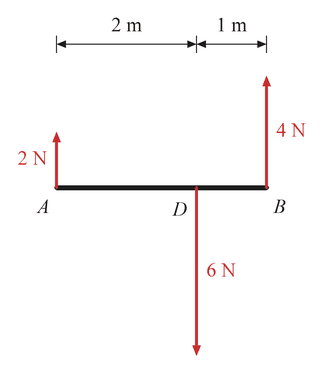
A weightless rod is acted upon by upward parallel forces of 2 newton and 4 newton magnitudes at ends and respectively. The total length of the rod metre. To keep the rod in equilibrium, a force of 6 newton act in the following manner.
Solve with AIAnswer
(A) downward at any point between and
(B) downward at the midpoint of
(C) downward at a point C such that metre
- Correct
(D) downward at a point D such that metre
Answer: (D) Downward at a point D such that BD = 1 m
Concept: A rigid body is in equilibrium when (1) the net force on it is zero and (2) the net moment (torque) about any point is zero.
Step 1 — Use the force condition. The two upward forces add to , so the 6 N force must act downward to make the net force zero.
Step 2 — Use the moment condition about A. Let the 6 N force act at a distance from A. The 4 N force at B turns the rod one way and the 6 N force the other way; the 2 N force at A has no moment about A:
Step 3 — Locate the point. The point is 2 m from A, so its distance from B is:
The figure shows the three forces on the rod in equilibrium:
- (A) At most points the moments do not balance, so the rod would turn; only one point works.
- (B) About the midpoint, the 2 N force has a moment of 3 N m (2 N at 1.5 m) and the 4 N force a moment of 6 N m (4 N at 1.5 m), so the rod would turn.
- (C) About a point 1 m from A, the 2 N force has a moment of 2 N m (2 N at 1 m) and the 4 N force a moment of 8 N m (4 N at 2 m), so the rod would turn.
Therefore, the 6 N force must act downward at the point D with BD = 1 m (2 m from A), option (D).
- 121 mark
Question 12
A block of mass is pulled along horizontal frictionless surface by a rope of mass . Force is applied at one end of rope. The force which the rope exerts on the block is
Solve with AIAnswer
(A)
(B)
- Correct
(C)
(D)
Answer: (C)
Concept: The block and the rope move together with one acceleration. The force accelerates both; the rope's pull on the block accelerates the block alone.
Step 1 — Find the common acceleration. The only horizontal external force on the block-and-rope system is , and its total mass is :
Step 2 — Find the force on the block. The rope's pull is the only horizontal force on the block, so :
This is less than , because part of is used in accelerating the rope itself.
- (A) This has the form force ÷ mass, so it is an acceleration, not a force; it also uses , which has no meaning here.
- (B) This is force ÷ (mass × mass), which is not a force at all.
- (D) This is larger than , which is impossible: the rope cannot pass on more force than is applied to it.
Therefore, the rope exerts a force on the block, option (C).
- 131 mark
Question 13
A force vector applied on a mass is represented as and acceleration with 1 m/s. What will be the mass of the body?
Solve with AIAnswer
- Correct
(A) kg
(B) kg
(C) 10 kg
(D) 20 kg
Answer: (A) kg
Concept: Newton's second law gives , where is the magnitude of the force: .
Step 1 — Find the magnitude of the force. We square the components, add and take the square root:
Step 2 — Find the mass. The acceleration is :
- (B) kg would need a force of N, but the squares of the components add to 200, not 40.
- (C) 10 kg uses only the component (10 N) and ignores the other two components.
- (D) 20 kg would need a force of 20 N, but the magnitude of the force is only N.
Therefore, the mass of the body is kg, option (A).
- 141 mark
Question 14
A pendulum bob is suspended inside a lift moving upward with constant velocity. If mass of the bob is 50 g, then its weight inside the compartment is
Solve with AIAnswer
(A) zero
(B) 0.1 N
- Correct
(C) 0.5 N
(D) 0.05 N
Answer: (C) 0.5 N
Concept: In a lift moving with constant velocity the acceleration is zero, so the apparent weight equals the true weight, .
Step 1 — Note the acceleration. The lift moves upward with constant velocity, so and the apparent weight is .
Step 2 — Convert the mass. We change grams to kilograms:
Step 3 — Find the weight. We multiply by :
This is 0.5 N to one significant figure (exactly 0.5 N if is taken as ).
Note: the book's printed answer is 0.05 N; the correct value is about 0.5 N, because 0.05 is only the mass in kilograms, and it must still be multiplied by .
- (A) The apparent weight (the pull of the bob on its string) would be zero only if the lift were falling freely, and even then gravity would still act on the bob; here the lift moves with constant velocity.
- (B) 0.1 N would be the weight of a 10 g bob (); this bob has a mass of 50 g.
- (D) 0.05 is the mass in kilograms written as if it were a force; it has not been multiplied by .
Therefore, the weight of the bob inside the lift is about 0.5 N, option (C).
- 151 mark
Question 15
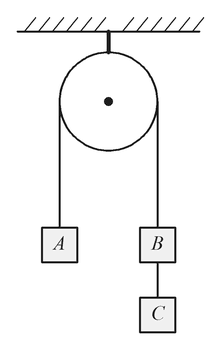
Three equal weights , , of mass 2 kg each are hanging on a string passing over a fixed frictionless pulley as shown in the following figure. The tension in the string connecting weights and is
 Solve with AI
Answer
(A) zero
- Correct
(B) 13 newton
(C) 3.3 newton
(D) 19.6 newton
Answer: (B) 13 newton
Concept: For bodies connected over a pulley, acceleration net force ÷ total mass. Then Newton's second law for one body alone gives the tension in its string.
Step 1 — Find the acceleration of the system. B and C together (4 kg) hang on one side and A (2 kg) on the other. The net force is the difference of the weights:
B and C move down, and A moves up, with this acceleration.
Step 2 — Apply the second law to C alone. The forces on C are its weight downward and the tension in the string B–C upward. C accelerates downward, so:
Step 3 — Solve for the tension. We take :
- (A) The tension would be zero only if C fell freely with acceleration ; here the system accelerates at only .
- (C) 3.3 is the numerical value of the acceleration, , not the tension.
- (D) 19.6 N is the weight of C, ; the tension would equal this only if the system were not accelerating (at rest or moving uniformly), but the unequal loads on the two sides make it accelerate.
Therefore, the tension in the string connecting B and C is about 13 N, option (B).
- 161 mark
Question 16
A man of mass 90 kg is standing in an elevator whose cable broke suddenly. If the elevator falls freely, the force exerted by the floor on the man is
Solve with AIAnswer
(A) 90 N
(B) 90 g N
- Correct
(C) 0 N
(D) any negative value
Answer: (C) 0 N
Concept: The force of the floor on a person in a lift (the normal reaction) is found from for downward acceleration .
Step 1 — Write the second law for the man. We solve for the normal reaction:
Step 2 — Use free fall. The elevator and the man fall freely, so :
The man and the floor fall together, so the floor does not press on the man at all. The man's apparent weight is zero, but gravity still acts: it pulls the man down with the full weight , and that is what makes the man fall.
- (A) 90 is the man's mass in kilograms; it is not a force.
- (B) N is the man's weight, the force the floor exerts only when the lift is at rest or moving with uniform velocity.
- (D) A floor can only push on a person, never pull them, so its force cannot be negative.
Therefore, the force exerted by the floor on the man is 0 N, option (C).
- 171 mark
Question 17
A machine gun fires bullets per second and the mass of each bullet is . If is the speed of each bullet, then the force exerted on the machine gun is
Solve with AIAnswer
(A)
- Correct
(B)
(C)
(D)
Answer: (B)
Concept: By Newton's second law, force = rate of change of momentum. By the third law, the force on the gun is equal and opposite to the force the gun gives the bullets.
Step 1 — Find the momentum given to one bullet. Each bullet starts from rest and leaves with speed :
Step 2 — Find the momentum given per second. The gun fires bullets each second:
Step 3 — Find the force on the gun. This rate of change of momentum is the force on the bullets, and the gun feels an equal force backward (its recoil):
- (A) is the firing rate multiplied by the weight of one bullet; its unit is (newton per second), not newton, and the weight of the bullets plays no part in the recoil force.
- (C) has the unit , which is not a force.
- (D) has the unit of mass (kg), not of force.
Therefore, the force exerted on the machine gun is , option (B).
- 181 mark
Question 18
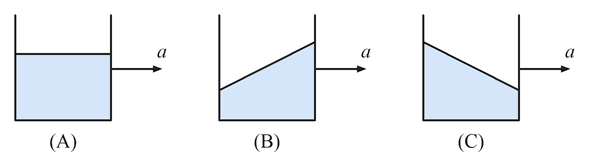
A vessel containing water is given a constant acceleration towards the right, a straight horizontal path. Which of the following diagram represents the surface of the liquid?
 Solve with AI
Answer
(A) Diagram (A)
(B) Diagram (B)
- Correct
(C) Diagram (C)
Answer: (C) Diagram (C), with the surface higher at the back (left) and lower at the front
Concept: To give the water a forward acceleration , there must be a net forward force on it. This comes from the water being deeper, so the pressure being higher, at the back of the vessel than at the front. In the vessel's frame, the water feels a pseudo force backward as well as its weight , and the surface sets itself perpendicular to their resultant.
Step 1 — Find the direction of the tilt. The forward force on the water must come from a higher pressure at the back. So the water piles up at the back (the left) and is lower at the front (the right).
Step 2 — Find the angle of the surface. In the vessel's frame the effective gravity has components downward and backward, and the surface is perpendicular to it, so it makes an angle with the horizontal given by:
Step 3 — Pick the diagram. Diagram (C) shows the surface sloping down from the back to the front.
- (A) A level surface is seen only when the vessel is at rest or moves with uniform velocity; with no tilt there would be no net horizontal force to accelerate the water.
- (B) A surface higher at the front would push the water backward; it would match an acceleration towards the left (for example, the vessel braking while moving right).
Therefore, the surface is tilted with the water higher at the back, as in diagram (C), option (C).
- 191 mark
Question 19
Name the absolute unit and gravitational unit of force.
Solve with AIWritten solution
Solution:
Concept: An absolute unit of force is defined from without using gravity; a gravitational unit is defined as the weight of a standard mass.
Step 1 — Name the absolute unit. In SI the absolute unit of force is the newton (N), the force that gives a 1 kg mass an acceleration of .
Step 2 — Name the gravitational unit. The gravitational unit is the kilogram weight (kg wt or kgf), the weight of a 1 kg mass. With , .
Therefore, the absolute unit of force is the newton and the gravitational unit is the kilogram weight (1 kg wt = 9.8 N).
- 201 mark
Question 20
“Action and reaction do not cancel each other”. Why?
Solve with AIWritten solution
Solution:
Concept: Forces can cancel only when they act on the same body. By Newton's third law, action and reaction act on two different bodies.
Step 1 — Locate the two forces. If A pushes B, the action acts on B and the reaction acts on A.
Step 2 — Conclude. Each force changes the motion only of the body it acts on, so the two cannot cancel.
Therefore, action and reaction do not cancel each other because they act on different bodies.
- 211 mark
Question 21
“Chinawares are wrapped in straw or paper before packing”. Why?
Solve with AIWritten solution
Solution:
Concept: Impulse, , equals the change in momentum. For a given change in momentum, a longer time of impact gives a smaller force.
Step 1 — See what happens in a jerk. During transport the china may be jerked or knocked, and its momentum changes suddenly.
Step 2 — See what the packing does. Straw or paper is soft, so it makes the change in momentum take a longer time. The force on the china is therefore smaller, and it does not break.
Therefore, china ware is wrapped in straw or paper to increase the time of impact during jerks and so reduce the force on it, preventing damage.
- 221 mark
Question 22
“It is difficult to walk on sand or ice”. Why?
Solve with AIWritten solution
Solution:
Concept: We walk by pushing the ground backward with our feet; by Newton's third law the ground pushes us forward with an equal reaction.
Step 1 — Walking on ice. Ice is very smooth, so there is very little friction. Our feet slip and cannot push backward on the ice with much force, so the forward reaction is very small.
Step 2 — Walking on sand. Sand gives way and is pushed backward when we press on it, so it cannot provide a firm forward reaction either.
Therefore, it is difficult to walk on sand or ice because we cannot push firmly backward on them, so we get only a very small forward reaction.
- 231 mark
Question 23
Name the principle of working of a rocket.
Solve with AIWritten solution
Solution:
Concept: When no external force acts on a system, its total linear momentum stays constant.
Step 1 — Describe the rocket. A rocket throws out hot gases backward at a high speed.
Step 2 — Apply the principle. The gases carry momentum backward, so the rocket gains an equal momentum forward. (Equivalently, by Newton's third law, the gases push the rocket forward.)
Therefore, a rocket works on the principle of conservation of linear momentum (Newton's third law).
- 241 mark
Question 24
“A cork floats on the surface of water”. What is the net force acting on the cork?
Solve with AIWritten solution
Solution:
Concept: A body at rest has zero acceleration, so by Newton's second law the net force on it is zero.
Step 1 — Identify the forces. The cork's weight acts downward, and the upthrust (buoyant force) of the water acts upward.
Step 2 — Find the net force. The floating cork stays at rest, so these two forces are equal and opposite.
Therefore, the net force on the floating cork is zero.
- 251 mark
Question 25
A bullet fired from a rifle is more dangerous than air molecule hitting a person though both of them have almost the same speed. Explain.
Solve with AIWritten solution
Solution:
Concept: The damage done depends on the momentum to be destroyed and on the force needed to stop the body. At the same speed, a heavier body has far more momentum.
Step 1 — Compare the masses. An air molecule has a mass of about , while a bullet has a mass of a few grams; a 10 g bullet is about times as heavy as an air molecule.
Step 2 — Compare the momenta. At the same speed, the bullet's momentum is larger by the same enormous factor, so stopping it needs a huge impulse and force.
Note: the book's hint quotes a factor of about ; for a 10 g bullet the factor is about , still enormous.
Therefore, the bullet is far more dangerous because its mass, and hence its momentum, is enormously larger than that of an air molecule moving at the same speed.
- 261 mark
Question 26
Why does an electric fan continue to rotate for some time after the current is switched off?
Solve with AIWritten solution
Solution:
Concept: Inertia of motion: a moving body keeps moving unless a force stops it.
Step 1 — Apply inertia of motion. When the current is switched off, the motor stops driving the blades, but the blades keep turning because of their inertia of motion.
Step 2 — Explain the stopping. Air resistance and friction slowly bring them to rest.
Therefore, the fan keeps rotating for some time because of inertia of motion.
- 271 mark
Question 27
What is an impulsive force?
Solve with AIWritten solution
Solution:
Concept: Some forces act for only a very short time but are very large, as in collisions and blows.
Step 1 — Define the force. An impulsive force is a very large force that acts on a body for a very short interval of time and usually varies during that time.
Step 2 — Give examples. Examples are the force of a bat on a ball and the force of a hammer on a nail.
Therefore, an impulsive force is a large force that acts for a very short time (and varies with time), such as a bat striking a ball.
- 281 mark
Question 28
Why are shock absorbers used in scooters and cars?
Solve with AIWritten solution
Solution:
Concept: Impulse, , equals the change in momentum; a longer time of impact gives a smaller force.
Step 1 — See what happens on a bump. When a scooter or car goes over a bump or a pothole, its wheels get a sudden jerk.
Step 2 — See what the shock absorbers do. They make the change of motion take place over a longer time, so the force passed on to the vehicle body and the riders is much smaller.
Therefore, shock absorbers are used to increase the time of impact during jerks, which reduces the force on the vehicle and its riders.
- 291 mark
Question 29
“A stone when thrown on a glass window smashes the window pane to pieces. But a bullet fired from a gun passes through making a hole”. Why?
Solve with AIWritten solution
Solution:
Concept: Inertia of rest: a body at rest needs time to be set moving.
Step 1 — Look at the bullet. The bullet moves very fast and is in contact with the glass for an extremely short time. The glass around its path, by inertia of rest, does not get time to share its motion, so only a small hole is made.
Step 2 — Look at the stone. The stone moves much more slowly, so it stays in contact with the glass for a longer time. Its push spreads through a large part of the pane, which is set in motion and shatters.
Therefore, the fast bullet makes only a hole because, owing to inertia of rest, the surrounding glass has no time to move, while the slower stone has time to push the whole pane and smashes it.
- 301 mark
Question 30
What are coplanar forces?
Solve with AIWritten solution
Solution:
Concept: Forces are described by their size, direction and line of action.
Step 1 — Define the term. Forces whose lines of action all lie in the same plane are called coplanar forces.
Step 2 — Give an example. The forces on a book lying on a table (its weight and the normal reaction) are coplanar.
Therefore, coplanar forces are forces whose lines of action lie in the same plane.
- 311 mark
Question 31
What is a resultant force?
Solve with AIWritten solution
Solution:
Concept: Several forces acting together on a body can often be replaced by one force.
Step 1 — Define the term. The resultant force is the single force that has the same effect on a body as a number of forces acting together.
Step 2 — Say how it is found. For two forces it is found by the parallelogram law (or the triangle law) of forces.
Therefore, a resultant force is the single force that produces the same effect as several forces acting together.
- 321 mark
Question 32
What is the acceleration of a body when the net force acting on it is zero?
Solve with AIWritten solution
Solution:
Concept: Newton's second law: .
Step 1 — Put the net force equal to zero. With , the second law gives:
Step 2 — Find the acceleration. The mass is not zero, so the acceleration must be zero; the body stays at rest or keeps moving with constant velocity.
Therefore, the acceleration of the body is zero.
- 331 mark
Question 33
Give one condition for the equilibrium of a rigid body under coplanar forces.
Solve with AIWritten solution
Solution:
Concept: A rigid body is in equilibrium when it has neither a translational acceleration nor an angular acceleration.
Step 1 — State the condition for no translation. The vector sum of all the forces acting on the body must be zero, .
Step 2 — Mention the second condition. For complete equilibrium, the algebraic sum of the moments of the forces about any point in their plane must also be zero, so that the body does not rotate.
Therefore, one condition is that the vector sum of all the forces acting on the body is zero (the other is that the net moment about any point is zero).
- 342 marks
Question 34
“An empty train starts more quickly than a loaded train”. Why?
Solve with AIWritten solution
Solution:
Concept: Newton's second law: . For the same force, a smaller mass gets a larger acceleration. (Equivalently, force is the rate of change of momentum.)
Step 1 — Compare the masses. The engine exerts about the same pulling force in both cases, but the empty train has a much smaller mass than the loaded one.
Step 2 — Compare the accelerations. With the same force, the smaller mass of the empty train gives it a larger acceleration, so it gains speed faster. Put another way, it needs less momentum to reach a given speed, so the same force gets it there in less time.
Therefore, an empty train starts more quickly because its smaller mass gets a larger acceleration from the same pulling force ().
- 352 marks
Question 35
If we jerk a piece of paper from under a book quick enough, the book will not move. Why?
Solve with AIWritten solution
Solution:
Concept: Inertia of rest, together with impulse : a force acting for a very short time produces only a very small change in momentum.
Step 1 — Look at the force on the book. The only horizontal force on the book is the friction from the paper, which is small.
Step 2 — Look at the time. When the paper is jerked out quickly, this friction acts for a very short time, so the impulse on the book, and the velocity it gets, is negligible.
Step 3 — Apply inertia of rest. The book therefore stays where it was, by its inertia of rest.
Therefore, the book does not move because, owing to inertia of rest, the small friction acting for a very short time cannot set it in motion.
- 362 marks
Question 36
“A man jumping out of a moving train falls with his head forward”. Why?
Solve with AIWritten solution
Solution:
Concept: Inertia of motion: a moving body tends to keep moving with the same velocity.
Step 1 — Find the man's motion before landing. While in the train, the man moves forward with the speed of the train and keeps this speed on jumping out.
Step 2 — See what happens on landing. When the man's feet touch the ground, friction stops them almost at once.
Step 3 — Apply inertia of motion. The upper part of the body continues to move forward, so the man falls head forward. (For the same reason, anyone who steps off a vehicle that is still moving is thrown forward. Getting off or jumping out of a moving train or bus is dangerous and must never be tried: always wait until it has stopped.)
Therefore, the man falls head forward because the feet are stopped by the ground while the upper part of the body keeps moving forward by inertia of motion.
- 372 marks
Question 37
A bob is suspended by a cord from the ceiling of a car. What is the effect on the position of the bob if
(i) the car moves with constant velocity,
(ii) the car moves with constant acceleration and
(iii) the car takes a left turn?
Solve with AIWritten solution
Solution:
Concept: The bob moves with the car. The net force on it (the vector sum of the tension in the cord and its weight ) must equal its mass times its acceleration.
Step 1 — Part (i), constant velocity. The acceleration is zero, so the net force must be zero. The tension must exactly balance the weight, so the cord hangs vertically, as it does when the car is at rest.
Step 2 — Part (ii), constant acceleration . A net forward force is now needed. The cord tilts backward (opposite to the acceleration) by an angle , so that its tension has a forward component:
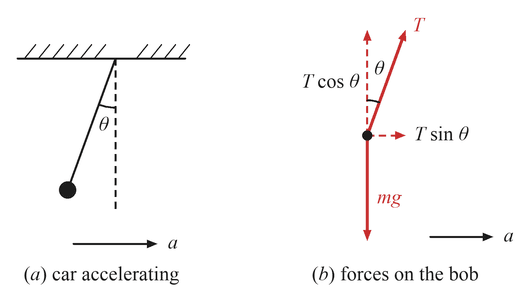
The vertical and horizontal parts of Newton's second law are:
Dividing the second equation by the first gives the angle:
The bob stays at this angle as long as the acceleration is constant.
Step 3 — Part (iii), a left turn. The bob must now move on a curve to the left, which needs a force towards the centre of the turn. The cord tilts so that the bob swings outward, to the right, and the tension supplies the inward force. (In the car it looks as if the bob is thrown outward because of its inertia of direction.)
Therefore, (i) the bob hangs vertically; (ii) it is deflected backward, opposite to the acceleration, and stays at an angle to the vertical with ; (iii) it swings outward to the right.
- 382 marks
Question 38
“A ball thrown vertically upwards by a person sitting in a train comes back to his hands”. Why?
Solve with AIWritten solution
Solution:
Concept: Inertia of motion: a body keeps its horizontal velocity when no horizontal force acts on it. We take the train to be moving with uniform velocity on a straight track.
Step 1 — Find the ball's horizontal velocity. Before it is thrown, the ball moves forward with the train. When thrown straight up (relative to the person), it keeps this forward velocity.
Step 2 — Compare with the person. While the ball rises and falls, it moves forward at the same speed as the train and the person, because no horizontal force acts on it (neglecting air resistance).
Step 3 — Conclude. The ball and the hands cover the same horizontal distance, so the ball lands back in the hands.
Therefore, the ball comes back to the person's hands because, by inertia of motion, it keeps the same forward velocity as the uniformly moving train and the person.
- 392 marks
Question 39
“When the branch of a tree is shaken, the fruits fall”. Why?
Solve with AIWritten solution
Solution:
Concept: Inertia of rest: a body at rest tends to remain at rest.
Step 1 — Look at the branch. When the branch is shaken, the force acts on the branch and it moves suddenly.
Step 2 — Look at the fruits. The fruits tend to stay where they were because of their inertia of rest. This pulls hard on their stalks, which break, and the fruits fall under gravity.
Therefore, the fruits fall because the branch moves suddenly while the fruits, owing to inertia of rest, tend to stay in place, so they break away from the branch.
- 402 marks
Question 40
“A person on a horse's back tends to fall back if the horse starts running all of a sudden”. Why?
Solve with AIWritten solution
Solution:
Concept: Inertia of rest: a body at rest tends to remain at rest.
Step 1 — Look at the lower part of the body. When the horse starts suddenly, the lower part of the rider's body, in contact with the horse, moves forward with it.
Step 2 — Look at the upper part. The upper part of the body tends to stay at rest because of inertia of rest, so it is left behind.
Therefore, the rider tends to fall back because the lower part of the rider's body moves forward with the horse while the upper part, owing to inertia of rest, stays behind.
- 412 marks
Question 41
“When a body falls to the Earth, the Earth also moves up to meet it; but Earth's motion cannot be seen”. Why?
Solve with AIWritten solution
Solution:
Concept: By Newton's third law, the body pulls the Earth upward with a force equal to the Earth's pull on it. By the second law, the Earth's acceleration is .
Step 1 — Find the force on the Earth. A falling body of mass pulls the Earth with a force .
Step 2 — Find the Earth's acceleration. For a 1 kg body, , and the mass of the Earth is :
Step 3 — Conclude. This acceleration is far too small to be detected.
Therefore, the Earth's motion cannot be seen because its mass is so large that the acceleration produced by the equal force is extremely small.
- 422 marks
Question 42
What is inertia? How is it measured?
Solve with AIWritten solution
Solution:
Concept: Newton's first law describes the natural tendency of bodies to keep their state of rest or of uniform motion.
Step 1 — Define inertia. Inertia is the property of a body by which it cannot by itself change its state of rest or of uniform motion in a straight line.
Step 2 — Name its kinds. The inability to change its state of rest is called inertia of rest; the inability to change its state of uniform motion along a straight line when no external force acts is called inertia of motion.
Step 3 — Say how it is measured. Inertia is measured by the mass of the body: the greater the mass, the greater the inertia, and the harder it is to change its motion.
Therefore, inertia is the inability of a body to change by itself its state of rest or uniform motion, and it is measured by the mass of the body.
- 432 marks
Question 43
What is inertia of direction? Give one example.
Solve with AIWritten solution
Solution:
Concept: Inertia of direction is a part of inertia of motion: a moving body keeps moving in the same straight line unless a force turns it.
Step 1 — Define the term. Inertia of direction is the inability of a body to change by itself its direction of motion.
Step 2 — Give an example. When a knife is sharpened on a grinding wheel, the sparks fly off along the tangent to the wheel. Once free, each glowing particle keeps moving in the direction it had at that instant.
Therefore, inertia of direction is the inability of a body to change its direction of motion by itself; sparks flying off a grinding wheel tangentially are an example.
- 442 marks
Question 44
Define momentum. Give its S.I. unit and dimensional formula.
Solve with AIWritten solution
Solution:
Concept: Momentum measures the quantity of motion of a body; it depends on both its mass and its velocity.
Step 1 — Define momentum. The momentum of a body is the product of its mass and its velocity:
It is a vector in the direction of the velocity.
Step 2 — Find the SI unit. We multiply the units of mass and velocity:
Step 3 — Find the dimensional formula. We multiply the dimensions of mass, , and velocity, :
Therefore, momentum ; its SI unit is and its dimensional formula is .
- 452 marks
Question 45
What is impulse? What is impulsive force?
Solve with AIWritten solution
Solution:
Concept: The effect of a force on the motion of a body depends both on how large it is and on how long it acts.
Step 1 — Define impulse. The impulse of a force is the product of the force and the time for which it acts:
It equals the change in momentum produced, and its SI unit is the newton second (N s). The idea is used mostly for large forces acting for a very short time.
Step 2 — Define impulsive force. An impulsive force is a large force that acts on a body for a very short interval of time (and usually varies during that time), for example the force of a bat on a ball.
Therefore, impulse is force × time of action (equal to the change in momentum), and an impulsive force is a large force acting for a very short time.
- 462 marks
Question 46
What is the relation between impulse and momentum?
Solve with AIWritten solution
Solution:
Concept: Newton's second law: force = rate of change of momentum.
Step 1 — Describe the situation. A force acts on a body of mass for a time , changing its velocity from to :
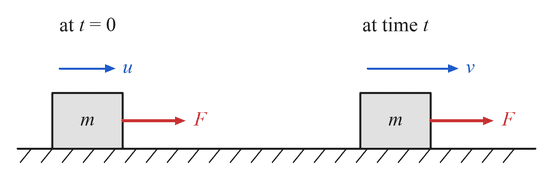
Step 2 — Write the second law. The force equals the change in momentum divided by the time:
Step 3 — Rearrange. Multiplying both sides by gives the impulse:
Therefore, the impulse is equal to the change in momentum, .
- 472 marks
Question 47
“Mass of a body is constant, but its weight is different at different places”. Why?
Solve with AIWritten solution
Solution:
Concept: Mass is the quantity of matter in a body (a measure of its inertia) and does not depend on place. Weight is the force of gravity on the body, .
Step 1 — Look at the mass. The amount of matter in the body does not change when it is moved, so is the same everywhere.
Step 2 — Look at the weight. The value of changes from place to place: it is less at the equator than at the poles, and it decreases with height above the Earth and with depth below it. On the Moon it is only about one-sixth of its value on the Earth.
Step 3 — Conclude. Since , the weight changes with .
Therefore, the mass is constant but the weight changes from place to place because the acceleration due to gravity is different at different places.
- 482 marks
Question 48
What is one kilogram weight? How is it related to newton?
Solve with AIWritten solution
Solution:
Concept: The gravitational unit of force is the weight of a standard mass.
Step 1 — Define the unit. One kilogram weight (1 kg wt or 1 kgf) is the force with which the Earth attracts a mass of 1 kg, that is, the weight of a 1 kg mass.
Step 2 — Relate it to the newton. We use , with :
(With the standard value , 1 kgf = 9.80665 N.)
Therefore, one kilogram weight is the weight of a 1 kg mass, and 1 kg wt = 9.8 N.
- 492 marks
Question 49
What is inertial mass? What are its characteristics?
Solve with AIWritten solution
Solution:
Concept: Inertia is measured by mass. The mass found from how a body responds to a force, , is its inertial mass.
Step 1 — Define inertial mass. The inertial mass of a body is the mass that measures its inertia. It is the ratio of the applied force to the acceleration it produces.
Step 2 — List its characteristics. Its main characteristics are:
- It does not depend on the presence of other bodies near it, or on the place where it is measured.
- It does not depend on the shape, size or state of the body.
- It stays (very nearly) unchanged in chemical reactions.
- Masses add: the inertial mass of a combination is the sum of the masses of its parts.
- It is equal to the gravitational mass of the body.
Therefore, inertial mass is the measure of a body's inertia (); it is independent of other bodies and of place, is (very nearly) conserved in chemical reactions, and adds algebraically.
- 502 marks
Question 50
Two bodies of different masses are made to fall from the same height. If both of them experience the same resistance, will the two bodies reach the Earth simultaneously?
Solve with AIWritten solution
Solution:
Concept: Newton's second law for a falling body with an upward air resistance : .
Step 1 — Find the acceleration. We divide by :
Step 2 — Compare the two bodies. The resistance is the same for both. For the heavier body is larger, so is smaller and its acceleration is larger.
Step 3 — Conclude. Both start from rest at the same height, so the body with the larger acceleration covers the height in a shorter time.
Therefore, no: the heavier body has the larger acceleration and reaches the Earth first.
- 512 marks
Question 51
“A man standing in a lift going downward with uniform velocity experiences a loss of weight at the start, but not when the lift is in uniform motion”. Why?
Solve with AIWritten solution
Solution:
Concept: A person in a lift feels the normal reaction of the floor as their weight. When the lift accelerates downward with acceleration , Newton's second law gives .
Step 1 — At the start. When the lift starts moving down, its speed increases, so it has a downward acceleration . We solve for :
This is less than , so the man feels lighter.
Step 2 — In uniform motion. When the lift moves down with uniform velocity, :
Therefore, at the start the downward acceleration makes the man's apparent weight , less than , but during uniform motion and the apparent weight is , so there is no loss of weight.
- 522 marks
Question 52
Action force and reaction force are equal and opposite to each other. If it is so, how can there be a net force on an object?
Solve with AIWritten solution
Solution:
Concept: The net force on an object is the vector sum of the forces acting on that object only. Action and reaction act on two different objects.
Step 1 — Locate the pair. If A pushes B, the action acts on B and the reaction acts on A, so they never act on the same object.
Step 2 — Find the net force on one object. To find the net force on B, we add only the forces acting on B. The reaction (which acts on A) is not included, so the action on B need not be cancelled.
Step 3 — Give an example. When we kick a ball, our foot pushes the ball and the ball pushes back on our foot. The ball has a net force on it and accelerates.
Therefore, there can be a net force on an object because action and reaction act on different bodies, and only the forces acting on the object itself are added to find its net force.
- 532 marks
Question 53
Why it is difficult to measure the impulsive force?
Solve with AIWritten solution
Solution:
Concept: An impulsive force is very large, acts for a very short time and keeps changing during that time.
Step 1 — See the difficulty. The force acts for a tiny fraction of a second and changes rapidly from zero to a maximum and back, so ordinary instruments cannot follow it and measure it.
Step 2 — Measure its effect instead. The impulse, which equals the change in momentum, , can be found easily from the masses and velocities before and after. Dividing it by the time of contact gives the average force.
Therefore, an impulsive force is hard to measure because it is very large, acts for a very short time and varies during it; so we measure its impulse (the change in momentum) instead.
- 542 marks
Question 54
What are the conditions for calling a force as an impulsive force?
Solve with AIWritten solution
Solution:
Concept: For an impulsive force, the word large means large compared with the other forces acting at that time.
Step 1 — State the conditions. A force is called impulsive when:
- it acts for a very short interval of time;
- it is much larger than any other force acting on the body at that time (for example, the force of a golf club on a ball, of the order of thousands of newtons, compared with the ball's weight);
- it usually varies with time during that interval.
Therefore, a force is impulsive if it acts only for a very short time, is much larger than the other forces present and usually varies with time.
- 552 marks
Question 55
While stating the law of conservation of momentum, why should we say that “no external force acts on the system?”
Solve with AIWritten solution
Solution:
Concept: By Newton's second law applied to a system, the rate of change of its total momentum equals the net external force: . Internal forces cancel in pairs by the third law.
Step 1 — See what an external force does. If an external force acts, is not zero, so the total momentum of the system changes.
Step 2 — See the condition for constancy. Only when , the rate is zero, so stays constant.
Therefore, we must say that no external force acts, because an external force would change the total momentum of the system; only then is the momentum conserved.
- 562 marks
Question 56
Out of the three Newton's laws, which is the law of motion? Why?
Solve with AIWritten solution
Solution:
Concept: The second law, , gives the size and direction of the change of motion produced by a force, so it describes motion quantitatively.
Step 1 — Obtain the first law from it. If , then , so the velocity is constant. This is the first law.
Step 2 — Obtain the third law from it. For two bodies interacting with no external force, the total momentum is constant, so . By the second law, the forces they exert on each other are equal and opposite. This is the third law.
Note: the second step uses the constancy of the momentum of an isolated system, which is an experimental fact; for this reason many physicists regard the third law as an independent law.
Therefore, Newton's second law is the real law of motion, because (as treated in this book) the first and third laws can be derived from it.
- 572 marks
Question 57
“A cricket ball and a table tennis ball are moving with the same velocity”. Which is easier to catch? Why?
Solve with AIWritten solution
Solution:
Concept: To stop a ball its momentum must be reduced to zero, and the force needed is the change in momentum divided by the stopping time.
Step 1 — Compare the momenta. A cricket ball has a mass of about 160 g, while a table tennis ball has a mass of about 2.7 g. At the same velocity, the table tennis ball has about of the momentum of the cricket ball.
Step 2 — Compare the forces. For the same stopping time, the much smaller change in momentum needs a much smaller force.
Therefore, the table tennis ball is easier to catch, because its mass, and so its momentum, is much smaller, and a much smaller force stops it.
- 582 marks
Question 58
“The floor exerts an upward force on a person standing on the floor”. Then why is the person not moving upwards?
Solve with AIWritten solution
Solution:
Concept: Whether a body accelerates depends only on the net force acting on it. A person standing on a floor has two forces acting on them: their weight downward and the normal force of the floor upward.
Step 1 — Identify the forces on the person. The Earth pulls the person down with their weight . The floor pushes the person up with the normal force .
Step 2 — Compare them. The person stays at rest, so the net force on them is zero, and the two forces are equal and opposite:
Step 3 — Conclude. The upward push of the floor is exactly balanced by the person's weight, so the person does not move upward.
Note: the person also pushes down on the floor with an equal and opposite force (the third-law partner of ), but that force acts on the floor, not on the person, so it is not what stops the person rising; their weight is.
Therefore, the person does not move upward because the floor's upward force is balanced by their weight, the other force acting on them, so the net force on the person is zero.
- 592 marks
Question 59
“A boxer moves his head backward just before receiving a punch”. Why?
Solve with AIWritten solution
Solution:
Concept: Impulse, , equals the change in momentum; for a given change in momentum, a longer time of contact means a smaller force.
Step 1 — See what moving back does. By moving the head backward with the punch, the boxer makes the opponent's fist take a longer time to come to rest against the boxer's face.
Step 2 — Find the effect on the force. The change in momentum of the fist is about the same, but it now happens over a longer time, so the force on the boxer's head is smaller.
Therefore, the boxer moves the head backward to increase the time of impact, which reduces the force of the punch and so the injury.
- 602 marks
Question 60
“A karate man can break a heap of bricks with a swift blow with the side of his bare hand”. How is it possible?
Solve with AIWritten solution
Solution:
Concept: Average force change in momentum ÷ time. A large change in momentum in a very short time means a very large force.
Step 1 — Look at the change in momentum. The karate expert moves the hand very fast, so the hand has a large momentum, and it is brought to rest on the bricks.
Step 2 — Look at the time. The swift blow stops in a very short time on the hard bricks.
Step 3 — Find the force. A large change in momentum in a very short time gives a very large impulsive force, and it is applied on the small area of the side of the hand, which is enough to break the bricks.
Therefore, it is possible because the swift blow changes the large momentum of the hand in a very short time, producing a very large impulsive force on the bricks.
- 612 marks
Question 61
“When a ball falls towards the Earth, its momentum increases”. Do you think this is a violation of the law of conservation of linear momentum?
Solve with AIWritten solution
Solution:
Concept: Momentum is conserved for a system on which no external force acts. For the ball alone, the Earth's pull is an external force; for the ball–Earth system it is an internal force.
Step 1 — Look at the ball alone. Gravity acts on the ball, so its momentum changes; this is allowed, because the ball alone is not an isolated system.
Step 2 — Look at the ball–Earth system. The ball pulls the Earth upward with an equal and opposite force, so the Earth gains an equal momentum upward. The total momentum of the ball and the Earth stays constant (zero, if both started at rest).
Therefore, no: the momentum of the ball–Earth system stays constant, because the Earth gains an equal and opposite momentum, so there is no violation of the law.
- 622 marks
Question 62
Do you think that a large force always produces a larger impulse on a body than a small force? Explain.
Solve with AIWritten solution
Solution:
Concept: Impulse ; it depends on both the force and the time for which the force acts.
Step 1 — See what the impulse depends on. Since impulse is the product of force and time, comparing the two forces alone is not enough. A larger force is sure to give a larger impulse when it acts for the same time as the smaller force or longer; when it acts for a shorter time, the answer depends on the two products .
Step 2 — Give a counter-example. Let a large force of 100 N act for 0.01 s. Its impulse is:
Now let a small force of only 1 N act for 5 s. Its impulse is:
Here the small force gives the larger impulse, because it acts for a much longer time.
Step 3 — See that a shorter time does not always lose either. If the 100 N force acts for 0.5 s instead, its impulse is:
This is larger than the 5 N s of the small force, even though the large force acts for a shorter time. So only the product decides which impulse is larger.
Note: the book's hint says yes, provided the time is very small; in fact a shorter time makes the impulse of the large force smaller, so the comparison depends on the product .
Therefore, no: a large force does not always produce a larger impulse; since impulse = force × time, the larger force gives the larger impulse only when its product is larger, which is certain if it acts for at least as long as the smaller force.
- 632 marks
Question 63
Explain the terms (i) resultant and (ii) equilibrant. How are they related?
Solve with AIWritten solution
Solution:
Concept: Several forces acting at a point can be replaced by one force with the same effect, or balanced by one force that cancels them.
Step 1 — Part (i), resultant. The resultant of a number of forces is the single force that produces the same effect on a body as all those forces acting together.
Step 2 — Part (ii), equilibrant. The equilibrant is the single force which, acting together with those forces, keeps the body in equilibrium.
Step 3 — Relate them. The equilibrant must cancel the resultant, so it is equal in magnitude and opposite in direction to the resultant, and acts along the same line.
Therefore, the resultant replaces a set of forces, the equilibrant balances them, and the equilibrant is equal in magnitude and opposite in direction to the resultant.
- 642 marks
Question 64
Three forces can be represented by the three sides of a triangle. What can you say about the forces?
Solve with AIWritten solution
Solution:
Concept: Triangle law of forces: if three forces acting at a point can be represented in magnitude and direction by the three sides of a triangle taken in order, the forces are in equilibrium.
Step 1 — Represent the forces. Let forces , and act at a point P, and let them be represented by the sides , and of triangle OAB, taken in order (head of one to the tail of the next):

Step 2 — Add the vectors. Going round the triangle brings us back to the starting point, so:
Step 3 — Conclude. The net force is zero, so the forces are in equilibrium; each force is equal and opposite to the resultant of the other two.
Therefore, if three forces acting at a point can be represented by the sides of a triangle taken in order, they are in equilibrium (their vector sum is zero).
- 652 marks
Question 65
Can a body be in equilibrium, even if only one external force acts on it? Explain.
Solve with AIWritten solution
Solution:
Concept: A body is in (translational) equilibrium when the vector sum of all the forces acting on it is zero.
Step 1 — Take one force strictly alone. If a single non-zero force were the only force on a body, nothing could cancel it, the net force would not be zero and the body would accelerate. Strictly, then, one force alone cannot give equilibrium.
Step 2 — Take one applied force together with the weight. In everyday problems the body's weight is always present. If one applied external force (for example the upward pull of a string, or the upward push of a table) exactly balances the weight, being equal and opposite to it along the same line, the net force is zero and the body is in equilibrium.
Therefore, yes in the sense intended here: a body can be in equilibrium under one applied force if that force exactly balances its weight; a single force acting entirely alone, however, can never give equilibrium.
- 662 marks
Question 66
Can a body be in equilibrium, if it is in motion? Explain.
- 673 marks
Question 67
State Newton's second law of motion. Derive the relation .
- 683 marks
Question 68
What is impulse? Show that impulse is equal to change in momentum.
- 693 marks
Question 69
State Newton's first law of motion. Explain (i) inertia of rest, (ii) inertia of motion and (iii) inertia of direction with examples.
- 703 marks
Question 70
What is equilibrium? Obtain the conditions of equilibrium of a rigid body under three coplanar forces.
- 715 marks
Question 71
(a) State Newton's laws of motion.
(b) Define momentum and impulse. Obtain the relation connecting them.
- 725 marks
Question 72
State law of conservation of linear momentum. Prove the law of conservation of linear momentum using Newton's second law.
- 735 marks
Question 73
(a) Prove that Newton's second law is the real law of motion.
(b) Explain recoil of a gun. What is (i) muzzle velocity and (ii) recoil velocity?
- 745 marks
Question 74
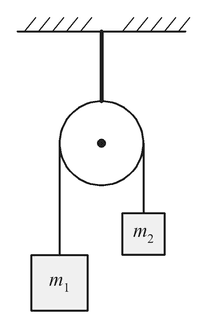
What is a free body diagram? Using free body diagram, obtain an expression for the tension in a string, whose ends are connected to two masses and () and passing over a smooth frictionless pulley.
What Class 11 Physics Ch 6 covers
The sections of the chapter, in the order the book takes them. Every question above comes from one of these.
- 01Force and the Cause of Motion
- 02Newton's First Law and Inertia
- 03Momentum and Newton's Second Law
- 04Mass and Weight
- 05Impulse of a Force
- 06Newton's Third Law of Motion
More ways to study this chapter
The same chapter asked three other ways. Practise it, revise it, and see what the board has set on Ch 6 before.
Class 11 Physics Ch 6 questions students ask
How many questions are there in Class 11 Physics Ch 6?
74 questions. Every one is solved step by step on this page.
Are these Class 11 Physics solutions free?
Yes. Every question and its full working is free to read, with no account needed.
Can I download the Class 11 Physics Ch 6 solutions as a PDF?
There is no PDF to download. Every solution is on this page instead, which means it is searchable, always the current syllabus, and readable on a phone. Use your browser's print option if you want it on paper.