Solution:
Concept: The bob moves with the car. The net force on it (the vector sum of the tension T in the cord and its weight mg) must equal its mass times its acceleration.
Step 1 — Part (i), constant velocity. The acceleration is zero, so the net force must be zero. The tension must exactly balance the weight, so the cord hangs vertically, as it does when the car is at rest.
Step 2 — Part (ii), constant acceleration a. A net forward force ma is now needed. The cord tilts backward (opposite to the acceleration) by an angle θ, so that its tension has a forward component:
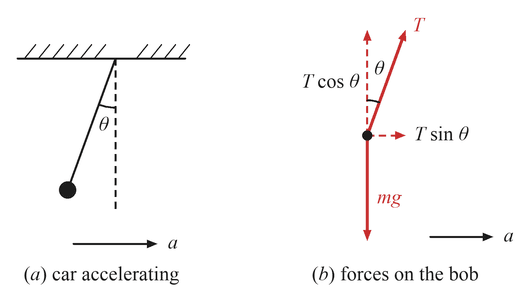
The vertical and horizontal parts of Newton's second law are:
Tcosθ=mg
Tsinθ=ma
Dividing the second equation by the first gives the angle:
tanθ=ga
The bob stays at this angle as long as the acceleration is constant.
Step 3 — Part (iii), a left turn. The bob must now move on a curve to the left, which needs a force towards the centre of the turn. The cord tilts so that the bob swings outward, to the right, and the tension supplies the inward force. (In the car it looks as if the bob is thrown outward because of its inertia of direction.)
Therefore, (i) the bob hangs vertically; (ii) it is deflected backward, opposite to the acceleration, and stays at an angle θ to the vertical with tanθ=a/g; (iii) it swings outward to the right.
