
A weightless rod is acted upon by upward parallel forces of 2 newton and 4 newton magnitudes at ends and respectively. The total length of the rod metre. To keep the rod in equilibrium, a force of 6 newton act in the following manner.
Newton's Laws of Motion · Question 11 of 74
A weightless rod is acted upon by upward parallel forces of 2 newton and 4 newton magnitudes at ends A and B…
(A) downward at any point between and
(B) downward at the midpoint of
(C) downward at a point C such that metre
- Correct answer
(D) downward at a point D such that metre
Answer: (D) Downward at a point D such that BD = 1 m
Concept: A rigid body is in equilibrium when (1) the net force on it is zero and (2) the net moment (torque) about any point is zero.
Step 1 — Use the force condition. The two upward forces add to , so the 6 N force must act downward to make the net force zero.
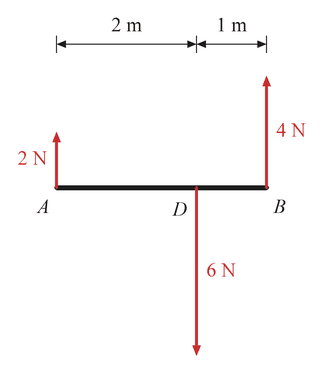
Step 2 — Use the moment condition about A. Let the 6 N force act at a distance from A. The 4 N force at B turns the rod one way and the 6 N force the other way; the 2 N force at A has no moment about A:
Step 3 — Locate the point. The point is 2 m from A, so its distance from B is:
The figure shows the three forces on the rod in equilibrium:

- (A) At most points the moments do not balance, so the rod would turn; only one point works.
- (B) About the midpoint, the 2 N force has a moment of 3 N m (2 N at 1.5 m) and the 4 N force a moment of 6 N m (4 N at 1.5 m), so the rod would turn.
- (C) About a point 1 m from A, the 2 N force has a moment of 2 N m (2 N at 1 m) and the 4 N force a moment of 8 N m (4 N at 2 m), so the rod would turn.
Therefore, the 6 N force must act downward at the point D with BD = 1 m (2 m from A), option (D).
