
Question 673 marksMedium
State Newton's second law of motion. Derive the relation .
Confirming your payment
Sign up now and get 250 free tokens.
Newton's Laws of Motion · Question 67 of 74
State Newton's second law of motion. Derive the relation .
Solution:
Concept: The momentum of a body is . Newton's second law connects the force on a body to the rate at which its momentum changes.
Step 1 — State the law. The rate of change of momentum of a body is directly proportional to the applied force and takes place in the direction in which the force acts.
Step 2 — Set up the derivation. Let a constant force act on a body of mass for a time , changing its velocity from to :
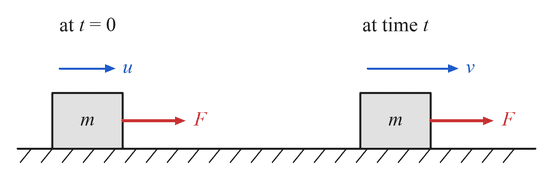
The change in momentum is , and it takes place in time .
Step 3 — Write the law as a proportion. The rate of change of momentum is proportional to the force:
Step 4 — Bring in the acceleration. For a constant mass, , and is the acceleration:
Step 5 — Remove the proportionality sign. We write , where is a constant. The unit of force is chosen so that : one newton is the force that gives a mass of 1 kg an acceleration of . Then:
In calculus form the same steps read, for a constant mass :
The equation is a vector equation: the acceleration is in the direction of the force.
Watch out: The form holds when the mass stays constant and the speed is much less than that of light; the general form is .
Therefore, the second law states that the rate of change of momentum is proportional to the applied force and in its direction, and with the newton chosen as the unit of force it gives .