Opening your dashboard
Class 11 Physics Chapter 6 Newton's Laws of Motion: Competency-Based Questions (CBQ)
44 questions on Chapter 6, each worked through on its own page with the AI tutor. Class 11 Physics, ICSE 2026-27.
44 questions
1–4 marks · Mixed difficulty
- 14 marks
Question 1
Competency: Application
A small hovercraft rides on a cushion of air over a level car park. With its rider, its total mass is . While it is moving in a straight line at , the rider switches off the propeller fan, and the craft coasts on in the same straight line until it comes to rest farther on. Treat the total resisting force on it (air resistance and the drag of its skirt) as constant. (Hypothetical data.)
(a) Find the deceleration of the hovercraft while it coasts, and the resisting force on it.
(b) The rider now wants to cruise at a steady . What forward thrust must the fan provide? A friend says, "By Newton's first law no force is needed to keep a body moving, so the fan can be switched off once the craft is moving." Explain what is wrong with this reasoning.
(c) Galileo argued that if every resisting force were removed, a moving body would never stop. Find how far the craft would coast from if the resisting force were only , and explain how your results support Galileo's argument.
- 21 mark
Question 2
Competency: Analysis & Evaluation
There are four fundamental forces in nature: the gravitational, electromagnetic, strong nuclear and weak nuclear forces. The gravitational attraction between two protons is about times weaker than the electric repulsion between them, yet gravity controls the motion of the planets round the Sun.
Assertion (A): Gravity controls the motion of the planets round the Sun because it is the strongest of the four fundamental forces.
Reason (R): Gravity is always attractive and has an infinite range, while the electric forces due to the positive and negative charges in a planet very nearly cancel.
- 34 marks
Question 3
Competency: Application
A car is waiting at a red light when another car runs into it from behind. During the impact, the struck car and its seats are pushed forward with an acceleration of about for . The driver's head has a mass of . (Hypothetical data.) Take .
(a) Using the idea of inertia, explain why, without a head restraint, the driver's head is jerked backward relative to the body in such a crash (a "whiplash" injury).
(b) Find the speed the car gains in the impact. Find also the force needed on the head to give it the same acceleration as the car, and how many times the weight of the head this force is.
(c) In one car the head restraint is behind the driver's head. Suppose that the neck exerts almost no force on the head until the head reaches the restraint. How long after the impact begins does the head reach the restraint, and how fast is it then moving relative to the car? Use your answers to explain why a head restraint should be set as close to the head as possible.
- 41 mark
Question 4
Competency: Analysis & Evaluation
Riya spins a raw egg and a hard-boiled egg, one after the other, on a smooth table. She stops each spinning egg for a moment with her fingertip and then lifts her finger at once. One of the eggs starts turning again by itself. Which egg is it, and why?
- 51 mark
Question 5
Competency: Analysis & Evaluation
A frame of reference fixed to the Earth's surface turns with the Earth's daily spin and moves with the Earth round the Sun. At the equator the spin gives the ground an acceleration of about towards the Earth's axis, and the orbital motion gives the Earth an acceleration of about towards the Sun.
Assertion (A): For most laboratory experiments on motion, a frame of reference fixed to the laboratory floor can be treated as an inertial frame.
Reason (R): A frame fixed to the Earth's surface has no acceleration at all, because the Earth spins at a steady rate.
- 63 marks
Question 6
Competency: Application
A battery leaf blower of mass draws in still air and blows it out of its nozzle as a horizontal jet at . It moves of air every second. A gardener holds the blower at rest, with the nozzle pointing straight ahead. (Hypothetical data.) Take , and treat the air drawn in as starting from rest.
(a) Find the momentum given to the air each second. Hence use Newton's second law to find the force that the blower exerts on the air.
(b) Find the force that the air exerts on the blower. Hence find the size and direction of the total force that the gardener's hands must exert on the blower to hold it at rest.
(c) A narrower nozzle is fitted. The air now leaves at , but only of air passes each second. Does the push of the air on the blower increase or decrease, and by how much?
- 71 mark
Question 7
Competency: Analysis & Evaluation
To test whether the acceleration of a body is proportional to the net force on it, students pull a trolley along a friction-compensated track with a light string that runs over a light pulley to a hanger, as shown.

To change the pulling force, they take slotted masses off the trolley one at a time and put them on the hanger, instead of adding new masses to the hanger. The main reason for doing it this way is
- 83 marks
Question 8
Competency: Application
Pragyan, the rover carried to the Moon by Chandrayaan-3, has a mass of about . Take on the Moon and on the Earth.
(a) What is the mass of the rover on the Moon? Find its weight on the Moon and on the Earth.
(b) On the Moon the rover starts from rest on level ground and reaches its driving speed of in . (Hypothetical data.) Find the net horizontal force needed. Would the same net force be needed for the same start on level ground on the Earth? Explain.
(c) Before launch, engineers test such a rover on the Earth while an overhead cable pulls it straight up, so that the ground pushes up on its wheels with the same force as on the Moon. (Hypothetical data.) Find the upward pull of the cable.
- 91 mark
Question 9
Competency: Analysis & Evaluation
The label on a packet of rice says "Net mass: 1 kg". A physics textbook says that the weight of the packet is about , directed vertically downward.
Assertion (A): Weight is a vector quantity, while mass is a scalar quantity.
Reason (R): The weight of a body changes from place to place, but its mass stays the same everywhere.
- 104 marks
Question 10
Competency: Analysis & Evaluation
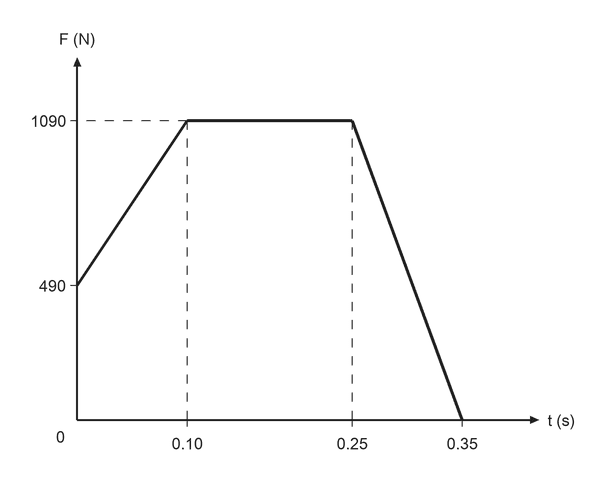
In a sports-science laboratory, a student of mass stands still on a force plate, which records the upward force that it exerts on the student. The student bends their knees, holds still for a moment, and then pushes off and jumps straight up. The graph shows from the start of the push () until the student leaves the plate at : it rises steadily from to in the first , stays at until , and then falls steadily to zero. (Hypothetical data.) Take .
(a) What does the plate read while the student stands still before the jump? Explain.
(b) Use the graph to find the impulse of the plate's force on the student during the push-off. Find also the impulse of the student's weight over the same time, and hence the net impulse on the student.
(c) Find the student's speed on leaving the plate, and how high the student's centre of mass rises after leaving it.
- 111 mark
Question 11
Competency: Application
During a heavy shower, rain falls vertically at a rate of per hour; that is, the water would collect to a depth of in one hour on level ground. It falls on a flat roof of area . The drops hit the roof at and lose all their vertical speed as they splash and drain away. (Hypothetical data.) Take the density of water as and . The average force on the roof due to the impacts of the drops, not counting the weight of any water lying on it, is about
- 123 marks
Question 12
Competency: Analysis & Evaluation
Two identical ring magnets, A and B, each of mass , are slipped over a smooth vertical wooden rod fixed to a base. Like poles face each other, so magnet A floats at rest above magnet B, which rests on the base. The whole set-up stands on a digital scale, as shown, which reads . The rod is smooth, so it exerts no vertical force on either magnet. (Hypothetical data.) Take .
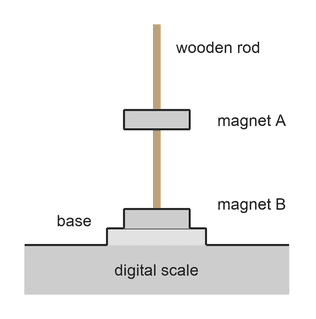
(a) Name the forces acting on magnet A, and find the magnetic force on it.
(b) Using Newton's third law, find the force that magnet A exerts on magnet B. Hence find the force that the base exerts on magnet B.
(c) A student says, "Magnet A is floating, so it does not press on anything. If it were lifted off the rod, the reading would not change." Is the student right? Explain, and give the reading with magnet A removed.
- 131 mark
Question 13
Competency: Analysis & Evaluation
The Earth and the Moon attract each other by gravity. The mass of the Earth is about 81 times the mass of the Moon.
Assertion (A): The Moon pulls the Earth with a force exactly as large as the force with which the Earth pulls the Moon.
Reason (R): The acceleration that this pull gives the Earth is about 81 times smaller than the acceleration it gives the Moon.
- 144 marks
Question 14
Competency: Application
A painter of mass sits on a bosun's chair (a seat hung from a rope) of mass . The rope is tied to the chair, passes over a light, frictionless pulley fixed to the roof, and comes back down to the painter, who holds it and pulls on it to rise, as shown. The rope is light and both parts of it hang vertically. (Hypothetical data.) Take .
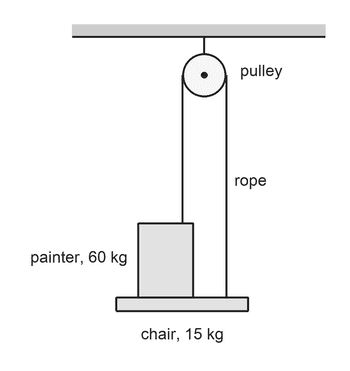
(a) Draw separate free-body diagrams of the painter and of the chair, naming each force.
(b) Find the force with which the painter must pull down on the rope to rise at a steady speed, and the force between the painter and the seat.
(c) To start moving up, the painter rises with an acceleration of for a short time. Find the painter's pull on the rope and the force between the painter and the seat during this time.
- 151 mark
Question 15
Competency: Analysis & Evaluation
A school bag hangs at rest from a hook on a classroom wall. A student draws the free-body diagram of the bag.
Assertion (A): The pull of the bag on the hook is not shown in the free-body diagram of the bag.
Reason (R): A free-body diagram of a body shows only the forces that act on that body, exerted on it by other bodies.
- 161 mark
Question 16
Competency: Application
A forklift truck carries a pallet of bricks of mass on its forks. While the truck speeds up along a level floor with an acceleration of , the forks also raise the pallet with an upward acceleration of . The pallet does not slide on the forks. (Hypothetical data.) Take . The total force exerted by the forks on the pallet is
- 174 marks
Question 17
Competency: Analysis & Evaluation
In a school laboratory, glider A (mass ) and glider B (mass ) move towards each other along a level air track and collide through a spring bumper. Light gates give these velocities, taking motion to the right as positive. (Hypothetical data.)
Glider Velocity before (m s⁻¹) Velocity after (m s⁻¹) A +0.80 −0.15 B −0.40 +1.02 (a) Find the total momentum of the two gliders before and after the collision. By what percentage does the total change? Do the results support the law of conservation of linear momentum?
(b) The bumpers are in contact for . Find the impulse on B and the average force on B during the collision, and compare the impulse on B with the impulse on A.
(c) The students then fit sticky putty to the bumpers, so that the gliders stick together on impact. With the same velocities before the collision, predict the velocity of the joined gliders.
- 181 mark
Question 18
Competency: Application
Two trolleys, P of mass and Q of mass , rest on a smooth level track with a compressed spring between them, as shown. When the spring is released it pushes them apart in a very short time, and then they roll freely. Bumper 1 is from P. (Hypothetical data.)

For both trolleys to hit their bumpers at the same instant, the distance from Q to bumper 2 should be
- 191 mark
Question 19
Competency: Analysis & Evaluation
In a Newton's cradle, five identical steel balls hang in a row, just touching one another. One ball at the end is pulled aside and released, and it strikes the other four.
Assertion (A): Almost exactly one ball swings out at the far end, with nearly the same speed that the striking ball had.
Reason (R): Conservation of momentum on its own allows only one ball to leave, because two balls leaving together would carry more momentum than the striking ball had.
- 203 marks
Question 20
Competency: Application
A kite of weight is held at rest in a steady wind. Its taut, straight string pulls on the kite with a tension of and rises from the flyer's hand at above the horizontal, as shown. Apart from its weight and the pull of the string, the only other force on the kite is the force of the wind. (Hypothetical data.) Take .
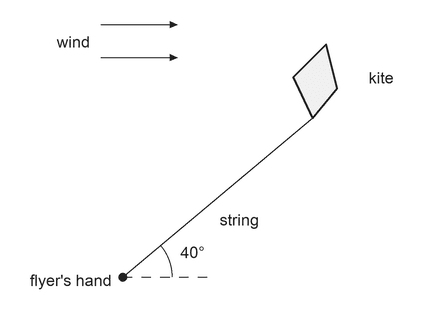
(a) Find the horizontal and vertical components of the pull of the string on the kite.
(b) Using the condition of equilibrium, find the size of and the angle it makes with the horizontal.
(c) Suddenly the string snaps. Just after this, before the wind force has had time to change, find the net force on the kite and its acceleration.
- 211 mark
Question 21
Competency: Application
In a hospital, a patient's broken leg is kept in traction. Two ropes are tied to a harness on the foot. Each rope passes over a smooth pulley and carries a hanging mass, and the two ropes leave the foot at above and below the horizontal, as shown. (Hypothetical data.) Take .
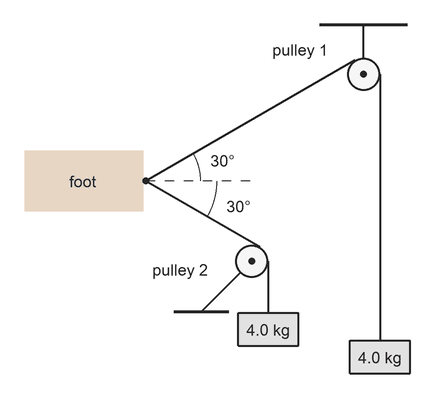
The total pull of the two ropes on the foot is
- 221 mark
Question 22
Competency: Analysis & Evaluation
A street light hangs at rest from two cables of different lengths, which are fixed at the same height to two walls, as shown. The cables are light.
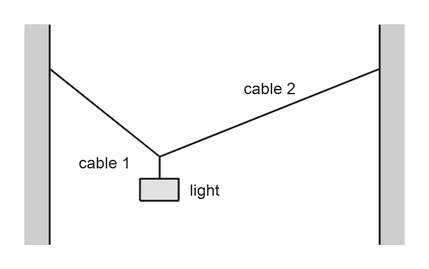
Assertion (A): The shorter cable (cable 1) carries the larger tension.
Reason (R): The tensions in the two cables add up to the weight of the light.
- 234 marks
Question 23
Competency: Application
A tower crane on a building site has a horizontal jib on a vertical tower, as shown. On one side of the tower axis, a counterweight of hangs from the axis, and the counter-jib that carries it has a mass of acting from the axis. On the other side, the main jib has a mass of acting from the axis, and a load hangs from a trolley that can run along the jib. For safety, the total moment of all these weights about the tower axis, in either direction, must never be more than ; the tower and its base supply the rest. (Hypothetical data.) Take and .

(a) With no load on the hook, find the total moment of the weights about the tower axis, and say which way it tends to turn the top of the tower. Is the crane safe?
(b) Find the largest load that may be lifted with the trolley (i) and (ii) from the axis.
(c) The site manager suggests adding to the counterweight so that heavier loads can be lifted at . Show, with a calculation, why this is not allowed.
- 241 mark
Question 24
Competency: Application
A cyclist pushes straight down on a pedal with a steady force of . The crank is long. At the instant shown, the crank points below the forward horizontal. (Hypothetical data.)

The torque of the push about the axle at this instant, and the crank positions at which the same downward push gives no torque at all, are
- 251 mark
Question 25
Competency: Analysis & Evaluation
Door handles are normally fitted near the edge of a door that is farthest from its hinges, not close to the hinges.
Assertion (A): A door handle is placed far from the hinges so that the door can be opened with a small push or pull.
Reason (R): The torque of a force about the hinge line equals the force multiplied by the perpendicular distance of its line of action from that line.
- 264 marks
Question 26
(Hypothetical data.) A uniform beam AB, long and of mass , is hinged to a vertical wall at A. It is held horizontal by a light cable BC, fixed to the wall at C, above A; the cable makes an angle of with the beam. A sign of mass hangs from the point D of the beam, from A, as shown. Take .
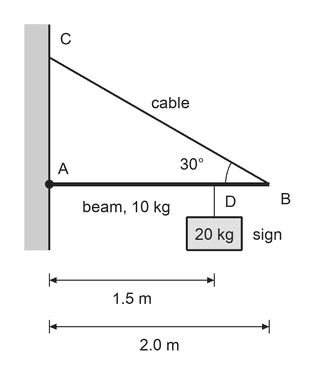
(a) Find the tension in the cable.
(b) Find the horizontal and vertical components of the force exerted by the hinge on the beam.
(c) Find the size and direction of the hinge force.
- 273 marks
Question 27
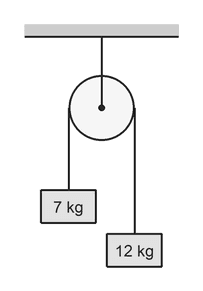
Two masses 7 kg and 12 kg are connected at the two ends of a light inextensible string that goes over a frictionless pulley. Find the acceleration of the masses and the tension in the string when the masses are released.
- 283 marks
Question 28
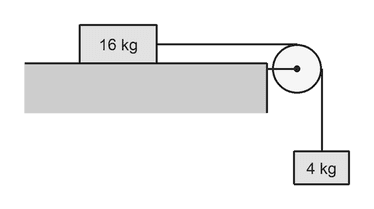
A body of mass 16 kg placed on a smooth horizontal table is connected by a light string passing over a pulley to a hanging body of mass 4 kg. What is the acceleration of the masses and the tension in the string?
- 293 marks
Question 29
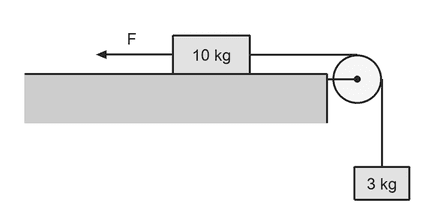
A horizontal force is applied to the 10 kg mass shown in the given figure. Calculate the value of for which the 3 kg mass accelerates upward? (b) For what value of , the tension in the string is zero?
- 304 marks
Question 30
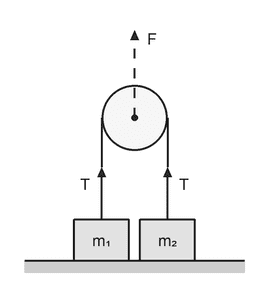
A constant force directed vertically upwards is applied to the pulley shown in the given figure. What are the acceleration produced in the masses and when is equal to (i) 20 N and (ii) 40 N? Given kg, kg and are initially at rest on the horizontal surface. Assume that the strings are massless and the pulley is frictionless.
- 313 marks
Question 31
Three masses kg, kg and kg are connected as shown in the given figure, on a horizontal frictionless table and is pulled to the right with a force 75 N. (i) What is the acceleration of the system? (ii) Find the values of tensions and .

- 323 marks
Question 32
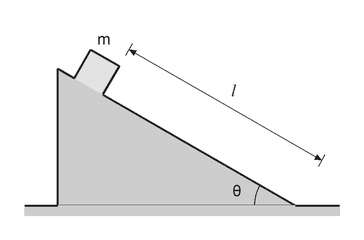
A block of mass is placed on a frictionless inclined plane of angle . What is the acceleration of the block when it is released? Calculate the time taken by the block to reach the bottom and its speed at the bottom.
- 333 marks
Question 33
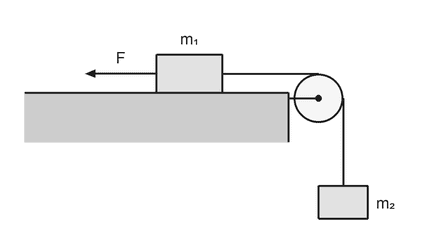
A constant force is applied on the block of mass as shown in the given figure. The string and the pulleys are light and the surface of the table is smooth. What is the acceleration of ?
- 344 marks
Question 34
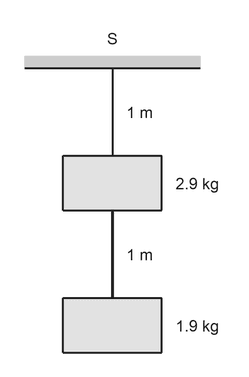
Two blocks of masses 2.9 kg and 1.9 kg are suspended from a rigid support by two inextensible wires, each of length 1 m. The upper wire has negligible mass and the lower wire has a uniform mass of . The whole system of blocks, wires and support have an upward acceleration of . (i) Find the tension in the midpoint of the lower wire. (ii) Find the tension at the midpoint of the upper wire.
- 353 marks
Question 35
An elevator of total mass 1000 kg is moving upwards with a speed of 8 m/s. It is brought to rest in a distance of 16 m. Find the tension in the supporting cable and the force exerted by a man of mass 60 kg inside the elevator, on the floor ().
- 364 marks
Question 36
A man weighing 60 kg is standing on a weighing machine in a lift. What is his weight as shown by the machine when the lift (a) is at rest, (b) moves downwards with a uniform velocity of (c) moves upwards with a uniform velocity of (d) moves downwards with a uniform acceleration of and (e) moves upwards with a uniform acceleration of . []
- 373 marks
Question 37
A body of mass at rest explodes into three pieces, two of which of mass each are thrown off in perpendicular directions with velocities of 3 m/s and 4 m/s respectively. What is the velocity of the third piece?
- 383 marks
Question 38
Three particles , , of equal masses, moving with same speed along the medians of an equilateral triangle, collide at the centroid of the triangle. After collision, comes to rest and retraces its path with speed . What is the speed of after collision?

- 393 marks
Question 39
A stationary shell is exploded into three fragments , and of masses in the ratio 1:2:3. travels with a speed of and with a speed of in two directions inclined at an angle of at each other. Find the speed of the fragment .
- 404 marks
Question 40
A rocket motor consumes 100 kg of fuel per second exhausting it with a speed of m/s. What force is exerted on the rocket? What will be the velocity of the rocket at the instant that its mass is reduced to (1/20)th of its initial mass, its initial velocity being zero? (Neglect gravitational and viscous forces etc)
- 413 marks
Question 41
The sum of the magnitudes of two forces inclined to each other at an angle is 8 N and their resultant which is perpendicular to the smaller force is 4 N. Calculate the forces and the angle between them.
- 423 marks
Question 42
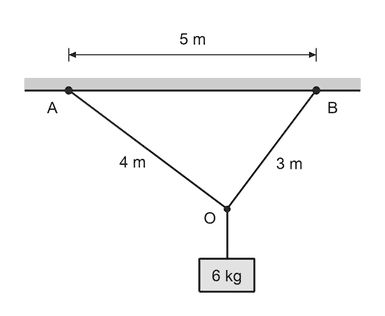
A body of mass 6 kg is suspended by two strings of length 4 m and 3 m attached to two points 5 m apart in the same horizontal line. Find the tensions in the strings.
- 433 marks
Question 43
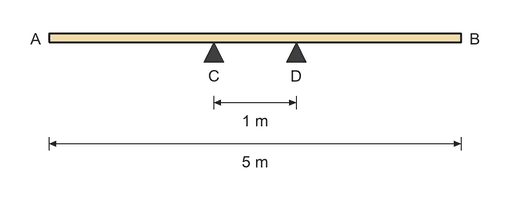
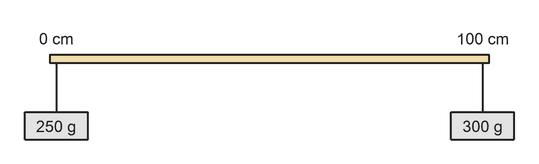
A uniform metre scale has a mass of 100 g. Masses of 250 g and 300 g are suspended from its ends. At what points must the rod be supported so that it may remain horizontally in equilibrium?
- 444 marks
Question 44
A uniform plank 5 m long weighing 150 kg rests symmetrically on two supports and are one metre apart. A man weighing 75 kg walks from the centre of the plank. (i) How far beyond the support, can he safely proceed? (ii) How far from the end should the support be placed so that the man can just walk to the end of the plank without tripping the plank?