
Question 715 marksMedium
(a) State Newton's laws of motion.
(b) Define momentum and impulse. Obtain the relation connecting them.
Confirming your payment
Sign up now and get 250 free tokens.
Newton's Laws of Motion · Question 71 of 74
(a) State Newton's laws of motion.
(b) Define momentum and impulse. Obtain the relation connecting them.
Solution:
Concept: Newton's three laws describe how forces change the motion of bodies. Momentum measures the quantity of motion, and impulse measures the total effect of a force over the time it acts.
Step 1 — Part (a), the first law. Every body continues in its state of rest or of uniform motion in a straight line unless it is compelled by an external force to change that state.
Step 2 — Part (a), the second law. The rate of change of momentum of a body is directly proportional to the applied force and takes place in the direction of the force. With suitable units, , which becomes for a constant mass.
Step 3 — Part (a), the third law. To every action there is an equal and opposite reaction, and the two act on different bodies: .
Step 4 — Part (b), momentum. The momentum of a body is the product of its mass and velocity, . It is a vector along the velocity; its SI unit is and its dimensional formula is .
Step 5 — Part (b), impulse. The impulse of a force is the product of the force and the time for which it acts, (for a varying force, ). Its SI unit is N s.
Step 6 — Part (b), the relation. Let a force act on a body of mass for a time , changing its velocity from to :
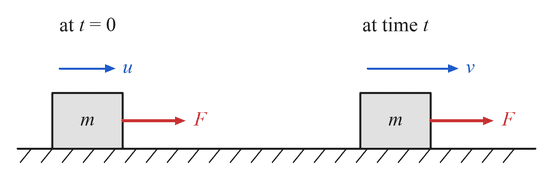
By the second law, the force is the rate of change of momentum:
Multiplying both sides by :
Step 7 — Part (b), a varying force. If the force varies, each small impulse equals the small change in momentum , and adding them up gives the same result. The impulse is then the area under the force–time graph:
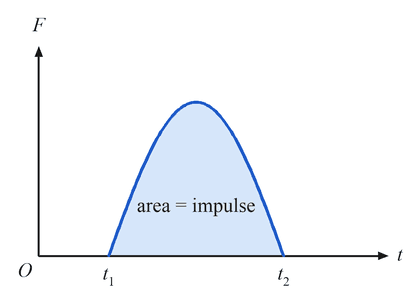
Therefore, (a) the three laws are as stated above; (b) momentum is , impulse is force × time, and impulse equals the change in momentum, .