
Question 725 marksMedium
State law of conservation of linear momentum. Prove the law of conservation of linear momentum using Newton's second law.
Confirming your payment
Sign up now and get 250 free tokens.
Newton's Laws of Motion · Question 72 of 74
State law of conservation of linear momentum. Prove the law of conservation of linear momentum using Newton's second law.
Solution:
Concept: By Newton's second law the rate of change of momentum of each body equals the force on it. The forces that bodies of a system exert on one another (internal forces) occur in equal and opposite pairs (third law).
Step 1 — State the law. When two or more bodies interact with one another, their total linear momentum remains constant, provided no external force acts on them.
Step 2 — Write the total momentum. Consider a system of particles of masses moving with velocities . The total momentum is:
Step 3 — Differentiate and use the second law. The rate of change of each particle's momentum is the total force on it:
Step 4 — Separate external and internal forces. Each is the sum of an external force and the internal forces from the other particles. The internal forces occur in equal and opposite pairs, so they add up to zero, and only the external forces remain:
Step 5 — Put the external force equal to zero. If no external force acts, :
so is a constant. This proves the law.
Step 6 — Show it for two colliding bodies. Let bodies of masses and , moving along a line with velocities and , collide and be in contact for a short time , after which their velocities are and . Let be the force on body 1 by body 2, and the force on body 2 by body 1:
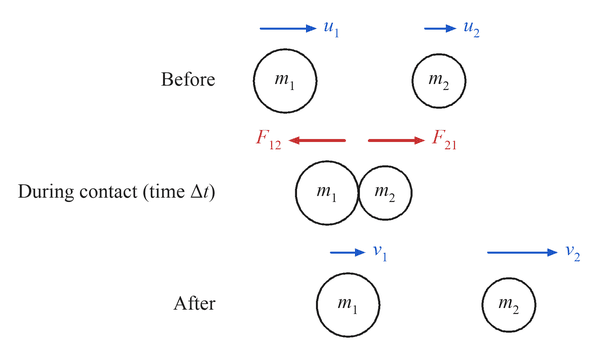
By the second law, each force equals the rate of change of momentum of the body it acts on:
These forces are equal and opposite, , so:
The total momentum after the collision equals the total momentum before it.
Therefore, the total linear momentum of a system stays constant when no external force acts on it, because by the second law , which is zero; for two colliding bodies .