
Question 735 marksMedium
(a) Prove that Newton's second law is the real law of motion.
(b) Explain recoil of a gun. What is (i) muzzle velocity and (ii) recoil velocity?
Confirming your payment
Sign up now and get 250 free tokens.
Newton's Laws of Motion · Question 73 of 74
(a) Prove that Newton's second law is the real law of motion.
(b) Explain recoil of a gun. What is (i) muzzle velocity and (ii) recoil velocity?
Solution:
Concept: The second law, , describes completely how a force changes motion. The book calls it the real law because the first and third laws can be obtained from it. The recoil of a gun follows from the conservation of linear momentum.
Step 1 — Part (a), first law from the second. We start from . If no external force acts, :
Since , and is constant. A body at rest stays at rest and a moving body keeps moving uniformly in a straight line, which is the first law.
Step 2 — Part (a), third law from the second. Consider two bodies 1 and 2 that act on each other, with no external force on the pair. Let be the force on body 1 by body 2, and the force on body 2 by body 1, as in a collision:
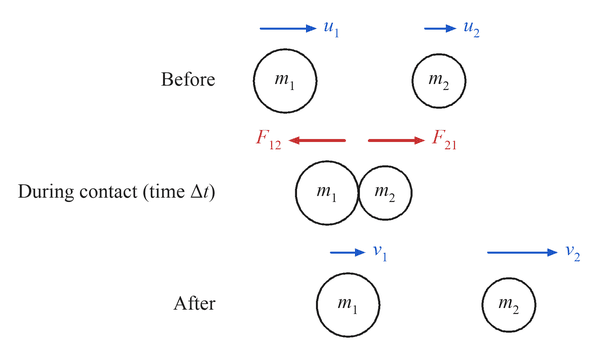
By the second law:
Adding, and using the fact that the total momentum of the isolated pair does not change:
Action and reaction are equal and opposite, which is the third law. Since both the first and third laws follow from the second, the second law is called the real law of motion.
Note: the step uses the constancy of momentum of an isolated pair, which is an experimental fact equivalent to the third law; for this reason many physicists regard the third law as an independent law.
Step 3 — Part (b), recoil of a gun. The gun (mass ) and the bullet (mass ) form one system, at rest before firing, so their total momentum is zero. On firing, the bullet moves forward with velocity and the gun moves backward with velocity :

No external force acts along the barrel during the firing, so the momentum stays zero:
The minus sign shows that the gun moves opposite to the bullet. This backward motion of the gun is called its recoil. Because is much larger than , is much smaller than ; for example, a 4 kg rifle firing a 10 g bullet at recoils at .
Step 4 — Part (b), the two velocities. The muzzle velocity is the velocity with which the bullet leaves the muzzle (the open end) of the gun. The recoil velocity is the backward velocity of the gun at the instant of firing.
Therefore, (a) the second law is the real law since the first and third laws can be derived from it; (b) a gun recoils because the forward momentum of the bullet must be balanced by an equal backward momentum of the gun, , where the muzzle velocity is the bullet's velocity as it leaves the barrel and the recoil velocity is the gun's backward velocity.