
Question 745 marksMedium
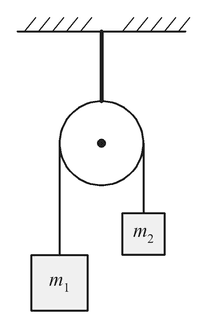
What is a free body diagram? Using free body diagram, obtain an expression for the tension in a string, whose ends are connected to two masses and () and passing over a smooth frictionless pulley.
Confirming your payment
Sign up now and get 250 free tokens.
Newton's Laws of Motion · Question 74 of 74
What is a free body diagram? Using free body diagram, obtain an expression for the tension in a string, whose ends are connected to two masses and () and passing over a smooth frictionless pulley.
Solution:
Concept: A free body diagram shows one body of a system on its own, with every force acting on it drawn as an arrow. Newton's second law is then applied to that body alone: net force = mass × acceleration.
Step 1 — Define a free body diagram. A free body diagram is a diagram of a single body (or part of a system), separated from its surroundings, showing all the external forces acting on it in magnitude and direction.
Step 2 — Describe the motion. The string is light and does not stretch, and the pulley is smooth, so the tension is the same throughout the string and both masses have the same acceleration . Since , moves down and moves up.
Step 3 — Draw the free body diagrams. On act the tension upward and its weight downward; on act upward and downward:
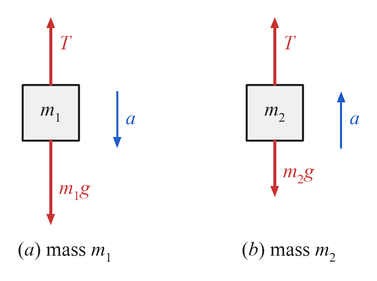
Step 4 — Apply the second law to each mass. For (accelerating downward) and for (accelerating upward):
Step 5 — Find the acceleration. Adding the two equations removes :
Step 6 — Find the tension. From the second equation, . We substitute :
Check: For and , , about 23.5 N, which lies between the two weights, 19.6 N and 29.4 N, as it must.
Therefore, a free body diagram shows one body with all the forces acting on it, and for the two masses over the pulley the tension is , with acceleration .