
Opening your dashboard
Class 11 Physics Chapter 6 Newton's Laws of Motion: Practice Questions
163 questions on Chapter 6, each worked through on its own page with the AI tutor. Class 11 Physics, ICSE 2026-27.
163 questions
1–4 marks · Mixed difficulty
- 11 mark
Question 1
An ice-hockey puck is struck by a stick and then slides across smooth, level ice. Ignoring friction and air resistance, what can be said about the horizontal force on the puck while it slides, after it has left the stick?
- 24 marks
Question 2
In a hydrogen atom, the electron and the proton are about apart. Take , , , and .
(a) Find the electric force between the electron and the proton.
(b) Find the gravitational force between them.
(c) How many times stronger is the electric force?
(d) Gravity is by far the weaker force, yet it is gravity, not the electric force, that holds the planets in their orbits round the Sun. Explain why.
- 33 marks
Question 3
In a version of Galileo's experiment, a small ball is released from rest on a smooth incline at a height of above the level floor. It rolls down, across the floor and up a second smooth incline. Energy losses are negligible, so the ball always rises to the height from which it was released. When the second incline makes with the horizontal, the ball travels along it before stopping, as in figure (a). (Hypothetical data.) The second incline is then lowered to , as in figure (b).
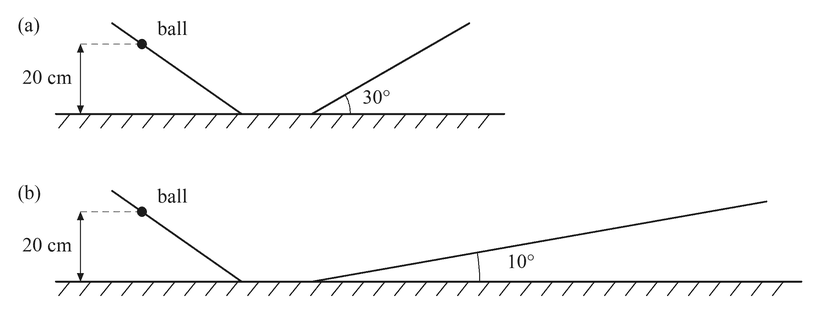
(a) How far along the incline does the ball travel before it stops?
(b) What would happen if the second incline were lowered all the way to the horizontal? What does this show about force and motion?
- 43 marks
Question 4
A skydiver of total mass (with equipment) falls with the parachute open at a steady speed of . (Hypothetical data.) Take .
(a) What is the net force on the skydiver?
(b) What is the size and direction of the total force that the air exerts on the skydiver and the parachute?
(c) A friend says, "The skydiver is moving downward, so the downward force must be bigger than the upward force." Is the friend right? Explain.
- 51 mark
Question 5
The push of a table on a book resting on it, the pull of a stretched rope and the friction on a box sliding across a floor are all contact forces. Among the four fundamental interactions, these contact forces arise from
- 61 mark
Question 6
A smooth marble rests on the smooth, level floor of a bus that is standing still. The bus then starts forward with an acceleration of . (Hypothetical data.) Treating the floor as frictionless, while the marble is still on the floor, a person standing on the road sees that the marble
- 73 marks
Question 7
A carpenter tightens a loose hammer head by holding the hammer upright, head at the top, and striking the bottom end of the wooden handle hard on a concrete floor.
(a) Use the idea of inertia to explain why the head moves further down onto the handle.
(b) Just before the impact, the hammer moves down at . The handle stops almost at once, while the head slides a further down the handle before it stops. (Hypothetical data.) Assuming the head slows down uniformly, find the average force that the handle exerts on the head. Ignore the weight of the head.
- 81 mark
Question 8
A box lies on the smooth back seat of a car that is moving straight ahead. The car then turns sharply to the left at a steady speed, and the box slides across the seat towards the right-hand door. Seen from above by a person standing on the ground, while it slides across the seat, the box
- 94 marks
Question 9
A car travelling at hits a wall head-on, and its crumpling front lets it stop in . (Hypothetical data.) Take .
(a) Use Newton's first law to explain why a passenger who is not wearing a seat belt is thrown forward against the dashboard.
(b) A passenger wearing a seat belt stops along with the car in the same . Assuming uniform deceleration, find the average force the seat belt exerts on this passenger.
(c) How many times the passenger's own weight is this force?
- 101 mark
Question 10
In which one of the following situations is the net force on the body zero?
- 111 mark
Question 11
The graph shows how the momentum of a trolley moving along a straight track changes with time . (Hypothetical data.)
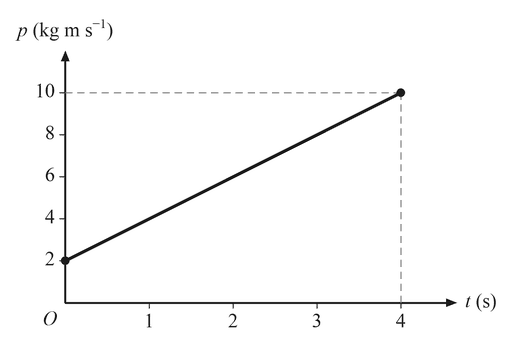
The net force on the trolley is
- 123 marks
Question 12
The momentum of a particle moving in a plane changes with time as
where is in and is in seconds. (Hypothetical data.)
(a) Find the force on the particle at , and give its magnitude and the angle it makes with the -axis.
(b) Is the force on the particle constant? Explain.
- 131 mark
Question 13
Two carts of masses and are at rest on a smooth, level track. Each is pushed from rest by the same steady horizontal force for the same length of time. (Hypothetical data.) Just after the pushes end,
- 143 marks
Question 14
In a laboratory, a trolley of mass is pulled along a track by a constant horizontal force. The track is tilted very slightly, so that friction is just compensated and the net force on the trolley is the pull alone. A motion sensor records these velocities. (Hypothetical data.)
Time (s) 0 0.50 1.00 1.50 Velocity (m s⁻¹) 0.40 0.70 1.00 1.30 (a) Show that the acceleration is constant, and find it.
(b) Find the net force on the trolley.
(c) A block is now fixed on the trolley, and the same pull is applied. Predict the new acceleration.
- 153 marks
Question 15
The velocity–time graph of a car of mass moving along a straight road is shown. (Hypothetical data.)

(a) Find the net force on the car during each of the three stages of the journey, and state its direction.
(b) During the middle stage the engine is still running. Explain why the net force is zero even though the car is moving.
- 161 mark
Question 16
On the Earth (), a bag of rice reads on a beam balance and also on a spring balance whose scale is marked in kilograms. Both balances and the bag are taken to the Moon, where . (Hypothetical data.) On the Moon, the readings of the beam balance and of the spring balance are, respectively,
- 173 marks
Question 17
A student of mass stands on a bathroom scale at the equator, where , and later at the North Pole, where . (Hypothetical data for the student.)
(a) Find the student's weight at each place.
(b) By how much does the weight change from the equator to the pole? Give the change in newtons and as a percentage of the weight at the equator.
(c) Give two reasons why is smaller at the equator.
- 183 marks
Question 18
On board an orbiting space station, a box floats freely, so it cannot be weighed on a spring balance. An astronaut pushes the box with a steady force of , measured with a force sensor, and finds that its acceleration is . (Hypothetical data.)
(a) Find the mass of the box.
(b) What would the box weigh on the Earth's surface, where ?
(c) Explain why this method works even though the box floats, and name the kind of mass it measures.
- 191 mark
Question 19
An astronaut of mass is in a space station orbiting above the Earth, where the acceleration due to gravity is about . (Hypothetical data for the astronaut.) Which statement about the astronaut is correct?
- 203 marks
Question 20
A packet of tea has a mass of . (Hypothetical data.) Taking , express its weight in
(a) gram weight (g wt),
(b) dyne,
(c) newton, and
(d) kilogram weight (kg wt).
(e) Which two of these units are absolute units of force, and which two are gravitational units?
- 211 mark
Question 21
A tennis ball of mass , momentarily at rest at the top of the toss, is struck by the racket. The graph shows the force on the ball during the contact. (Hypothetical data.)

Ignoring gravity during the brief contact, the speed of the ball as it leaves the racket is about
- 224 marks
Question 22
In a fall from a bicycle, a rider's head (mass ) hits the road at and is brought to rest. Suppose that, to avoid serious injury, the average force on the head must not be more than . A helmet has a foam liner that crushes as the head stops. (Hypothetical data.)
(a) Find the impulse needed to stop the head.
(b) Find the least stopping time that keeps the average force within .
(c) Assuming uniform deceleration, find the least thickness of foam that must crush during this time.
(d) Without a helmet the head would stop in about . Find the average force in that case.
- 233 marks
Question 23
A rubber ball of mass rolls east along a smooth floor at . A player strikes it with a stick, and it moves off north at . The stick is in contact with the ball for . (Hypothetical data.)
(a) Find the magnitude and direction of the impulse given to the ball.
(b) Find the average force of the stick on the ball.
- 244 marks
Question 24
During a kick, the force on a football of mass , initially at rest, varies with time as
where is the contact time. The largest force, which acts at , is . (Hypothetical data.)
(a) Find the constant .
(b) Find the impulse on the ball by integration.
(c) Find the speed of the ball as it leaves the foot.
(d) Find the average force during the contact and compare it with the largest force.
- 253 marks
Question 25
Two balls, each of mass , are thrown straight at a wall at . A ball of soft clay sticks to the wall, stopping in . A rubber ball bounces straight back at after a contact lasting . (Hypothetical data.)
(a) Find the impulse given to each ball by the wall.
(b) Find the average force each ball exerts on the wall.
(c) Which ball pushes harder on the wall, and how many times harder? Give two reasons.
- 261 mark
Question 26
In a tug-of-war on level ground, team 1 starts to drag team 2 towards its own side, so both teams begin to speed up in that direction. The rope is light and stays straight and horizontal. Which statement correctly explains why team 1 wins?
- 273 marks
Question 27
(Hypothetical data.) Two rowing boats, P and Q, float at rest on a still lake, apart, joined by a light rope. Ravi, sitting in boat P, pulls the rope in, hand over hand, with a steady force of . The total mass of boat P with Ravi is , and that of boat Q with its passenger is . Neglect the resistance of the water.
(a) What force does the rope exert on boat Q? Explain your answer.
(b) Find the acceleration of each boat.
(c) After what time do the boats meet, and how far from P's starting position?
- 281 mark
Question 28
(Hypothetical data.) At the start of a race, a sprinter of mass has lifted both hands from the track and pushes against the starting blocks with the feet, which are the only part of the body touching anything; the sprinter accelerates horizontally at . During this push the sprinter's centre of mass moves horizontally, so the vertical forces on the sprinter balance. Take and neglect air resistance. The force that the sprinter exerts on the blocks is about
- 293 marks
Question 29
(Hypothetical data.) A fridge magnet of mass stays at rest on the vertical steel door of a refrigerator, as shown. The door pulls the magnet towards itself with a magnetic force of . Take .
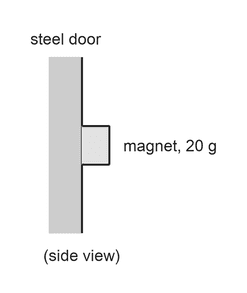
(a) Name every force acting on the magnet, and give the size and direction of each.
(b) For each force in (a), name the body on which its third-law partner acts, and give the direction of that partner.
(c) The magnetic pull of the door on the magnet and the normal force of the door on the magnet are equal and opposite. Explain why they are not an action–reaction pair.
- 303 marks
Question 30
(Hypothetical data.) A car of mass is moving at when an insect of mass , hovering almost at rest, hits its windscreen. The insect is brought up to the speed of the car in .
(a) Find the average force on the insect and the average force on the car during the impact.
(b) By how much does the speed of the car change? Explain why the insect is crushed while the car is hardly affected.
- 313 marks
Question 31
(Hypothetical data.) A worker pushes a crate along a smooth horizontal floor. The push is , directed at below the horizontal, as shown. Neglect friction and take .
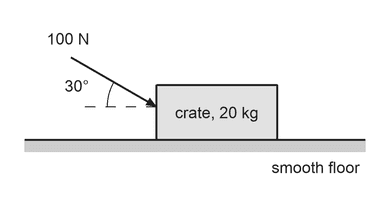
(a) Draw the free-body diagram of the crate.
(b) Find the normal force exerted by the floor on the crate.
(c) Find the acceleration of the crate.
- 321 mark
Question 32
(Hypothetical data.) A student of mass stands still on a bathroom scale that is placed on a ramp inclined at to the horizontal. Friction keeps the student and the scale from sliding, and the scale measures only the force pressing perpendicular to its top. Taking , the reading of the scale is about
- 334 marks
Question 33
(Hypothetical data.) A car of mass tows a trailer of mass along a straight, level road using a light, rigid tow bar. The road pushes the car forward with a driving force of . Air and road resistance oppose the motion with a force of on the car and on the trailer.
(a) Find the acceleration of the car and trailer.
(b) Find the force in the tow bar, and say whether the bar pulls or pushes the trailer.
(c) The driver now releases the accelerator, so that the driving force becomes zero, and brakes. The brakes act on the car only and give it a backward force of ; the resistances are unchanged. Find the new force in the tow bar, and say whether the bar now pulls or pushes the trailer.
- 341 mark
Question 34
(Hypothetical data.) A book of mass is held pressed against a horizontal ceiling by a vertical pole that pushes up on it with a force of , as shown. Take .
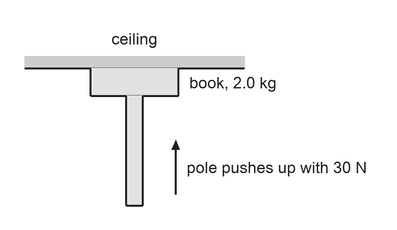
The force exerted by the ceiling on the book is
- 353 marks
Question 35
(Hypothetical data.) A delivery drone of mass carries a parcel of mass that hangs below it on a light cord. The rotors produce a steady vertical upward thrust of on the drone. Neglect air resistance and take .
(a) Find the upward acceleration of the drone and parcel.
(b) With the thrust unchanged, the drone suddenly lets go of the cord. Find the acceleration of the drone just after the release.
(c) Find the acceleration of the parcel just after the release, and explain why it is not zero even though the parcel is still moving upward.
- 361 mark
Question 36
(Hypothetical data.) An angler of mass stands at one end of a boat of mass that is at rest on still water. The angler walks along the boat towards the other end. Neglecting the resistance of the water, how far does the boat move relative to the water?
- 373 marks
Question 37
(Hypothetical data.) On a level road, a car of mass runs into the back of a car of mass that is standing still at a traffic signal. The two cars lock together, and measurements of the skid marks show that just after the impact they moved together at .
(a) Explain why the law of conservation of linear momentum may be used for the impact, even though friction from the road acts on both cars.
(b) Find the speed of the moving car just before the impact, in .
(c) The impact lasted . Find the average force that each car exerted on the other.
- 381 mark
Question 38
For which one of the following systems is the total linear momentum conserved during the process described? Neglect air resistance.
- 392 marks
Question 39
(Hypothetical data.) An open railway wagon of mass rolls freely along a straight, level track at . It passes under a hopper that drops of coal vertically into it. Neglect friction.
(a) Find the speed of the loaded wagon.
(b) Further along, the wagon, still rolling freely, lets all the coal fall out through a trapdoor in its floor. Find the speed of the wagon after the coal has fallen out, and explain your answer.
- 403 marks
Question 40
(Hypothetical data.) On an air-hockey table, puck A of mass slides east at and strikes an identical puck B that is at rest. After the collision, A moves at in a direction north of east, as shown. Friction is negligible.
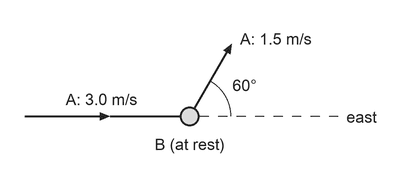
(a) Find the east and north components of B's velocity after the collision.
(b) Find the speed of B and its direction.
(c) Show that the two pucks move off at right angles to each other.
- 411 mark
Question 41
(Hypothetical data.) In a force-table experiment, three strings tied to a small ring pass over pulleys at the rim of a horizontal circular table. One string pulls the ring with along the line and another pulls it with along the line. The third string must keep the ring at rest at the centre. Its pull, and the direction of that pull measured anticlockwise from the line, are about
- 423 marks
Question 42
(Hypothetical data.) A lamp of mass hangs from the mid-point P of a light rope whose ends are tied at the same height to two poles at A and B, apart. The weight of the lamp pulls P down to below the level of A and B, as shown. Take .
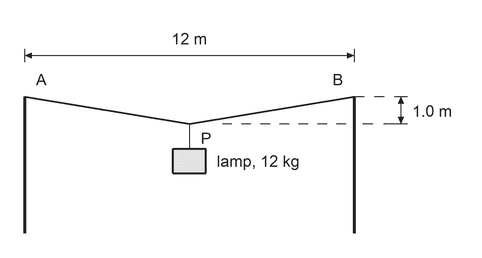
(a) Find the angle that each half of the rope makes with the horizontal.
(b) Find the tension in the rope.
(c) Explain why the rope can never be pulled perfectly straight (horizontal) while the lamp hangs from it.
- 431 mark
Question 43
(Hypothetical data.) A smooth steel ball of mass rests in a V-shaped groove formed by two smooth planes, each inclined at to the horizontal, as shown. Take .

The force exerted on the ball by each plane is about
- 443 marks
Question 44
(Hypothetical data.) A car is stuck in mud on a straight road. Two tractors pull it with horizontal ropes attached at the same point of the car, as shown in the top view. Rope 1 makes an angle of with the road on one side and pulls with a tension of ; rope 2 makes an angle of with the road on the other side.
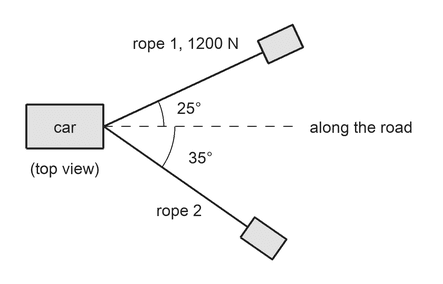
(a) Find the tension in rope 2 so that the resultant pull of the two ropes acts straight along the road.
(b) Find the size of this resultant pull.
(c) The car still does not move. Find the size and direction of the horizontal force that the mud exerts on the car.
- 451 mark
Question 45
Four coplanar forces act on a particle and keep it in equilibrium. Three of them are , and . The fourth force is
- 461 mark
Question 46
(Hypothetical data.) A wheel nut on a car needs a torque of to loosen it. A mechanic pushes on the handle of a wheel spanner at a point from the centre of the nut, and the push makes an angle of with the handle, as shown.
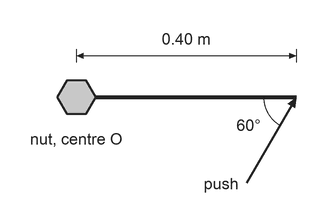
The push needed is about
- 473 marks
Question 47
(Hypothetical data.) A gardener holds a loaded wheelbarrow at rest, with its legs just off the ground, by lifting its handles vertically. The wheelbarrow and its load of bricks have a total mass of . Their centre of gravity G is behind the axle of the wheel, and the gardener's hands are behind the axle, both distances being measured horizontally, as shown. Take .
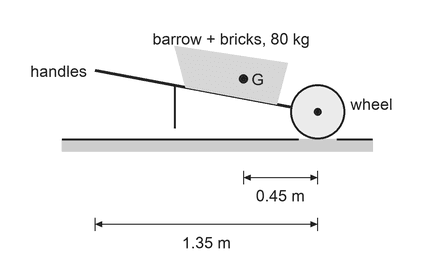
(a) Find the upward force the gardener must apply.
(b) Find the upward force of the ground on the wheel.
(c) The bricks are moved forward so that G is only behind the axle. Find the new force the gardener needs, and explain why a load is best placed close to the wheel.
- 481 mark
Question 48
(Hypothetical data.) A driver turns a steering wheel of diameter by pushing up on one side of the rim with one hand and pulling down on the opposite side with the other hand. Each hand applies a force of along the rim, at the two ends of a horizontal diameter. The resultant force on the wheel and the total moment of the two forces about its centre are
- 493 marks
Question 49
(Hypothetical data.) A student holds a dumb-bell of mass in one hand, with the upper arm vertical and the forearm horizontal, as shown. The forearm and hand together have a mass of , and their centre of gravity G is from the elbow joint E. The dumb-bell is from E. The biceps muscle pulls vertically upward on the forearm at a point from E. Take .
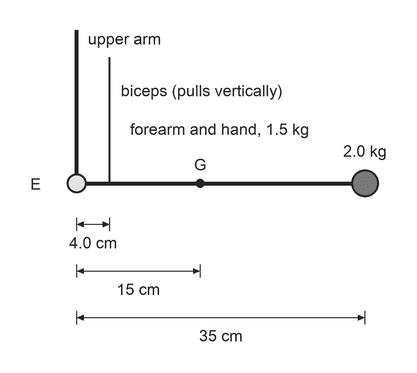
(a) Find the force exerted by the biceps.
(b) Find the size and direction of the force exerted on the forearm at the elbow joint.
(c) The biceps force is many times the weight of the dumb-bell. Explain why.
- 502 marks
Question 50
Explain why bullets fired from a rifle leave a clean hole in window panes.
- 511 mark
Question 51
The blades of a fan continue to rotate even when the current is switched off. Why?
- 522 marks
Question 52
Athletes run some distance before taking a long jump. Why?
- 531 mark
Question 53
Why are mudguards used over the rotating wheels of the vehicles?
- 542 marks
Question 54
A person falling from a certain height receives more severe injuries if he falls on a cemented floor than on a heap of sand. Why?
- 552 marks
Question 55
While catching a cricket ball, the player lowers his hands. Why?
- 561 mark
Question 56
If action and reaction are equal and opposite, then why do they not cancel each other?
- 572 marks
Question 57
When an object falls to the Earth, the Earth also moves up to meet it. Why is the Earth's motion not noticeable?
- 581 mark
Question 58
In order to swim, a person pushes the water backward, why?
- 592 marks
Question 59
Suppose a boy is standing at the centre of a frictionless ice floor. How can he reach the edge of the floor?
- 602 marks
Question 60
When a horse pulls a cart, the cart pulls the horse backwards. Then explain how the motion takes place.
- 611 mark
Question 61
Explain why a horse cannot pull a cart and run in empty space.
- 622 marks
Question 62
It is easier to pull than to push a lawn roller, why?
- 632 marks
Question 63
Which of the observers below are inertial and which are non-inertial?
(a) A child revolving in a giant wheel.
(b) A driver in a sports car along a straight road at 200 km/h.
(c) The pilot of an aeroplane which is taking off.
(d) A cyclist negotiating a sharp turn.
- 642 marks
Question 64
Can a sailboat be propelled by air blown at the sails from a fan attached to the boat?
- 651 mark
Question 65
When a soda water bottle falls freely, will the gas bubbles rise in water?
- 662 marks
Question 66
A person experiences a loss of weight at the start of a lift going down but not when the lift is in uniform motion. Why?
- 671 mark
Question 67
What is the angle between two forces when the resultant is (i) maximum and (ii) minimum?
- 682 marks
Question 68
What is the angle between two equal forces such that the magnitude of their resultant is equal to either of them?
- 692 marks
Question 69
At what angle should two forces act such that their vector sum and vector difference are equal in magnitude?
- 702 marks
Question 70
The resultant of two forces and is . What is the angle between the forces?
- 712 marks
Question 71
Three forces 3 N, 4 N and 9 N are acting at a point. Is it possible to produce equilibrium?
- 722 marks
Question 72
Can two unequal forces acting at a point be in equilibrium? Can three?
- 732 marks
Question 73
Give an example when a single force cannot replace two forces acting on a body.
- 743 marks
Question 74
A constant force acting on a body of mass 6 kg changes its speed from to in 50 s. The direction of motion of the body remains unchanged. What is the magnitude and direction of force?
- 753 marks
Question 75
On a planet , a stone dropped from rest falls through a distance 8 m in 2 s. (a) What is the value of on the planet? (b) What is the weight of a 100 kg on the planet ?
- 763 marks
Question 76
A body of mass 20 kg is moving with a velocity of . Find the force required to stop it (a) in 5 s and (b) in a distance of 250 m?
- 773 marks
Question 77
A bullet weighing 20 g is fired with a velocity of into a wooden plank of 3 cm thick. The bullet emerges out with a velocity of . Find the average resistance offered by the wood.
- 783 marks
Question 78
A bullet of mass 5 g moving with a velocity of hits a wall and pierces to a depth of 15 mm. Find the force exerted by the wall on the bullet.
- 793 marks
Question 79
A constant force of 144 N acts for 3 s on a mass of 16 kg and then ceases to act. Find the distance covered by the body during the next 3 seconds.
- 803 marks
Question 80
A vehicle having a mass of 500 kg is moving with a speed of 10 m/s. Sand is dropped into it at the rate of 10 kg/min. What force is needed to keep the vehicle moving with a uniform speed?
- 813 marks
Question 81
A cricket ball of mass 150 g is moving with a velocity of 12 m/s and is hit by a bat so that the ball is turned back with a velocity of 20 m/s. The force of blow acts for 0.01 s on the ball. Find the average force exerted by the bat on the ball.
- 823 marks
Question 82
A disc of mass 10 g is kept floating horizontally by throwing 10 marbles per second against it from below, each of mass 5 g. Find the velocity with which the marbles are striking the disc, assuming that they strike normally and rebound with the same speed.
- 833 marks
Question 83
A balloon of total mass 180 kg just floats motionless in the Earth's surface. If 60 kg of load in it is thrown out, with what acceleration will the balloon start to rise?
- 843 marks
Question 84
A machine gun fires 1800 bullets per minute into a target. The velocity of bullet is and mass of each bullet is 20 g. Find the steady force experienced by the target.
- 853 marks
Question 85
A jet of water issuing horizontally at the rate of strikes a vertical wall with a velocity and returns with half the original velocity. What is the force exerted by the jet on the wall?
- 863 marks
Question 86
A body of mass 5 kg is acted upon by two forces 3 N and 4 N inclined to the horizontal at and as shown in the given figure. What is the acceleration of the body?
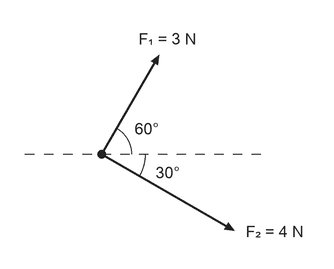
- 873 marks
Question 87
What is the force required to produce an acceleration of , on a body of weight 9.8 N?
- 883 marks
Question 88
The driver of a three wheeler moving with a speed of 36 km/h sees a child standing in the middle of the road and brings his vehicle to rest in 4 s just in time to save the child. What is the average retarding force on the vehicle? The mass of the three wheeler is 400 kg and the mass of the driver is 65 kg.
- 893 marks
Question 89
A cricket ball of mass 100 g moving with a velocity of is brought to rest by a player in 0.1 s. Find the impulse of the ball and the average force applied by the player.
- 903 marks
Question 90
A cricket ball weighing 200 g moving horizontally at is hit straight back with a velocity of . Find the impulse. If the time of contact of the ball and the bat is 1/20 s. What is the impulsive force applied by the bat?
- 913 marks
Question 91
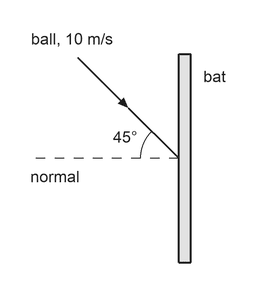
A tennis ball of mass 100 g strikes a bat held vertically at an angle to the normal, with a velocity of 10 m/s and gets deflected. Calculate the impulse on the bat.
- 923 marks
Question 92
What is the average force needed to stop a hammer with 25 N s momentum in 0.05 s?
- 933 marks
Question 93
The mass of a volleyball is 0.35 kg. In a match, the ball is spiked so that its incoming velocity of 2 m/s is changed to an outgoing velocity of 22 m/s. What impulse does the player apply to the ball?
- 943 marks
Question 94
A 50 kg skater is standing still in front of a wall. By pushing the wall, he propels himself backward with a velocity of 1.2 m/s. If his hands were in contact with the wall for 0.70 second, find the impulse and impulsive force.
- 953 marks
Question 95
A rubber ball of mass 0.05 kg falls from a height of 1 m and rebounds to a height of 0.5 m. Find the impulse and the average force between the ball and the ground, if the time during which they are in contact was 0.1 s.
- 963 marks
Question 96
A ball of mass (1/2) kg moving with a velocity of strikes a wall normally and bounce back with the same speed. If the time of contact between the ball and the wall was 1 millisecond, then what average force in newton is exerted by the wall on the ball?
- 973 marks
Question 97
A bullet moving with a velocity of was brought to rest in 0.01 s by applying a force of 2000 N. Find this impulse and the mass of the bullet.
- 983 marks
Question 98
The breaking strength of a rope is 8 kg wt. How can an object of weight 10 kg wt be lowered using this rope?
- 993 marks
Question 99
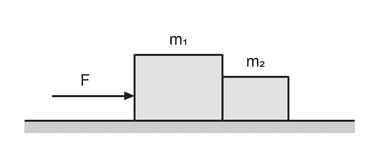
On a frictionless horizontal surface, two blocks of masses kg and kg are placed in contact as shown in the given figure. What is the magnitude of the acceleration of the system when a horizontal force of 150 N is applied to ? What is the magnitude of the contact force between the two blocks?
- 1003 marks
Question 100
A mass of 10 kg is suspended from a string, the other end of which is held in hand. Find the tension in the string when the hand is moved up with a uniform acceleration of ().
- 1013 marks
Question 101
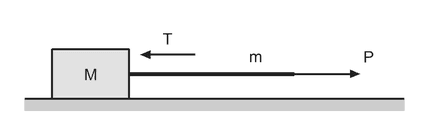
A block of mass is pulled along a horizontal frictionless surface by a rope of mass . Force is exerted at one end of the rope. Find the force which the rope exerts on the block.
- 1023 marks
Question 102
The horizontal acceleration of a truck is . A metal bob is suspended from the roof of the truck near the driver. What is the angle through which the bob is displaced?
- 1033 marks
Question 103
A man of mass of 90 kg is standing in an elevator whose cable broke suddenly. If the elevator falls freely, calculate the force exerted by the floor on the man.
- 1043 marks
Question 104
The mass of the block shown in the given figure is 0.5 kg. Both the masses and are kept in the elevator which is descending with an acceleration of . What is the force exerted by the block on block ?

- 1053 marks
Question 105
In an elevator, a man of mass 80 kg stands on a spring balance. When it starts to move, the scale reads 700 N. Calculate the acceleration of the elevator.
- 1063 marks
Question 106
An elevator has a mass of 4000 kg. What is the acceleration of the elevator when the tension in the supporting cable is 48000 N? []
- 1073 marks
Question 107
A man weighing 50 kg is standing on a lift moving down with an acceleration of . What is the apparent weight of the man? ()
- 1083 marks
Question 108
A lift has a mass of 1000 kg. Calculate the force exerted by the cable used to suspend the elevator if it accelerates (i) upward at and (ii) downward at .
- 1093 marks
Question 109
A body of mass 2 kg moving with a velocity of collides with another body of mass 1 kg moving with a velocity of in the opposite direction. After collision they stick together. Calculate their common velocity.
- 1103 marks
Question 110
A spacecraft of mass is moving with velocity in free space when it explodes and breaks into two. After the explosion, a mass of the spacecraft is left stationary. What is the velocity of the other part?
- 1113 marks
Question 111
A shell of mass 25 kg moving with a velocity of explodes and bursts into two portions of mass 20 kg and 5 kg respectively. If the former be brought to rest owing to explosion, find the velocity of the latter.
- 1123 marks
Question 112
A 30 g bullet leaves a rifle with a velocity of 300 m/s and the rifle recoils with a velocity of 0.60 m/s. Find the mass of the rifle.
- 1133 marks
Question 113
A hunter has a machine gun that can fire 50 g bullets with a velocity of . A 40 kg tiger springs at him with a velocity of . How many bullets must the hunter fire into the tiger in order to stop him in the track?
- 1143 marks
Question 114
A gun weighing 10 kg fires a bullet of 30 g with a velocity of . With what velocity does the gun recoil? What is the resultant momentum of the gun and the bullet before firing and after firing?
- 1153 marks
Question 115
A neutron having a mass kg and moving at collides with a deuteron at rest and sticks to it. If the mass of deuteron is kg, find the speed of the combination.
- 1163 marks
Question 116
While launching rocket of mass kg, a force of N is applied for 20 s. What is the velocity attained by the rocket at the end of 20 s?
- 1173 marks
Question 117
A rocket with lift-off mass 20000 kg is blasted upward with an initial acceleration of . Calculate the initial thrust of the blast.
- 1183 marks
Question 118
The rate of consumption of fuel per second of a rocket is 50 g/s. The velocity of the exhausting gas is . Calculate the force exerted by the gas on the rocket.
- 1193 marks
Question 119
What is the resultant of two forces 4 N and 6 N acting in directions inclined to each other at ?
- 1203 marks
Question 120
Two forces are acting at an angle of to each other. The resultant of the two forces is perpendicular to the smaller force. If the greater force is 60 N, find the smaller force using the triangle law of forces.
- 1213 marks
Question 121
The greatest and least resultant of two forces acting at a point is 29 kg wt and 5 kg wt respectively. If each force is increased by 3 kg wt, find the magnitude of the resultant of two new forces when acting at right angles to each other.
- 1223 marks
Question 122
and are two forces acting on a particle. When the first force is increased by 20 kg wt and the second is doubled, the direction of the resultant remains unaltered. Find .
- 1233 marks
Question 123
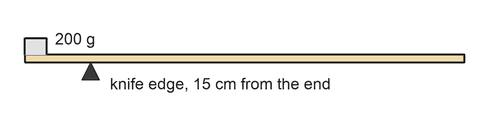
A mass of 200 g is placed at one end of a uniform metre scale. The scale balances in a knife edge at a point 15 cm from the end. Find the weight of the metre scale.
- 1241 mark
Question 124
A man getting down a running bus falls forward because
- 1251 mark
Question 125
A person is standing in an elevator. In which situation he finds his weight less than actual weight?
- 1261 mark
Question 126
A force vector applied on a mass is represented as and accelerates with . What will be the mass of the body?
- 1271 mark
Question 127
If a person with a spring balance and a body hanging from it goes up and up in an aeroplane, then the reading of the weight of the body as indicated by the spring balance will
- 1281 mark
Question 128
A plumb line is suspended from a ceiling of a car moving with horizontal acceleration of . What will be the angle of inclination with vertical?
- 1291 mark
Question 129
Sand is being dropped on a conveyor belt at the rate of kg/s. The force necessary to keep the belt moving with a constant velocity of m/s will be
- 1301 mark
Question 130
A man is standing at a spring platform. Reading of spring balance is 60 kg wt. If man jumps outside platform, then reading of spring balance
- 1311 mark
Question 131
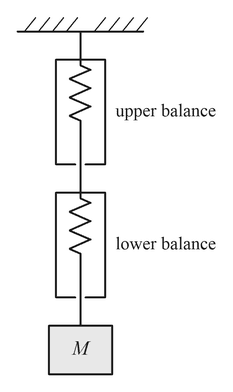
A light spring balance hangs from the hook of the other light spring balance and a block of mass kg hangs from the former one. Then the true statement about the scale reading is
- 1321 mark
Question 132
An explosion blows a rock into three parts. Two parts go off at right angle to each other. These two are, 1 kg first part moving with a velocity of and 2 kg second part moving with a velocity of . If the third part flies off with a velocity of , its mass would be
- 1331 mark
Question 133
For a body moving with relativistic speed, if the velocity is doubled, then
- 1341 mark
Question 134
A batsman hits back a ball of mass 0.15 kg straight in the direction of the bowler without changing its initial speed of . If the ball moves linearly, then the impulse imparted on it (in N s) is
- 1351 mark
Question 135
A body, whose momentum is constant, must have constant
(A) Force
(B) Velocity
(C) Acceleration
(D) All of these
- 1361 mark
Question 136
The motion of a rocket is based on the principle of conservation of
- 1371 mark
Question 137
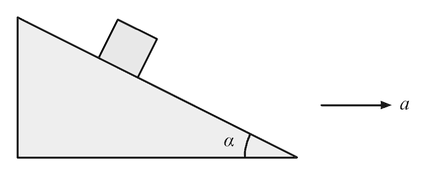
A block is kept on a frictionless inclined surface with angle of inclination ''. The incline is given an acceleration '' to keep the block stationary. Then is equal to
- 1381 mark
Question 138
Which of the four arrangements in the given figure correctly shows the vector addition of two forces and to yield the third force ?

- 1391 mark
Question 139
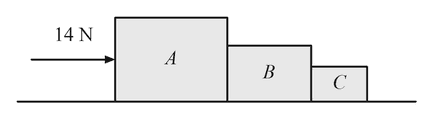
Three blocks , and of masses 4 kg, 2 kg and 1 kg respectively, are in contact on a frictionless surface, as shown in the figure. If a force of 14 N is applied on the 4 kg block, then the contact force between and is
- 1401 mark
Question 140
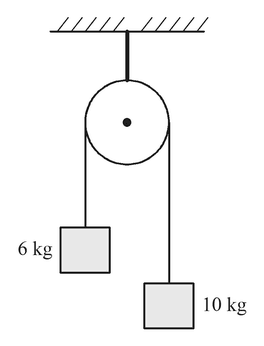
A light string passes over a frictionless pulley. To one of its ends, a mass of 6 kg is attached. To its other end, a mass of 10 kg is attached. The tension in the thread will be
- 1411 mark
Question 141
Three blocks with masses , and are connected by strings, as shown in the given figure. After an upward force is applied on block , the masses move upward at constant speed . What is the net force on the block of mass ( is the acceleration due to gravity)?
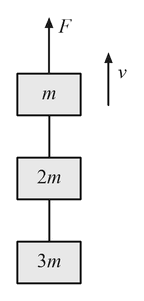
- 1421 mark
Question 142
Two blocks A and B of masses and , respectively, are connected by a massless and inextensible string. The whole system is suspended by a massless spring as shown in the given figure. The magnitudes of acceleration of A and B, immediately after the string is cut, are respectively

- 1431 mark
Question 143
A block of mass '' is connected to another block of mass '' by a spring (massless) of spring constant ''. The blocks are kept on a smooth horizontal plane. Initially the blocks are at rest and the spring is unstretched. Then a constant force '' starts acting on the block of mass '' to pull it. Find the force on the block of mass ''.

- 1441 mark
Question 144
A mass of 10 kg is suspended vertically by a rope from the roof. When a horizontal force is applied on the rope at some point, the rope deviates at an angle of at the roof point. If the suspended mass is at equilibrium, the magnitude of the force applied is ()

- 1451 mark
Question 145
A man (mass = 50 kg) and his son (mass = 20 kg) are standing on a frictionless surface facing each other. The man pushes his son so that he starts moving at a speed of with respect to the man. The speed of the man with respect to the surface is
- 1461 mark
Question 146
A bullet of mass 20 g has an initial speed of , just before it starts penetrating a mud wall of thickness 20 cm. If the wall offers a mean resistance of , the speed of the bullet after emerging from the other side of the wall is close to
- 1471 mark
Question 147
A particle of mass is moving in a straight line with momentum . Starting at time , a force acts in the same direction on the moving particle during time interval so that its momentum changes from to . Here, is a constant. The value of is
- 1481 mark
Question 148
A mass of 10 kg is suspended by a rope of length 4 m, from the ceiling. A force is applied horizontally at the midpoint of the rope such that the top half of the rope makes an angle of with the vertical. Then, equals (Take and the rope to be massless)
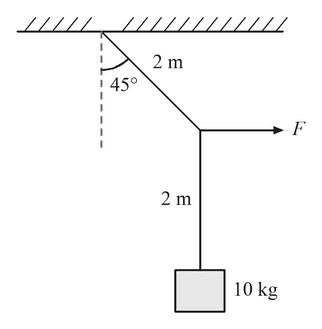
- 1491 mark
Question 149
Two bodies of mass 4 kg and 6 kg are tied to the ends of a massless string. The string passes over a pulley which is frictionless. The acceleration of the system in terms of acceleration due to gravity () is
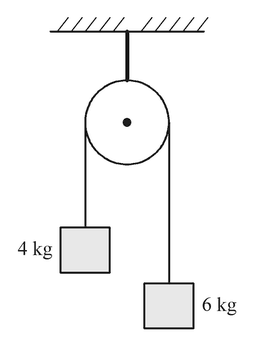
- 1501 mark
Question 150
Time period of a simple pendulum is inside a lift when the lift is stationary. If the lift moves upwards with an acceleration , the time period of pendulum will be
- 1511 mark
Question 151
Two billiard balls of equal mass 30 g strike a rigid wall with same speed of 108 kmph but at different angles. If the balls get reflected with the same speed, then the ratio of the magnitude of impulses imparted to ball '' and ball '' by the wall along '' direction is

- 1521 mark
Question 152
A force N acts on a body of mass 5 kg. If the body starts from rest, its position vector at time s, will be
- 1531 mark
Question 153
The initial mass of a rocket is 1000 kg. Calculate at what rate the fuel should be burnt so that rocket is given an acceleration of . The gases come out at a relative speed of with respect to the rocket [Use ]
- 1541 mark
Question 154
Two blocks of masses 3 kg are connected by a metal wire going over a smooth pulley. The breaking stress of the metal is . What is the minimum radius of the wire (take )?
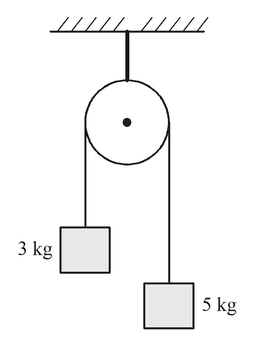
- 1551 mark
Question 155
A ball of mass 0.15 kg is dropped from a height 10 m, strikes the ground and rebounds to the same height. The magnitude of impulse imparted to the ball is () nearly
- 1561 mark
Question 156
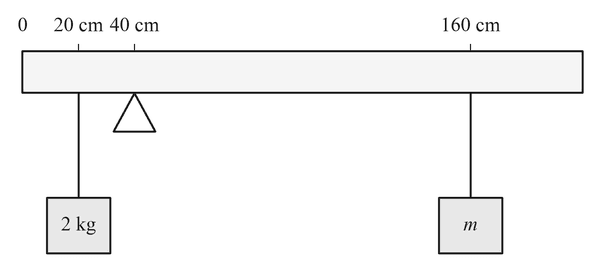
A uniform rod of length 200 cm and mass 500 g is balanced on a wedge placed at 40 cm mark. A mass of 2 kg is suspended from the rod at 20 cm and another unknown mass '' is suspended from the rod at 160 cm mark as shown in the figure. Find the value of '' such that the rod is in equilibrium ().
- 1571 mark
Question 157
Read the assertion and reason carefully to mark the correct option out of the options given below:
Assertion: A man in a closed cabin falling freely does not experience gravity.
Reason: Inertial and gravitational mass have equivalence.
- 1581 mark
Question 158
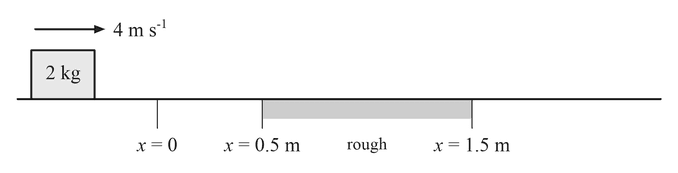
A block of mass 2 kg is moving on a horizontal surface with a speed of entering a rough surface ranging from m to m. The retarding force in this range of rough surface is related to distance by , where . The speed of the block as it crosses the rough surface will be
- 1591 mark
Question 159
A block of mass placed inside a box descends vertically with acceleration . The block exerts a force equal to one-fourth of its weight on the floor of the box. The value of will be
- 1601 mark
Question 160
Given below are two statements
Statement I: An elevator can go up or down with uniform speed when its weight is balanced with the tension of its cable.
Statement II: Force exerted by the floor of an elevator on the foot of a person standing on it is more than his/her weight when the elevator goes down with increasing speed.
In the light of the above statements, choose the correct answer from the options given below.
- 1611 mark
Question 161
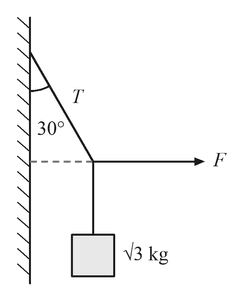
A block of mass kg is attached to a string whose other end is attached to the wall. An unknown force is applied as shown in the given figure, so that the string makes an angle of with the wall. The tension in the string is ()
- 1621 mark
Question 162
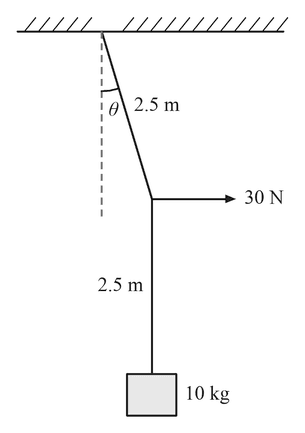
A mass of 10 kg is suspended vertically by a rope of length 5 m from the roof. A force of 30 N is applied at the middle point of the rope in the horizontal direction. The angle made by the upper half of the rope with the vertical is . The value of is ______ (given ).
- 1631 mark
Question 163
A lift of mass kg is descending with speed of . Its supporting cable begins to slip thus allowing it to fall with a constant acceleration of . The kinetic energy of the lift at the end of fall through a distance of 6 m will be ______ kJ.