
Question 33 marksMedium
In a version of Galileo's experiment, a small ball is released from rest on a smooth incline at a height of above the level floor. It rolls down, across the floor and up a second smooth incline. Energy losses are negligible, so the ball always rises to the height from which it was released. When the second incline makes with the horizontal, the ball travels along it before stopping, as in figure (a). (Hypothetical data.) The second incline is then lowered to , as in figure (b).
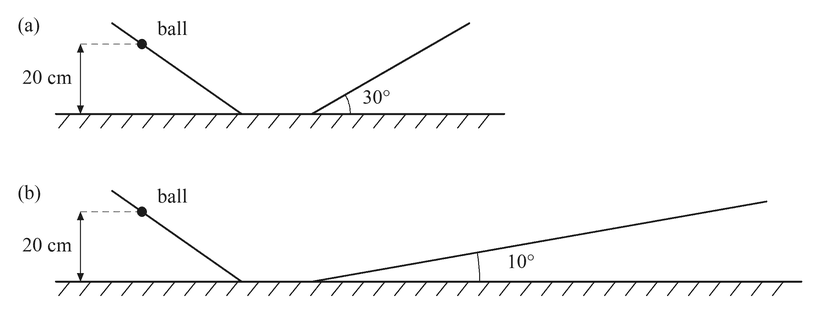
(a) How far along the incline does the ball travel before it stops?
(b) What would happen if the second incline were lowered all the way to the horizontal? What does this show about force and motion?