
Opening your dashboard
Class 11 Maths Chapter 22: Probability Solutions
119 textbook questions with step-by-step answers, free to read, for ISC 2026-27.
Get talked through Ch 22, not just shown the answer
Reading a finished solution is not the same as being able to do it. The AI tutor takes one question at a time and works it with you, in your own words, until you can.
- Ask it out loud, in your own words
- It gives you the next step, not the answer
- Stuck on part (ii)? Start there
119 questions with solutions
1–3 marks · Mixed difficulty
The first 12 solutions are on this page. This chapter is a long one, so the rest open on their own page to keep this one quick to load.
- 13 marks
Question 1
What do you mean by Random Experiment? Give two illustrations. Define sample space associated with a random experiment. Give an example.
Solve with AIWritten solution
Solution:
Concept: Probability studies experiments whose result depends on chance. Two ideas come first: the random experiment itself and the list of everything it can produce.
Step 1 — Say what a random experiment is. An experiment is called a random experiment when it satisfies three conditions:
- it can be repeated any number of times under the same conditions;
- all its possible outcomes are known in advance;
- the outcome of any particular trial cannot be predicted with certainty.
Step 2 — Give two illustrations. Two everyday random experiments are described below.
- Tossing a coin: we know the result will be a head or a tail, but we cannot say which one will show on a particular toss.
- Rolling a die: we know the uppermost face will show one of , but we cannot say which one before the roll.
Step 3 — Define the sample space. The set of all possible outcomes of a random experiment is called its sample space, and it is usually denoted by . Each element of is called a sample point.
Step 4 — Give an example of a sample space. When a die is rolled once, every face from to can turn up and nothing else can, so the sample space is
Similarly, for one toss of a coin the sample space is , where stands for head and for tail.
Therefore, a random experiment is a repeatable experiment whose outcomes are known but unpredictable (for example, tossing a coin or rolling a die), and its sample space is the set of all its possible outcomes, such as for one roll of a die.
- 23 marks
Question 2
What is the resulting sample space if
(i) one coin is tossed;
(ii) two coins are tossed simultaneously;
(iii) three coins are tossed simultaneously?
Solve with AIWritten solution
Solution:
Concept: A random experiment is an experiment whose possible outcomes are all known in advance, but whose actual outcome in any one trial cannot be predicted. The set of all its possible outcomes is the sample space , and an event is a subset of .
Write for a head and for a tail. When several coins are tossed, an outcome is written as a string of letters, the first letter for the first coin, the second for the second coin, and so on.
Step 1 — Part (i): one coin. A single coin can land only as a head or a tail, so the sample space has outcomes:
Step 2 — Part (ii): two coins. Each of the results of the first coin can go with each of the results of the second coin, so there are outcomes:
Notice that and are different outcomes: in the first coin shows the head, in the second coin does.
Step 3 — Part (iii): three coins. Each of the outcomes for the first two coins can go with or on the third coin, so there are outcomes:
Therefore, (i) ; (ii) ; (iii) .
- 33 marks
Question 3
Describe the sample space of this experiment:
(i) One die is rolled.
(ii) Two dice are rolled.
Solve with AIWritten solution
Solution:
Concept: A random experiment is an experiment whose possible outcomes are all known in advance, but whose actual outcome in any one trial cannot be predicted. The set of all its possible outcomes is the sample space , and an event is a subset of .
Step 1 — Part (i): one die. The uppermost face of a die can show any one of the numbers to , so the sample space has outcomes:
Step 2 — Part (ii): two dice. We write an outcome as an ordered pair , where is the number on the first die and the number on the second die. Each of the numbers on the first die can go with each of the numbers on the second die, so there are ordered pairs. The table lists them all; the row gives the first die and the column the second die:
First die second die So , the set of these ordered pairs.
Watch out: The pairs and are different outcomes, because the dice are different (the first die shows in one and in the other).
Therefore, (i) ; (ii) is the set of the ordered pairs with , as listed in the table.
- 43 marks
Question 4
Describe the sample space:
(i) A coin is tossed twice. If the second throw results in a tail, a die is thrown.
(ii) A coin is tossed twice. If the second throw results in a head, a die is thrown, otherwise a coin is tossed.
(iii) A coin is tossed. If it results in a head, a die is thrown. If the die shows up an even number, the die is thrown again.
Solve with AIWritten solution
Solution:
Concept: A random experiment is an experiment whose possible outcomes are all known in advance, but whose actual outcome in any one trial cannot be predicted. The set of all its possible outcomes is the sample space , and an event is a subset of .
In each part we follow the rules of the experiment one stage at a time, the way a tree diagram does. An outcome is written as the results in order: for example, means head, then tail, then on the die.
Step 1 — Part (i): find what follows each pair of tosses. The two tosses give , , or . The die is thrown only when the second toss is a tail, that is after and after ; each of these then splits into outcomes. After and the second toss is a head, so the experiment stops there. Counting gives outcomes:
Step 2 — Part (ii): find what follows each pair of tosses. After and (second toss a head) a die is thrown, so there are outcomes each. After and (second toss a tail) a coin is tossed again, so there are outcomes each. Counting gives outcomes:
Step 3 — Part (iii): follow the coin and then the die. If the coin shows a tail, nothing more is done, so is one outcome. If it shows a head, the die is thrown. An odd number (, or ) ends the experiment with the outcome , or . An even number (, or ) means the die is thrown again, and each of these splits into outcomes, for example . Counting gives outcomes:
Note: The printed answer to part (i) leaves out . The tosses tail-then-head are a possible outcome (the second toss is not a tail, so no die is thrown and the experiment ends), so the sample space has outcomes, not .
Therefore, (i) ( outcomes); (ii) ( outcomes); (iii) ( outcomes).
- 53 marks
Question 5
A five-sided spinner is spun and a coin is tossed.
(i) Show the combined outcomes in a space diagram and in a tree diagram.
(ii) List the combined outcomes and state the number of equally likely combined outcomes.
Solve with AIWritten solution
Solution:
Concept: When two experiments are done together, a combined outcome is a pair (result of the first, result of the second). A space diagram shows every pair as one dot on a grid; a tree diagram shows the first experiment's results as branches and the second's as smaller branches at the end of each.
Step 1 — Part (i): draw the space diagram. The spinner's five sectors show the scores and the coin shows or . We put the coin results along the horizontal axis and the spinner scores up the vertical axis, and mark one dot for each pair:

For example, the dot above at height is the outcome .
Step 2 — Part (i): draw the tree diagram. The first set of branches shows the coin ( or ); from the end of each, five branches show the spinner score. Following one path from left to right gives one combined outcome:
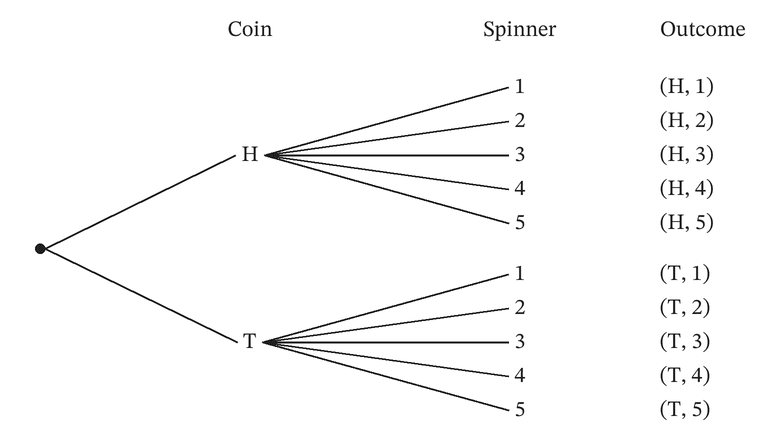
Step 3 — Part (ii): list and count the outcomes. Reading the dots (or the ends of the tree) gives the combined outcomes:
There are results for the coin and for the spinner, so the number of combined outcomes is . They are equally likely because each sector of the spinner and each face of the coin is equally likely.
Therefore, the combined outcomes are , , , , , , , , , , which are 10 equally likely outcomes.
- 63 marks
Question 6
In a bag there are three balls; one red, one blue and one yellow. A ball is selected, the colour is recorded and the ball is replaced. A second ball is then selected and the colour is recorded.
(i) Show in a space diagram and in a tree diagram all the possible combined outcomes.
(ii) List these combined outcomes and state the number of equally likely combined outcomes.
Solve with AIWritten solution
Solution:
Concept: When two experiments are done one after the other, a combined outcome is the ordered pair (first result, second result). Because the first ball is put back, the second draw again has all three colours available.
Write for red, for blue and for yellow.
Step 1 — Part (i): draw the space diagram. We put the colour of the first ball along the horizontal axis and the colour of the second ball up the vertical axis, and mark one dot for each pair:
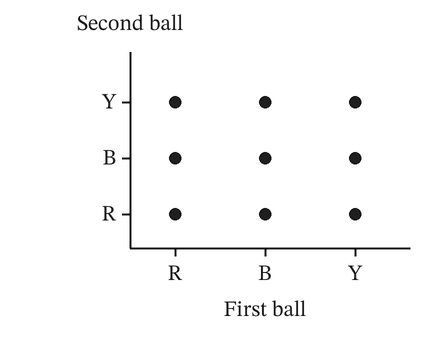
Step 2 — Part (i): draw the tree diagram. The first set of branches shows the first ball; from the end of each, three branches show the second ball:
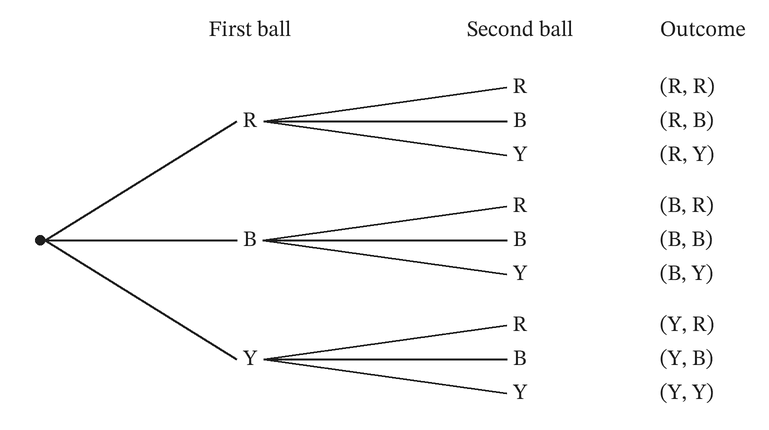
Step 3 — Part (ii): list and count the outcomes. Reading the diagram gives the combined outcomes:
Each of the colours for the first ball can go with each of the colours for the second ball, so there are combined outcomes. They are equally likely because each ball is equally likely to be selected on each draw.
Therefore, the combined outcomes are , , , , , , , , , which are 9 equally likely outcomes.
- 73 marks
Question 7
Satish and Mukesh who live in London wish to go on a holiday to France. They can travel to the coast by car, coach or train, and then cross the channel by ferry, train, helicopter or hovercraft.
(i) In a space diagram and in a tree diagram show all the combined outcomes of the different ways they could travel to France.
(ii) How many different ways could they travel?
Solve with AIWritten solution
Solution:
Concept: If a first stage can be done in ways and, after it, a second stage can be done in ways, the two stages together can be done in ways. A space diagram or a tree diagram shows all these combined ways.
Step 1 — Part (i): draw the space diagram. We put the way of reaching the coast along the horizontal axis and the way of crossing the channel up the vertical axis, and mark one dot for each combined route:
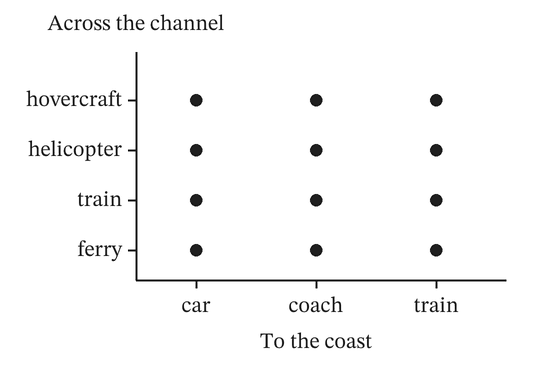
Step 2 — Part (i): draw the tree diagram. The first set of branches shows the journey to the coast; from the end of each, four branches show the channel crossing. Each path from left to right is one route:

Step 3 — Part (ii): count the routes. There are ways to reach the coast, and each of them can be followed by any of the ways of crossing the channel. So the number of ways is
This agrees with the dots in the space diagram and the paths in the tree.
Therefore, they could travel to France in 12 different ways.
- 83 marks
Question 8
From a group of 2 men and 3 women, two persons are selected. Describe the sample space of the experiment. If is the event in which one man and one woman are selected, then which are the cases favourable to ?
Solve with AIWritten solution
Solution:
Concept: A random experiment is an experiment whose possible outcomes are all known in advance, but whose actual outcome in any one trial cannot be predicted. The set of all its possible outcomes is the sample space , and an event is a subset of .
Step 1 — Name the people. Let the men be and the women . Selecting two persons means choosing a pair; the order of choosing does not matter, so and are the same selection.
Step 2 — List the sample space. We pair each person with every person after them in the list :
The number of pairs agrees with the number of ways of choosing persons out of :
Step 3 — Find the cases favourable to . The event needs one man and one woman, so we pair each of the men with each of the women; that makes cases:
The other selections (, , , ) have two persons of the same sex, so they are not favourable.
Therefore, ( outcomes), and the cases favourable to are ( cases).
- 93 marks
Question 9
A coin is tossed. If it results in a head, a coin is tossed, otherwise a die is thrown. Describe the following events:
(i) : getting at least one head;
(ii) : getting an even number;
(iii) : Getting a tail;
(iv) : getting a tail and an odd number.
Solve with AIWritten solution
Solution:
Concept: A random experiment is an experiment whose possible outcomes are all known in advance, but whose actual outcome in any one trial cannot be predicted. The set of all its possible outcomes is the sample space , and an event is a subset of .
Step 1 — Write down the sample space. If the first toss is a head, the coin is tossed again and the result is or . If the first toss is a tail, a die is thrown and the result is one of . So
Step 2 — Part (i): at least one head. A head can appear only on the coin; in the outcomes to there is no head at all. Both outcomes that begin with a head qualify:
Step 3 — Part (ii): an even number. A number appears only when the die is thrown, and the even faces are :
Step 4 — Part (iii): a tail. A tail shows in every outcome that starts with , and also in , where the second toss is a tail:
Step 5 — Part (iv): a tail and an odd number. We need a tail and an odd face or , which happens only on the branch where the first toss is a tail:
Therefore, , , and .
- 103 marks
Question 10
A coin and a die are tossed. Describe the following events.
(i) : getting a head and an even number;
(ii) : getting a prime number;
(iii) : getting a tail and an odd number;
(iv) : getting a head or a tail.
Solve with AIWritten solution
Solution:
Concept: A random experiment is an experiment whose possible outcomes are all known in advance, but whose actual outcome in any one trial cannot be predicted. The set of all its possible outcomes is the sample space , and an event is a subset of .
Step 1 — Write down the sample space. Each of the faces of the coin can go with each of the faces of the die, so there are outcomes. Writing for "head and ", and so on:
Step 2 — Part (i): a head and an even number. We need on the coin together with , or on the die:
Step 3 — Part (ii): a prime number. The prime numbers on a die are (note that is not prime). The coin may show either face:
Step 4 — Part (iii): a tail and an odd number. We need on the coin together with , or :
Step 5 — Part (iv): a head or a tail. Every outcome has either a head or a tail on the coin, so this event is the whole sample space (a sure event):
Therefore, , , and , the whole sample space.
- 113 marks
Question 11
A fair coin is tossed. If it shows a head, we draw a ball from a bag consisting of 3 distinct red and 4 distinct black balls, if it shows a tail, we throw a fair die. Draw a tree diagram to show all the possible outcomes and obtain the sample space. What are sets representing the following events: (i) the ball drawn is black; (ii) the coin shows tail.
Solve with AIWritten solution
Solution:
Concept: A random experiment is an experiment whose possible outcomes are all known in advance, but whose actual outcome in any one trial cannot be predicted. The set of all its possible outcomes is the sample space , and an event is a subset of .
Name the red balls and the black balls (they are distinct, so each is a separate outcome).
Step 1 — Draw the tree diagram. The first branches show the coin. After a head, seven branches show the ball drawn; after a tail, six branches show the face of the die:

Step 2 — Write down the sample space. Each path of the tree gives one outcome, so there are outcomes:
Step 3 — Part (i): the ball drawn is black. A ball is drawn only after a head, and it is black for to :
Step 4 — Part (ii): the coin shows tail. After a tail the die is thrown, so these are the six outcomes on the tail branch:
Therefore, ; the event "ball drawn is black" is and the event "coin shows tail" is .
- 123 marks
Question 12
Two dice are rolled. is the event that the sum of the numbers shown on the two dice is 5. is the event that at least one of the dice shows up a 3. Are the two events and (i) mutually exclusive, (ii) exhaustive? Give arguments in support of your answer.
Solve with AIWritten solution
Solution:
Concept: Two events and are mutually exclusive when they cannot happen together; in symbols, . They are exhaustive when between them they cover every outcome; in symbols, .
Step 1 — Write down the sample space. An outcome is an ordered pair : on the first die and on the second. There are such pairs, so .
Step 2 — List the event . The pairs whose numbers add up to are
Step 3 — List the event . The pairs with a on at least one die are the pairs with and the pairs with , with counted only once, which leaves outcomes in :
Step 4 — Part (i): test for mutually exclusive events. We look for outcomes common to and . The pairs and add up to and contain a :
Since , the two events can happen together, so they are not mutually exclusive.
Step 5 — Part (ii): test for exhaustive events. We count the outcomes in by adding and removing the overlap:
Since , the union is not the whole sample space; for example, is in neither event. So and are not exhaustive. The Venn diagram shows the counts:

Therefore, (i) and are not mutually exclusive, because ; (ii) they are not exhaustive, because , while .
- 133 marks
Question 13
What is the probability of getting:

(i) a head
(ii) a 6
(iii) a prime number?
- 143 marks
Question 14
Ramesh chooses a date at random in April for a party. Calculate the probability that he chooses:
(i) a Saturday
(ii) a Sunday
(iii) a Saturday or a Sunday.
Day Dates in April M 5, 12, 19, 26 T 6, 13, 20, 27 W 7, 14, 21, 28 T 1, 8, 15, 22, 29 F 2, 9, 16, 23, 30 S 3, 10, 17, 24 S 4, 11, 18, 25 - 153 marks
Question 15
A normal die is rolled. Calculate the probability that the number on the uppermost face when it stops rolling will be
(i) 5
(ii) not 5
(iii) an odd number
(iv) a prime number
(v) a 3 or a 4
(vi) a 1 or a 2 or a 3 or a 4.
- 163 marks
Question 16
Nine playing cards are numbered 2 to 10. A card is selected from them at random. Calculate the probability that the card will be:
(i) an odd number
(ii) a multiple of 4.
- 173 marks
Question 17
Nine counters numbered 2 to 10 are put in a bag. One counter is selected at random. What is the probability of getting a counter with :
(i) a number 5
(ii) an odd number
(iii) not an odd number
(iv) a prime number
(v) a square number
(vi) a multiple of 3?
- 183 marks
Question 18
A die is rolled. If the outcome is an even number, what is the probability that it is a prime number.
- 193 marks
Question 19
A bag contains 20 coloured balls. 8 are red, 6 are blue, 3 are green, 2 are white and 1 is brown. A ball is chosen at random from the bag. What is the probability that the ball chosen is:
(i) blue
(ii) not blue
(iii) brown
(iv) not brown
(v) blue or red
(vi) red or green
(vii) green or white or brown?
- 203 marks
Question 20
A bag contains 20 balls. These are of three different colours: green, red and blue. A ball is chosen at random from the bag. The probability of a green ball is . The probability of a red ball is .
(i) What is the probability of a blue ball?
(ii) How many balls are red?
(iii) How many balls are green?
(iv) How many balls are blue?
- 213 marks
Question 21
A pair of dice is thrown. Find the probability of getting a sum of 10 or more, if 5 appears on the first die.
- 223 marks
Question 22
A match can be won, drawn or lost. One week a school is to play two matches. Draw a tree diagram to show all the possible outcomes and list them. If the outcomes are equally likely, calculate the probability that:
(i) both matches are won;
(ii) one match is drawn;
(iii) at least one match is drawn ;
(iv) no match is lost;
(v) both matches are not lost.
- 233 marks
Question 23
The ace, king, queen, jack and ten from both the spades and hearts suits are placed in two separate piles and one card is taken from each pile: Draw the sample space diagram and find the probability that:
(i) both cards will be kings;
(ii) both of the cards could be either ace or a king;
(iii) both cards will be a pair;
(iv) at least one card will be an ace;
(v) neither card will be a 10;
(vi) neither card will be a king or jack;
(vii) one card will be a spade;
(viii) both cards will be hearts.
- 243 marks
Question 24
A die is thrown once. Find
(i) (an ace),
(ii) (an even number),
(iii) (a number ),
(iv) (a number ),
(v) (a number ),
(vi) (a number ).
- 253 marks
Question 25
A card is drawn from a well shuffled pack of 52 cards. Find the probability of (i) an ace, (ii) a spade, (iii) a black card, (iv) a face card, (v) Jack, queen or king, (vi) 3 of heart or diamond.
- 263 marks
Question 26
One card is drawn from a pack of 52 cards being equally likely to be drawn. Find the probability of (i) the card drawn to be red, (ii) the card drawn to be a king, (iii) the card drawn to be red and a king, (iv) the card drawn to be either red or a king.
- 273 marks
Question 27
A book contains 100 pages. A page is chosen at random. What is the chance that the sum of digits on the page is equal to 9?
- 283 marks
Question 28
From 25 tickets, marked with the first 25 numerals, one is drawn at random. Find the probability that (i) it is a multiple of 5 or 7, (ii) it is a multiple of 3 or 7.
- 293 marks
Question 29
What is the probability that a number selected from the numbers is a prime number? You may assume that each of the 25 numbers is equally likely to be selected.
- 303 marks
Question 30
In a simultaneous throw of two coins find the probability of (i) two heads, (ii) exactly one tail, (iii) at least one tail.
- 313 marks
Question 31
(i) In a single throw of two dice, find the probability of getting a total of 10 or 11.
(ii) Two dice are thrown. Find the probability of getting an odd number on one die and a multiple of 3 on the other.
(iii) Find the probability of getting a sum as 6 when two dice are thrown simultaneously.
(iv) Two dice are thrown simultaneously. Find the probability of getting a multiple of 3 as the sum.
(v) Find the probability of getting the sum as a prime number when two dice are thrown together.
(vi) In a single throw of two dice, find the probability of throwing
(a) a number on each die; (b) an odd number on one die and 5 on the other; (c) a multiple of 2 on one and a multiple of 3 on the other; (d) an even number as the sum; (e) an odd number as the sum.
(vii) In a single throw of two dice, what is the probability of
(a) two aces (b) at least one ace (c) doublets (d) a total less than 10 (e) a total of 11 (f) a total of 12 (g) a total of at least 10 (h) a doublet of even number
(viii) Find the probability of getting the product a perfect square (square of a natural number), when two dice are thrown together.
- 323 marks
Question 32
In a single throw of three dice, find the probability of getting a total of 17 or 18.
- 333 marks
Question 33
In a single throw of three dice, find the probability of getting
(i) a total of 5
(ii) a total of at most 5
(iii) a total of at least 5
(iv) the same number on all the dice
(v) not getting the same number on all the dice.
- 343 marks
Question 34
There are four events , , , and one of which must and only one can happen. The odds are in favour of , in favour of and in favour of . Find the odds against .
- 353 marks
Question 35
In a simultaneous toss of 4 coins, what is the probability of getting exactly 3 heads?
- 363 marks
Question 36
Four digit numbers are formed by using the digits 1, 2, 3, 4 and 5 without repeating the digit. Find the probability that a number, chosen at random, is an odd number.
- 373 marks
Question 37
What is the probability of getting 3 white balls in a draw of 3 balls from a box containing 6 white and 4 red balls?
- 383 marks
Question 38
A bag contains 6 white, 7 red and 5 black balls. Three balls are drawn at random. Find the probability that they will be white.
- 393 marks
Question 39
A bag contains 2 white marbles, 4 blue marbles, and 6 red marbles. A marble is drawn at random from the bag. What is the probability that
(i) it is white?
(ii) it is blue?
(iii) it is red?
(iv) it is not white?
(v) it is not blue?
(vi) it is black?
- 403 marks
Question 40
In Q. 4, a bag contains 2 white marbles, 4 blue marbles and 6 red marbles. Three marbles are drawn from the bag. What is the probability that
(i) they are all blue?
(ii) they are all red?
(iii) they are all white?
(iv) none of them is red?
(v) not all of them are red?
(vi) none is black?
- 413 marks
Question 41
Two balls are drawn from an urn containing 2 white, 3 red and 4 black balls, one by one without replacement. What is the probability that (i) both balls are of the same colour, (ii) at least one ball is red?
- 423 marks
Question 42
From a pack of cards, three are drawn at random. Find the chance that they are a king, a queen and a knave.
- 433 marks
Question 43
(i) Two cards are drawn at random from 8 cards numbered from 1 to 8. What is the probability that the sum of the numbers is odd, if the two cards are drawn together?
(ii) Two cards are drawn at random from a well shuffled pack of 52 cards, show that the chance of drawing two aces is .
(iii) From a pack of 52 cards, 3 cards are drawn 'at random'. Find the probability of drawing exactly two aces.
(iv) Three cards are drawn at a time at random from a well shuffled pack of 52 cards. Find the probability that all the three cards have the same number.
(v) Two cards are drawn from a well shuffled pack of cards without replacement. Find the probability that neither a Jack nor a card of spades is drawn.
- 443 marks
Question 44
Three cards are drawn from a deck of 52 cards. What is the probability that
(i) they are all spades?
(ii) they are all red cards?
(iii) none of them is a club?
(iv) all of them are aces?
- 453 marks
Question 45
In Q. 7, three cards are drawn at random from a pack of 52 cards. What are the odds that
(i) all three cards are spades?
(ii) they are all red cards?
(iii) none is a club?
(iv) all of them are aces?
- 463 marks
Question 46
One card is drawn from a pack of 52 cards, each of the 52 cards being equally likely to be drawn. Find the probability that the card drawn is (i) an ace, (ii) red, (iii) either red or king, (iv) red and a king.
- 473 marks
Question 47
Four cards are drawn at random from a pack of 52 playing cards. Find the probability of getting
(i) all the four cards of the same suit;
(ii) all the four cards of the same number;
(iii) one card from each suit;
(iv) two red cards and two black cards;
(v) all cards of the same colour;
(vi) all face cards; (King, Queen, Jack)
(vii) four honours of the same suit.
- 483 marks
Question 48
In a lottery of 50 tickets numbered 1 to 50, two tickets are drawn simultaneously. Find the probability that
(i) both the tickets drawn have prime numbers;
(ii) none of the tickets drawn has prime number;
(iii) a ticket has prime number.
- 493 marks
Question 49
(i) Out of 9 outstanding students in a college, there are 4 boys and 5 girls. A team of 4 students is to be selected for a quiz programme. Find the probability that 2 are girls and 2 are boys.
(ii) Four people are chosen at random from a group consisting of 3 men, 2 women, and 3 children. Find the probability that out of four chosen people, exactly 2 are children?
- 503 marks
Question 50
A committee of 5 principals is to be selected from a group of 6 gent principals and 8 lady principals. If the selection is made randomly, find the probability that there are 3 lady principals and 2 gent principals.
- 513 marks
Question 51
A bag contains tickets numbered 1 to 20. Two tickets are drawn. Find the probability that both numbers are odd.
- 523 marks
Question 52
A bag contains tickets numbered 1 to 30. Three tickets are drawn at random from the bag. What is the probability that the maximum number of the selected tickets exceeds 25?
- 533 marks
Question 53
(i) A room has 3 lamps. From a collection of 10 light bulbs of which 6 are no good, a person selects 3 at random and puts them in a socket. What is the probability, that he will have light?
(ii) has 3 shares in a lottery containing 3 prizes and 9 blanks; has two shares in lottery containing 2 prizes and 6 blanks. Compare their chances of success.
- 543 marks
Question 54
(i) There are letters and addressed envelopes. If the letters are placed in the envelopes at random, what is the probability that all the letters are not placed in the right envelope?
(ii) Three letters are written to different persons, and the addresses on the three envelopes are also written. Without looking at the addresses, find the probability that the letters go into the right envelopes.
- 553 marks
Question 55
The letters of word 'SOCIETY' are placed at random in a row. What is the probability that three vowels come together?
- 563 marks
Question 56
In a random arrangement of the letters of the word "COMMERCE", find the probability that all vowels come together.
- 573 marks
Question 57
Given a group of 4 persons, find the probability that
(i) no two of them have their birthdays on the same day,
(ii) all of them have same birthday. [Ignore the existence of a leap year]
- 583 marks
Question 58
Sameer throws an ordinary die. What is the probability that he throws
(i) 2
(ii) 5
(iii) 2 or 5?
- 593 marks
Question 59
Kavita draws a card from a pack of cards. What is the probability that she draws
(i) a heart
(ii) a club
(iii) a heart or a club?
- 603 marks
Question 60
Anurag draws a card from a pack of cards. What is the probability that he draws one of the following numbers?
(i) 3
(ii) 7
(iii) 3 or 7
- 613 marks
Question 61
A letter is chosen at random from the letters in the word PROBABILITY. What is the probability that the letter will be
(i) B
(ii) a vowel
(iii) B or a vowel?
- 623 marks
Question 62
A bag contains 7 white balls, 9 green balls and 10 yellow balls. A ball is drawn at random from the bag. What is the probability that it will be
(i) white
(ii) green
(iii) green or white
(iv) not yellow
(v) neither yellow nor green?
- 633 marks
Question 63
Suyash needs his calculator for his mathematics lesson. It is either in his pocket, bag or locker. The probability it is in his pocket is 0.20, the probability it is in his bag is 0.58. What is the probability that
(i) he will have the calculator for the lesson,
(ii) it is in his locker?
- 643 marks
Question 64
A spinner has numbers and colours on it, as shown in the diagram. Their probabilities are given in the tables. When the spinner is spun what is the probability of each of the following?

Colour Probability Red 0.5 Green 0.25 Blue 0.25 Number Probability 1 0.4 2 0.35 3 0.25 (i) red or green
(ii) 2 or 3
(iii) 3 or green
(iv) 2 or green
(v) Explain why the answer to P(1 or red) is not 0.9.
- 653 marks
Question 65
(i) In a single throw of two coins, find the probability of getting both heads or both tails.
(ii) A die is thrown twice. Find the probability that the sum of the two numbers obtained is 5 or 7?
(iii) Two dice are tossed once. Find the probability of getting an even number on first die or a total of 8.
- 663 marks
Question 66
If the probability of a horse winning a race is and the probability of horse winning the same race is , what is the probability that one of the horses will win?
- 673 marks
Question 67
In a single throw of two dice, what is the probability of obtaining a total of 9 or 11?
- 683 marks
Question 68
In a group there are 2 men and 3 women. 3 persons are selected at random from the group. Find the probability that 1 man and 2 women or 2 men and 1 woman are selected.
- 693 marks
Question 69
In a class of 25 students with roll numbers 1 to 25, a student is picked up at random to answer a question. Find the probability that the roll number of the selected student is either a multiple of 5 or 7.
- 703 marks
Question 70
If chance of winning a certain race be and the chance of winning it is , what is the chance that neither should win?
- 713 marks
Question 71
Discuss and criticise the following: , , are the probabilities of three mutually exclusive events , and .
- 723 marks
Question 72
and are two events associated with a random experiment for which , , . Find .
- 733 marks
Question 73
(i) Two events and have probabilities 0.25 and 0.50 respectively. The probability that both and occur simultaneously is 0.14. Find the probability that neither nor occurs.
(ii) The probability of an event occurring is 0.5 and of is 0.3. If and are mutually exclusive events, then find the probability of neither nor occurring.
- 743 marks
Question 74
(i) A box contains 25 tickets numbered 1 to 25. Two tickets are drawn at random. What is the probability that the product of the numbers is even?
(ii) A bag contains 7 white, 5 black and 4 red balls. Four balls are drawn without replacement. Find the probability that at least three balls are black.
- 753 marks
Question 75
(i) and are two mutually exclusive events of an experiment. If , and , find the value of .
(ii) and are two mutually exclusive events. If and , find .
- 763 marks
Question 76
(i) , , and are three mutually exclusive and exhaustive events associated with a random experiment. Find given that and .
(ii) If , , are three mutually exclusive and exhaustive events and , then find .
- 773 marks
Question 77
(i) In a single throw of two dice, find the probability that neither a doublet nor a total of a 10 will appear.
(ii) Two unbiased dice are thrown. Find the probability that the sum of the numbers obtained on the two dice is neither a multiple of 3 nor a multiple of 4.
(iii) Two dice are thrown together; what is the probability that the sum of the numbers on the two faces is neither divisible by 3 nor by 5.
- 783 marks
Question 78
In a given race, the odds in favour of horses , , and are 1 : 3, 1 : 4, 1 : 5 and 1 : 6 respectively. Find the probability that one of them wins the race.
- 793 marks
Question 79
100 students appeared for two examinations. 60 passed the first, 50 passed the second and 30 passed both. Find the probability that a student selected at random has failed in both examinations.
- 803 marks
Question 80
(i) A card is drawn from a deck of 52 cards. Find the probability of getting an ace or a spade card.
(ii) From a well shuffled deck of 52 cards, 4 cards are drawn at random. What is the probability that all the drawn cards are of the same colour.
- 813 marks
Question 81
(i) A card is drawn at random from a well shuffled pack of cards. What is the probability that it is a heart or a queen?
(ii) A card is drawn at random from a well shuffled pack of 52 cards. Find the probability it is neither a king nor a heart?
- 823 marks
Question 82
A card is drawn from a pack of 52 cards. Find the probability of getting a king or a heart or a red card.
- 833 marks
Question 83
There are three events , , one of which must and only one can happen. The odds are 8 to 3 against , 5 to 2 against ; find the odds against .
- 843 marks
Question 84
In a group of students, there are 3 boys and 3 girls. Four students are to be selected at random from the group. Find the probability that either 3 boys and 1 girl or 3 girls and 1 boy are selected.
- 851 mark
Question 85
A coin is tossed twice. The probability of at least one tail occurring is
- 861 mark
Question 86
A card is selected from a pack of 52 cards. The probability of getting a black card is
- 871 mark
Question 87
Three coins are tossed once. The probability of getting utmost two tails =
- 881 mark
Question 88
Given and , find if and are mutually exclusive events.
- 891 mark
Question 89
In rolling two fair dice, what is the probability of obtaining a sum greater than 3 but not exceeding 6?
- 901 mark
Question 90
A bag contains 17 tickets numbered from 1 to 17. A ticket is drawn at random, then another ticket is drawn without replacing the first one. Find the probability that both the tickets may show even number
- 911 mark
Question 91
Find the probability of obtaining a sum 8 in a single throw of two dice
- 921 mark
Question 92
A bag contains 4 red, 6 white, and 5 black balls. 2 balls are drawn at random. Find the probability of getting one red and one white ball
- 931 mark
Question 93
The probability of happening of an event is 0.5 and that of is 0.3. If and are mutually exclusive events then the probability of neither nor is
- 941 mark
Question 94
If , , , and are the four elementary outcomes in a sample space and , and , then find the probability of
- 951 mark
Question 95
A card is drawn from a well-shuffled standard deck of cards. What is the probability that the card drawn is either an ace or a jack or a king?
- 961 mark
Question 96
A box contains 3 red balls and 3 green balls. Two balls are picked up consecutively without replacement. If a green ball is picked up in the first turn, what is the probability of picking up a green ball again in the second turn?
- 971 mark
Question 97
If and are two events associated with an experiment such that , and , then is equal to
- 981 mark
Question 98
A bag contains 5 red balls and some blue balls. If the probability of drawing blue ball is double that of red ball, then find the number of blue balls.
- 991 mark
Question 99
Twelve tickets are numbered from 1 to 12. One ticket is drawn at random, then find the probability of the number to be divisible by 2 or 3.
- 1001 mark
Question 100
A jar contains 7 black balls, 6 yellow balls, 4 green balls, and 3 red balls. All of them are of the same size and weight. If a ball is drawn at random, then the probability of the ball being red is
- 1011 mark
Question 101
If and are mutually exclusive events and that and , then is equal to
- 1021 mark
Question 102
Three different numbers are chosen at random from the set and arranged in increasing order. The probability that the resulting sequence is an A.P. is
- 1031 mark
Question 103
The probability that the home team will win the game is 0.77, the probability that it will tie the game is
- 1041 mark
Question 104
If seven persons are to be seated in a row, then the probability that two particular persons sit next to each other is
- 1051 mark
Question 105
Six faces of an unbiased dice are numbered 2, 3, 5, 7, 11, and 13. If two such dice are thrown then the probability that the sum on the uppermost faces of the dice is an odd number is
- 1061 mark
Question 106
Three dice are rolled once. The chance of getting a total score of 5 is
- 1071 mark
Question 107
If without repetition of numbers, four digit numbers are formed with the numbers 0, 2, 3 and 5, then the probability of such a number divisible by 5 is
- 1081 mark
Question 108
Probability of product to be a perfect square when two dice are thrown together is
- 1091 mark
Question 109
A number is chosen at random from among the first 30 natural numbers. The probability of the number chosen being a prime is
- 1101 mark
Question 110
From the deck of cards, all the diamonds are removed. From remaining cards, a card is chosen randomly. What is the probability that it will be a black card?
- 1111 mark
Question 111
In a class, 60% of the students know lesson I, 40% know lesson II and 20% know lesson I and lesson II. A student is selected at random. The probability that the student does not know lessons I and II is
- 1121 mark
Question 112
Let and be two events belonging to a sample space. Then the probability that exactly one of them occurs is equal to
- 1131 mark
Question 113
The probability that at least one of the events and occurs is 0.6. If and occur simultaneously with probability 0.2, then is equal to
- 1141 mark
Question 114
If and are mutually exclusive events, then
- 1151 mark
Question 115
If , , are three mutually exclusive and exhaustive events of an experiment such that , then is equal to
- 1161 mark
Question 116
In a class of 60 students, 40 opted for NCC, 30 opted for NSS and 20 opted for both NCC and NSS. If one of these students is selected at random then the probability that the student selected has opted neither for NCC nor for NSS is
- 1171 mark
Question 117
Two letters are chosen from the letters of the word 'EQUATIONS'. The probability that one is vowel and the other is consonant is
- 1181 mark
Question 118
If three dice are thrown then the probability that the sum of the numbers on their uppermost faces is at least 5 is
- 1191 mark
Question 119
A complete cycle of a traffic light takes 60 seconds. During each cycle the light is green for 25 seconds, yellow for 5 seconds and red for 30 seconds. At a randomly chosen time, the probability that the light will not be green is
What Class 11 Maths Ch 22 covers
The sections of the chapter, in the order the book takes them. Every question above comes from one of these.
- 01Random Experiments, Sample Space and Events
- 02Algebra of Events and Venn Diagrams
- 03Classical Definition of Probability
- 04Odds in Favour and Against
- 05Addition Rule of Probability
More ways to study this chapter
The same chapter asked three other ways. Practise it, revise it, and see what the board has set on Ch 22 before.
Class 11 Maths Ch 22 questions students ask
How many questions are there in Class 11 Maths Ch 22?
119 questions. Every one is solved step by step on this page.
Are these Class 11 Maths solutions free?
Yes. Every question and its full working is free to read, with no account needed.
Can I download the Class 11 Maths Ch 22 solutions as a PDF?
There is no PDF to download. Every solution is on this page instead, which means it is searchable, always the current syllabus, and readable on a phone. Use your browser's print option if you want it on paper.