
Question 1121 markMCQEasy
Let and be two events belonging to a sample space. Then the probability that exactly one of them occurs is equal to
Confirming your payment
Sign up now and get 250 free tokens.
Probability · Question 112 of 119
Let and be two events belonging to a sample space. Then the probability that exactly one of them occurs is equal to
(A)
(B)
(C)
(D) None of these
Answer: (C)
Concept: The event "exactly one of , " means " but not " or " but not ". These two parts cannot happen together, and .
Step 1 — Split the event. The shaded parts of the diagram are and :
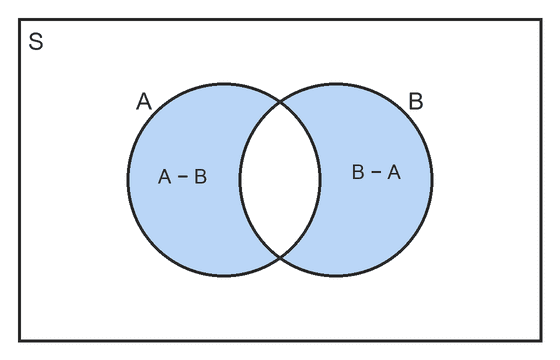
Step 2 — Add the two parts. Since the parts do not overlap, their probabilities add:
Note: The book's printed key is , and option (A) is printed as "", a misprint for . That expression gives the probability of exactly one only when and cannot happen together; by the meaning of "exactly one", the correct option in general is (C).
Therefore, the probability that exactly one of A and B occurs is , option (C).