
Question 1111 markMCQEasy
In a class, 60% of the students know lesson I, 40% know lesson II and 20% know lesson I and lesson II. A student is selected at random. The probability that the student does not know lessons I and II is
Confirming your payment
Sign up now and get 250 free tokens.
Probability · Question 111 of 119
In a class, 60% of the students know lesson I, 40% know lesson II and 20% know lesson I and lesson II. A student is selected at random. The probability that the student does not know lessons I and II is
(A)
(B)
(C)
(D)
Answer: (D)
Concept: The addition rule says that for any two events and , .
Step 1 — Name the events. Let be "knows lesson I" and be "knows lesson II", so , and .
Step 2 — Find the probability of knowing at least one lesson. We apply the addition rule:
Step 3 — Take the complement. A student who knows neither lesson I nor lesson II is outside , the shaded part of the diagram:
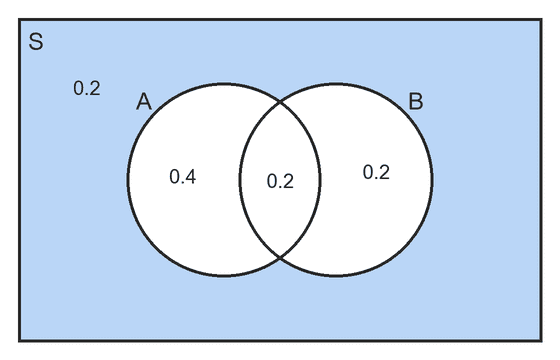
Note: Option (D) is printed as , which is the probability of knowing lesson I only (). The probability of knowing neither lesson is , so option (D) is shown with the true value.
Therefore, the probability that the student knows neither lesson is , option (D).