
Question 53 marksEasy
A five-sided spinner is spun and a coin is tossed.
(i) Show the combined outcomes in a space diagram and in a tree diagram.
(ii) List the combined outcomes and state the number of equally likely combined outcomes.
Confirming your payment
Sign up now and get 250 free tokens.
Probability · Question 5 of 119
A five-sided spinner is spun and a coin is tossed.
(i) Show the combined outcomes in a space diagram and in a tree diagram.
(ii) List the combined outcomes and state the number of equally likely combined outcomes.
Solution:
Concept: When two experiments are done together, a combined outcome is a pair (result of the first, result of the second). A space diagram shows every pair as one dot on a grid; a tree diagram shows the first experiment's results as branches and the second's as smaller branches at the end of each.
Step 1 — Part (i): draw the space diagram. The spinner's five sectors show the scores and the coin shows or . We put the coin results along the horizontal axis and the spinner scores up the vertical axis, and mark one dot for each pair:

For example, the dot above at height is the outcome .
Step 2 — Part (i): draw the tree diagram. The first set of branches shows the coin ( or ); from the end of each, five branches show the spinner score. Following one path from left to right gives one combined outcome:
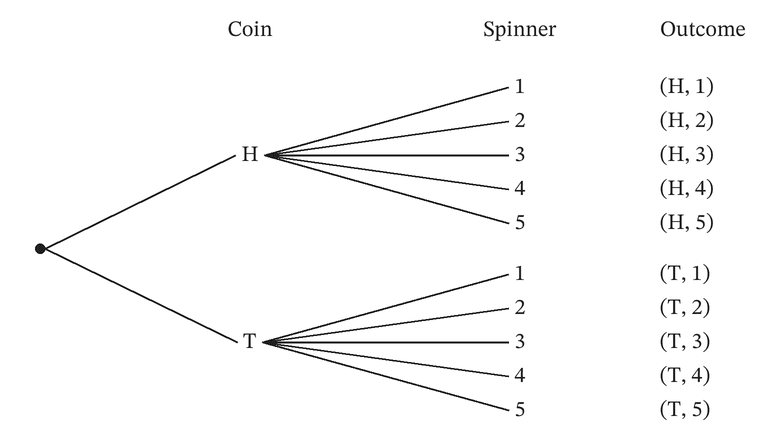
Step 3 — Part (ii): list and count the outcomes. Reading the dots (or the ends of the tree) gives the combined outcomes:
There are results for the coin and for the spinner, so the number of combined outcomes is . They are equally likely because each sector of the spinner and each face of the coin is equally likely.
Therefore, the combined outcomes are , , , , , , , , , , which are 10 equally likely outcomes.