Solution:
Concept: When two events cannot happen together (they are mutually exclusive), the probability that one or the other happens is the sum of their probabilities: P(A∪B)=P(A)+P(B).
For events that can happen together, the addition rule P(A∪B)=P(A)+P(B)−P(A∩B) is used instead.
Step 1 — Read the spinner. The spinner has four sectors: Red 1, Blue 3, Green 1 and Red 2. The tables give the probability of each colour and of each number.
Step 2 — Find part (i). A sector cannot be red and green at once, so we add:
P(red or green)=0.5+0.25=0.75
Step 3 — Find part (ii). The pointer cannot show 2 and 3 at once, so we add:
P(2 or 3)=0.35+0.25=0.6
Step 4 — Find part (iii). The only sector with 3 is blue, so "3" and "green" cannot happen together, and we add:
P(3 or green)=0.25+0.25=0.5
Step 5 — Find part (iv). The only sector with 2 is red, so "2" and "green" cannot happen together:
P(2 or green)=0.35+0.25=0.6
Step 6 — Explain part (v). Adding gives 0.4+0.5=0.9, but "1" and "red" are not mutually exclusive: the Red 1 sector is both red and 1, so adding counts it twice. Green 1 has probability 0.25 (all of green), so the Red 1 sector has
P(1 and red)=0.4−0.25=0.15
The Venn diagram shows the four regions (R = red, N = number 1):
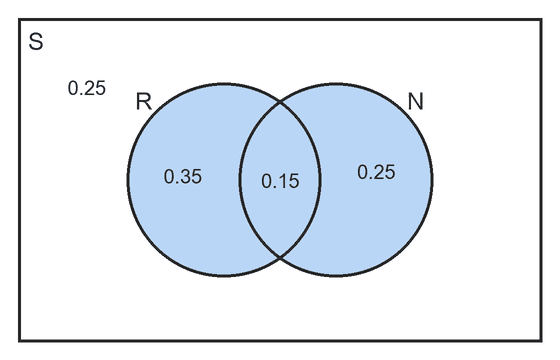
The addition rule removes the overlap once:
P(1 or red)=0.4+0.5−0.15=0.75
Therefore, (i) 0.75, (ii) 0.6, (iii) 0.5, (iv) 0.6, and (v) P(1 or red) is not 0.9 because "1" and "red" are not mutually exclusive (the Red 1 sector is counted twice); the correct value is 0.75.

