Solution:
Concept: The addition rule says that for any two events A and B, P(A∪B)=P(A)+P(B)−P(A∩B).
"Neither A nor B" is the complement of "A or B", so P(neither)=1−P(A∪B).
Step 1 — Find P(A ∪ B) in part (i). We use the addition rule with the given values:
P(A∪B)=0.25+0.50−0.14=0.61
Step 2 — Find the answer to part (i). We take the complement:
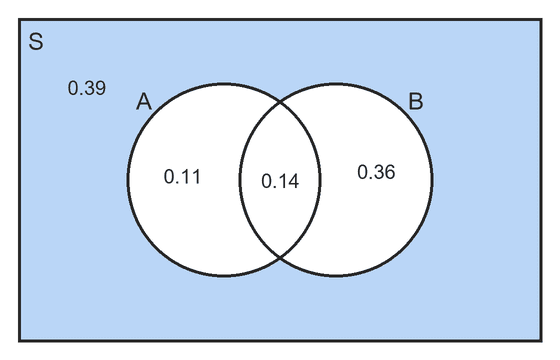
P(neither)=1−0.61=0.39
The Venn diagram shows the four regions; the shaded part is "neither":
Step 3 — Solve part (ii). For mutually exclusive events P(A∩B)=0, so we just add:
P(A∪B)=0.5+0.3=0.8
P(neither)=1−0.8=0.2
Therefore, (i) the probability that neither occurs is 0.39 and (ii) it is 0.2.
