Answer: (A) 61
Concept: The addition rule says that for any two events A and B, P(A∪B)=P(A)+P(B)−P(A∩B).
Step 1 — Count the students in NCC or NSS. Let C be the NCC students and N the NSS students. We use the addition rule for counts:
n(C∪N)=40+30−20=50
Step 2 — Count the students in neither. The remaining students, shaded in the diagram, opted for neither:
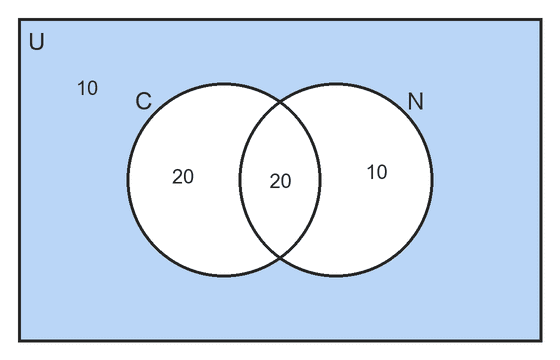
60−50=10
Step 3 — Divide. We divide by the 60 students:
P=6010=61
- (B) This equals 6050, the probability of opting for at least one of NCC and NSS.
- (C) This equals 6020, the probability of opting for both.
- (D) This equals 6040, the probability of opting for NCC.
Therefore, the probability is 61, option (A).
