Solution:
Concept: When all the outcomes are equally likely, P(E)=n(S)n(E). Taking one card from each pile is a combined experiment, so an outcome is a pair (spade card, heart card).
Step 1 — Draw the sample space diagram. The spades pile and the hearts pile each hold A,K,Q,J,10. We put the spade card along the horizontal axis and the heart card up the vertical axis; each dot is one outcome, written (spade card, heart card). In part (i) to part (viii) the events are called E1 to E8:
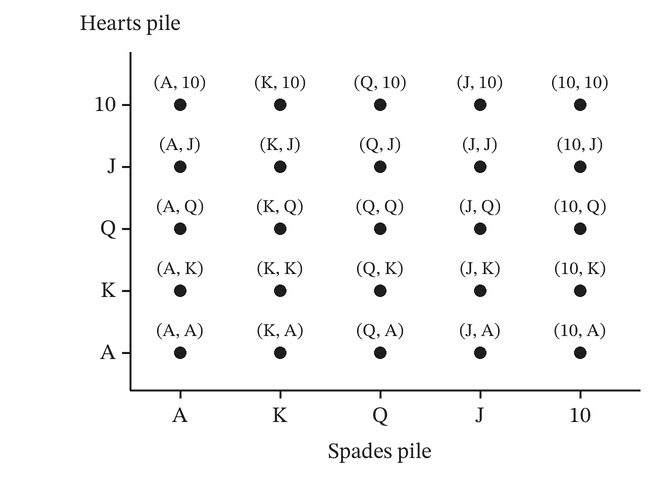
There are 5×5=25 equally likely outcomes, so n(S)=25.
Step 2 — Part (i): both kings. Only (K,K) is favourable, so n(E1)=1:
P(E1)=n(S)n(E1)=251
Step 3 — Part (ii): both cards ace or king. We read this, as the book does, as "both cards are aces, or both are kings". The favourable outcomes are (A,A) and (K,K), so n(E2)=2:
P(E2)=n(S)n(E2)=252
Step 4 — Part (iii): a pair. A pair means two cards of the same value. The favourable outcomes are (A,A),(K,K),(Q,Q),(J,J),(10,10), so n(E3)=5:
P(E3)=n(S)n(E3)=255=51
Step 5 — Part (iv): at least one ace. There are 5 outcomes with the spade ace and 5 with the heart ace, and (A,A) is in both lists, which leaves 5+5−1=9 favourable outcomes:
P(E4)=n(S)n(E4)=259
Step 6 — Part (v): neither card a 10. Each pile then offers 4 cards (A,K,Q,J), so there are 4×4=16 favourable outcomes:
P(E5)=n(S)n(E5)=2516
Step 7 — Part (vi): neither card a king or jack. Each pile then offers 3 cards (A,Q,10), so there are 3×3=9 favourable outcomes:
P(E6)=n(S)n(E6)=259
Step 8 — Part (vii): one card a spade. In every outcome exactly one card comes from the spades pile, so all 25 outcomes are favourable. This is a sure event:
P(E7)=n(S)n(E7)=2525=1
Step 9 — Part (viii): both cards hearts. The card from the spades pile is always a spade, so no outcome is favourable. This is an impossible event:
P(E8)=n(S)n(E8)=250=0
Note: In part (ii), if the words are read as "each card is an ace or a king", the outcomes (A,K) and (K,A) count too, and the probability is 254. In part (iii), the printed answer 252 is incorrect: it counts only the pairs of aces and of kings, but a pair is any two cards of the same value, and there are 5 such outcomes.
Therefore, (i) 251; (ii) 252; (iii) 255=51; (iv) 259; (v) 2516; (vi) 259; (vii) 1; (viii) 0.
