
Opening your dashboard
Class 11 Maths Chapter 22 Probability: Practice Questions
50 questions on Chapter 22, each worked through on its own page with the AI tutor. Class 11 Maths, ICSE 2026-27.
50 questions
1–4 marks · Mixed difficulty
- 11 mark
Question 1
Which of the following is NOT a random experiment?
- 22 marks
Question 2
A quiz has two true/false questions followed by one multiple-choice question with options a, b and c. Meena guesses every answer and records her three answers in order, for example (T, F, b).
(a) Write the sample space of this experiment and state how many outcomes it has.
(b) List the outcomes of the event : "Meena marks True for exactly one of the two true/false questions and does not choose option c".
- 31 mark
Question 3
A coin is tossed until a head appears, but it is tossed at most three times: the experiment stops at the first head, or after the third toss if no head has appeared. How many outcomes does the sample space of this experiment have?
- 43 marks
Question 4
A spinner has eight equal sectors numbered 1 to 8. It is spun once and the number it stops on is noted. Consider the events : "the number is a multiple of 3", : "the number is greater than 6" and : "the number is odd".
(a) Write the sample space and list the outcomes of , and .
(b) Which pairs of these events are mutually exclusive?
(c) Are , and exhaustive? Give a reason.
- 53 marks
Question 5
A two-character code is made by choosing a letter from and then a digit from , each choice made at random; for example P2. Let be the event "the digit is odd" and the event "the letter is Q".
(a) Write the sample space and list and .
(b) List , and .
(c) Describe the event in words and list it.
- 63 marks
Question 6
Rohan rolls an ordinary die with faces numbered 1 to 6. If it shows 6, he rolls it once more and then stops; otherwise he stops after the first roll. An outcome is the list of numbers he rolls, for example 4 or (6, 2).
(a) Write the sample space and state the number of outcomes.
(b) List the event : "the total of the numbers he rolls is at least 9".
(c) List the event : "every roll he makes shows an odd number".
- 72 marks
Question 7
Four cards marked 1, 2, 3 and 4 are placed face down. Two cards are drawn one after the other without replacement, and the numbers are recorded in order, for example (3, 1).
(a) Write the sample space and state how many outcomes it has.
(b) List the event : "the second card shows a larger number than the first", and describe its complement in words.
- 81 mark
Question 8
Two events and of a random experiment with sample space are mutually exclusive and exhaustive. Which of the following must be true?
- 93 marks
Question 9
A fair dodecahedral die has twelve faces numbered 1 to 12. It is rolled once. Let be the event "the number is prime" and the event "the number is a factor of 12".
(a) List , , , and .
(b) Verify that .
- 101 mark
Question 10
, and are three events of a random experiment. Which of the following represents the event "at least one of and occurs, but does not occur"?
- 113 marks
Question 11
A number is chosen at random from 1 to 20. Let be the event "the number is even", the event "the number is a multiple of 3" and the event "the number is greater than 10". The shaded region of the Venn diagram shows an event built from , and .
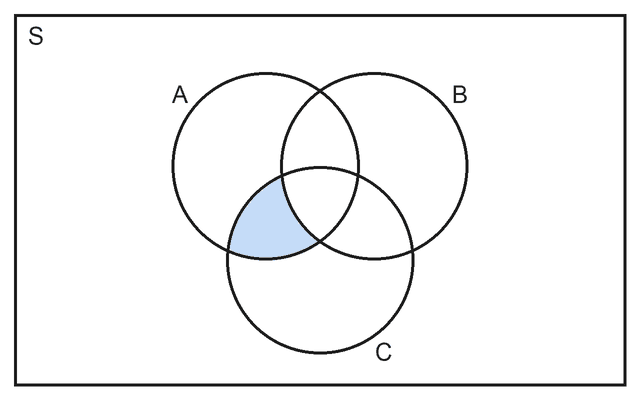
(a) Write the shaded event in set notation.
(b) Describe it in words.
(c) List its outcomes.
- 121 mark
Question 12
and are events of a random experiment with sample space , and . Which of the following is true for every such pair of events?
- 133 marks
Question 13
Two different letters are taken from the word CAT and written in a row in the order they are taken, for example TC. Let be the event "the first letter is a vowel" and the event "the letter T is used".
(a) Write the sample space and list and .
(b) List and . Are and mutually exclusive?
(c) List and describe it in words.
- 141 mark
Question 14
The sample space of a random experiment has exactly 5 outcomes. How many different events can be defined on it, counting the impossible event and the sure event?
- 153 marks
Question 15
A letter is chosen at random from the nine different letters of the word EDUCATION. Let be the event "the letter is a vowel", the event "the letter is in the first half of the alphabet (A to M)" and the event "the letter is one of the letters of the word TUNE".
(a) Write the event "exactly one of , and occurs" in set notation.
(b) Show the letters on a Venn diagram, shade the event of part (a), and list its outcomes.
- 161 mark
Question 16
A two-digit number (from 10 to 99) is chosen at random. What is the probability that its two digits are equal?
- 173 marks
Question 17
Two fair tetrahedral (four-faced) dice, one red and one blue, each have faces numbered 1, 2, 3 and 4. The score on each die is the number on its bottom face. Both dice are thrown once. Find the probability that
(a) the product of the two scores is even;
(b) the sum of the two scores is a prime number;
(c) the larger of the two scores is 3 (when both scores are equal, that common score counts as the larger).
- 181 mark
Question 18
A standard pack of 52 playing cards has 4 suits (spades and clubs are black; hearts and diamonds are red) of 13 cards each: ace, the number cards 2 to 10, jack, queen and king. One card is drawn at random from a standard pack. What is the probability that it is a black number card (2 to 10) whose number is a multiple of 3?
- 193 marks
Question 19
The six letters of the word GARDEN are arranged at random in a row. Find the probability that
(a) the arrangement begins with a vowel;
(b) the two vowels occupy the first and the last places;
(c) G appears somewhere to the left of N (not necessarily next to it).
- 201 mark
Question 20
A leap year is chosen at random. What is the probability that it has 53 Sundays?
- 213 marks
Question 21
Forty tickets are numbered 1 to 40, and one ticket is drawn at random. Find the probability that the number on it
(a) is a perfect square;
(b) contains the digit 3;
(c) leaves a remainder of 1 when divided by 6.
- 221 mark
Question 22
Four friends A, B, C and D sit at random on four chairs placed in a row. What is the probability that A and B sit on the two end chairs?
- 234 marks
Question 23
A relay squad of 5 athletes is to be chosen by drawing lots from 12 athletes, among whom are the twins Asha and Usha. Find the probability that
(a) both twins are chosen;
(b) exactly one of the twins is chosen;
(c) neither twin is chosen.
Check that your three answers add up to 1.
- 241 mark
Question 24
A number is chosen at random from the set . What is the probability that ?
- 253 marks
Question 25
(Hypothetical data.) The 40 students of a class were asked how many brothers and sisters they have. The results are shown below.
Number of siblings 0 1 2 3 Number of students 6 18 11 5 One student of the class is chosen at random. Find the probability that the student has
(a) at least 2 siblings;
(b) an odd number of siblings;
(c) exactly 1 sibling. Is the chosen student more likely to have exactly 1 sibling or a number of siblings other than 1?
- 261 mark
Question 26
One card is drawn at random from a well-shuffled standard pack of 52 playing cards, made up of four suits of 13 cards each (ace, 2 to 10, jack, queen, king). What are the odds in favour of drawing a picture card (a jack, a queen or a king)?
- 273 marks
Question 27
A bag contains 24 counters, each either red or blue. When one counter is drawn at random, the odds against its being red are .
(a) How many red counters are in the bag?
(b) How many more red counters must be put into the bag (with no counter removed) so that the odds in favour of drawing a red counter become ?
- 281 mark
Question 28
The probability of an event is . What are the odds against ?
- 293 marks
Question 29
Two fair six-faced dice, one red and one green, each numbered 1 to 6, are thrown together. Find
(a) the odds in favour of the event "the larger of the two numbers is at least 5" (if the numbers are equal, that common number counts as the larger);
(b) the odds against the event "the two numbers differ by exactly 2".
- 301 mark
Question 30
The odds in favour of an event are . What is the probability that does not happen?
- 313 marks
Question 31
Priya does not know the answers to two multiple-choice questions. Each question has four options p, q, r and s, of which exactly one is correct, and she picks one option for each question at random. Find
(a) the odds in favour of her getting at least one of the two questions right;
(b) the odds against her getting both questions right.
- 321 mark
Question 32
A number is chosen at random from the integers 1 to 30. What are the odds in favour of its being a multiple of 4 or a multiple of 6?
- 333 marks
Question 33
The five letters of the word RATIO are arranged at random in a row. Find the odds in favour of, and the odds against, the arrangement beginning and ending with a vowel.
- 342 marks
Question 34
An event is three times as likely to happen as to fail. Find the probability of , and write the odds in favour of and the odds against it.
- 351 mark
Question 35
For two events and , , and . What is the probability that occurs but does not?
- 363 marks
Question 36
For two events and , and , and the probability that exactly one of and occurs is . Find , and the probability that neither event occurs.
- 371 mark
Question 37
and are mutually exclusive events with and . What is ?
- 383 marks
Question 38
For two events and of a random experiment, and .
(a) Explain why and cannot be mutually exclusive.
(b) Find the least and the greatest possible values of , and describe when each value occurs.
- 391 mark
Question 39
A number is chosen at random from the integers 1 to 60. What is the probability that it is divisible by at least one of 3, 4 and 5?
- 404 marks
Question 40
(Hypothetical data.) In a class of 40 students, 18 play cricket, 15 play chess and 12 play football. Of these, 6 play both cricket and chess, 5 play both cricket and football, 4 play both chess and football, and 2 play all three games. One student of the class is chosen at random. Find the probability that the student plays
(a) at least one of the three games;
(b) exactly one of the three games;
(c) exactly two of the three games.
- 411 mark
Question 41
Two fair six-faced dice, one red and one blue, each numbered 1 to 6, are thrown. What is the probability that at least one die shows 6 or the sum of the two numbers is 7?
- 423 marks
Question 42
A die with faces numbered 1 to 6 is loaded so that the probability of each face turning up is proportional to the number on it. The die is thrown once.
(a) Find the probability of each face.
(b) Find the probability that the number is even or greater than 4.
- 432 marks
Question 43
For two events and , , and . Find and .
- 443 marks
Question 44
(Hypothetical data.) The 120 students of Class XI are classified below by where they live and whether they belong to the science club.
In the science club Not in the science club Hostel students 20 30 Day scholars 25 45 One student is chosen at random. Let be the event "the student lives in the hostel" and the event "the student is in the science club".
(a) Find , and .
(b) Use the addition rule to find .
(c) Check your answer to (b) by finding the probability of its complement directly from the table.
- 451 mark
Question 45
Two different numbers are chosen together at random from the integers 1 to 20. What is the probability that both numbers are even or both are multiples of 3?
- 463 marks
Question 46
A committee of 3 is chosen by lot from the 9 members of a society, among whom are Mr Rao and Ms Iyer. Use the addition rule to find the probability that the committee includes Mr Rao or Ms Iyer (or both), and check your answer by finding the probability of its complement.
- 471 mark
Question 47
Two fair six-faced dice, one white and one black, each numbered 1 to 6, are thrown. What are the odds in favour of the sum of the two numbers being a prime number or a multiple of 5?
- 484 marks
Question 48
Two cards are drawn together at random from a well-shuffled standard pack of 52 playing cards, in which the hearts and diamonds (13 each) are red, the spades and clubs (13 each) are black, and each suit has one king. Find the probability that both cards are red or both are kings, and write the odds against this event.
- 493 marks
Question 49
A random experiment has exactly five elementary outcomes , with , , and .
Let and .
(a) Find .
(b) Find , and , and use the addition rule to find .
(c) Check your answer to (b) by listing the outcomes of .
- 504 marks
Question 50
A three-digit code for a bicycle lock is set at random, each digit being chosen from 1, 2, 3 and 4 (digits may repeat). Let be the event "the code reads the same backwards as forwards" and the event "every digit of the code is odd".
(a) Find .
(b) Find the odds against .
(c) Find the probability that exactly one of and occurs.