
Opening your dashboard
Class 11 Maths Chapter 22 Probability: Competency-Based Questions (CBQ)
40 questions on Chapter 22, each worked through on its own page with the AI tutor. Class 11 Maths, ICSE 2026-27.
40 questions
1–5 marks · Mixed difficulty
- 13 marks
Question 1
Competency: Application
In a board game, Kavya's token stands on square 20. On her turn she tosses a coin and throws a die. If the coin shows a head (H), she moves the token forward by the number on the die; if it shows a tail (T), she moves it back by that number. The foot of a ladder is on each of squares 23 and 26, and the head of a snake is on each of squares 17 and 18. Write an outcome as the coin result followed by the die number, for example H4. (Hypothetical data.)
(a) Write the sample space of one turn, and list the outcomes of the event : "the move ends exactly on a square with the foot of a ladder".
(b) Find the probability that the move ends exactly on a square with the foot of a ladder or the head of a snake.
(c) Find the odds in favour of the move ending on an even-numbered square that has no foot of a ladder.
- 21 mark
Question 2
Competency: Application
For the first round of a school badminton tournament, 8 players, including the two top seeds Isha and Neel, are paired off into 4 matches by drawing lots, so that every way of pairing the 8 players is equally likely. (Hypothetical data.)
What is the probability that Isha and Neel play each other in the first round?
- 31 mark
Question 3
Competency: Analysis
In a quality check, a phone is picked at random from a batch and given a drop test and a water test. Let be the event "the phone fails both tests" and the event "the phone fails the drop test".
Assertion (A): For some batches, .
Reason (R): Every phone that fails both tests also fails the drop test, so .
- 44 marks
Question 4
Competency: Application & Analysis
A town's weather records for 1 July over many years show that the odds against rain on that day are . A thunderstorm on that day always comes with rain, and the odds in favour of a thunderstorm on that day are . Take these odds for the next 1 July, and let be the event "it rains on the next 1 July" and the event "there is a thunderstorm on the next 1 July". (Hypothetical data.)
(a) Find and .
(b) Explain why , and find the probability that it rains on the next 1 July without a thunderstorm.
(c) Find the odds against rain without a thunderstorm on that day, and the probability of neither rain nor a thunderstorm.
- 51 mark
Question 5
Competency: Analysis
A row of 4 decorative lamps is run by a programme that switches each lamp on or off, so that all 16 on/off patterns of the row are equally likely. (Hypothetical data.)
What is the probability that no two neighbouring lamps are both on?
- 61 mark
Question 6
Competency: Understanding
Assertion (A): If the odds against an event are , then .
Reason (R): The odds against an event are .
- 74 marks
Question 7
Competency: Application
A fruit wholesaler checks each crate of 15 mangoes by taking out 3 mangoes together at random. A crate is accepted if at most one of these 3 mangoes is bruised. One crate contains 4 bruised mangoes. (Hypothetical data.)
(a) How many different samples of 3 mangoes can be taken from this crate?
(b) Find the probability that the sample contains no bruised mango, and the probability that it contains exactly one bruised mango.
(c) Find the probability that this crate is accepted, and the odds against its being accepted.
- 81 mark
Question 8
Competency: Application
A carrom set has 9 white coins, 9 black coins and 1 red coin (the queen). Two coins are picked together at random from all 19 coins.
What is the probability that the queen is one of the two coins or both coins are black?
- 91 mark
Question 9
Competency: Evaluation
A weather app shows, for tomorrow in a city, "Chance of rain: 60%" and "Chance of no rain: 50%". (Hypothetical data.)
Assertion (A): These two figures cannot both be correct.
Reason (R): For any event , .
- 104 marks
Question 10
Competency: Application
A sleeper coach of a train has 72 berths arranged in 9 bays. Each bay has 8 berths: on one side of the aisle, two lower, two middle and two upper berths; on the other side, one side-lower and one side-upper berth. Passengers who book late are given berths at random. Call the lower and side-lower berths "low berths", and the side-lower and side-upper berths "side berths". (Hypothetical data.)
(a) One late passenger is given one of the 72 berths at random. Find the probability that it is a low berth and the probability that it is a side berth.
(b) Use the addition rule to find the probability that this passenger's berth is a low berth or a side berth.
(c) Two friends who book late together are given two different berths, chosen together at random from all 72. Find the probability that both get low berths.
- 114 marks
Question 11
Competency: Application & Analysis
At a blood-donation camp, 200 donors were tested: 74 were of group O, 46 of group A, 62 of group B and 18 of group AB. The red cells of groups A and AB carry antigen A, those of groups B and AB carry antigen B, and those of group O carry neither. One donor's record is picked at random. Let be the event "the donor's red cells carry antigen A" and the event "they carry antigen B". (Hypothetical data.)
(a) Name the blood group that makes up the event and the blood group that makes up , and find and .
(b) Use the addition rule to find , and check your answer with the number of group O donors.
(c) Find the probability that the donor's red cells carry exactly one of the two antigens.
- 121 mark
Question 12
Competency: Understanding
On her way to school, Nisha passes three traffic signals and notes, in order, the colour each one shows as she reaches it: red (R), amber (A) or green (G). Consider the event : "she meets no red signal and meets at least one amber signal".
How many outcomes of the sample space belong to ?
- 131 mark
Question 13
Competency: Analysis
Two dice, each with faces numbered 1 to 6, are thrown together.
Assertion (A): The events "a doublet is thrown" and "the sum of the two numbers is odd" are mutually exclusive.
Reason (R): There are exactly 6 doublets among the 36 outcomes.
- 143 marks
Question 14
Competency: Application
A double-six domino set has exactly one tile for each pair of numbers chosen from 0 (blank) to 6, the two numbers being equal or different; for example, [2|5] and [4|4] are tiles, and [5|2] is the same tile as [2|5]. All the tiles are placed face down and shuffled, and one tile is turned over at random.
(a) Show that the set has 28 tiles.
(b) Find the probability that the tile turned over is a double (both halves equal) or has a total of 8 pips.
(c) Find the odds in favour of the tile having a total of at least 9 pips.
- 151 mark
Question 15
Competency: Analysis
and are two events of a random experiment with sample space .
Assertion (A): If and are exhaustive, then .
Reason (R): For any two events, , and when and are exhaustive.
- 161 mark
Question 16
Competency: Understanding
In a garment factory, each shirt is given a stitching test and a colour-fastness test. Let be the event "the shirt passes the stitching test" and the event "the shirt passes the colour-fastness test". A shirt is rejected if it fails at least one of the two tests.
Which of the following is the event "the shirt is rejected"?
- 174 marks
Question 17
Competency: Application
A drawer holds three pairs of socks, one red pair, one blue pair and one grey pair, with all six socks loose. During a power cut, Ravi takes out two socks together at random. Name the socks . (Hypothetical data.)
(a) How many outcomes does the sample space have? List the outcomes of the event : "the two socks match", and find .
(b) Find the probability of the event : "neither sock is red".
(c) Use the addition rule to find the probability that the two socks match or neither of them is red.
- 181 mark
Question 18
Competency: Analysis
A square is chosen at random from the 64 squares of an chessboard.
Assertion (A): The probability that the chosen square lies along the edge of the board is .
Reason (R): The board has 32 edge squares, because each of its four sides has 8 squares.
- 193 marks
Question 19
Competency: Application & Analysis
A quiz show's question bank has 40 questions. Each question is either a Science question or an Arts question, and either easy or hard. For a question picked at random, the odds in favour of its being a Science question are , and the odds against its being hard are . Exactly 6 of the questions are hard Science questions. Let be the event "the question is a Science question" and the event "the question is hard". (Hypothetical data.)
(a) Find the number of Science questions and the number of hard questions in the bank.
(b) Find the probability that a question picked at random is a Science question or a hard question.
(c) Find the odds in favour of a question picked at random being an easy Arts question.
- 201 mark
Question 20
Competency: Application
A quiz-show board has 30 face-down cards in 5 categories, History, Science, Sports, Music and Films, with one card worth each of 100, 200, 300, 400, 500 and 600 points in every category. A contestant turns over one card at random. (Hypothetical data.)
What are the odds in favour of the card being a Sports card or a card worth at least 500 points?
- 214 marks
Question 21
Competency: Application
In a word game, the 11 letter tiles that spell MISSISSIPPI are put into a bag, and a player draws 2 tiles together at random. Treat the 11 tiles as different objects, even when they carry the same letter.
(a) Find the probability that both tiles show S.
(b) Find the probability that exactly one of the two tiles shows S.
(c) Find the probability that at least one of the two tiles shows I, and the odds in favour of this event.
- 221 mark
Question 22
Competency: Analysis
Five letter cards, I, N, D, I and A, which spell INDIA, are shuffled, and one card is picked at random.
Assertion (A): The odds against picking a vowel are .
Reason (R): The word INDIA is made up of 4 different letters.
- 233 marks
Question 23
Competency: Application & Analysis
In an examination hall, two friends, Arjun and Bela, are each handed one of four question-paper sets, K, L, M and N. The sets are handed out at random, the two friends may get the same set, and all 16 ordered pairs (Arjun's set, Bela's set) are equally likely. Let be the event "both get the same set" and the event "at least one of them gets set K". (Hypothetical data.)
(a) List the outcomes of and of , writing an outcome such as (K, M) for Arjun's set K and Bela's set M.
(b) Are and mutually exclusive? Are they exhaustive? Give a reason for each answer.
(c) Use the addition rule to find .
- 241 mark
Question 24
Competency: Evaluation
Two dice, each with faces numbered 1 to 6, are thrown, and the sum of the two numbers is noted.
Assertion (A): Since the sum can be any one of the 11 numbers 2, 3, …, 12, the probability that the sum is 7 is .
Reason (R): The 11 possible sums are not equally likely: a sum of 2 arises in 1 way and a sum of 7 in 6 ways out of the 36 equally likely outcomes.
- 251 mark
Question 25
Competency: Application
A toddler presses one of the 26 letter keys of a computer keyboard at random, each key being equally likely. On this QWERTY keyboard the top row of letter keys is Q, W, E, R, T, Y, U, I, O, P.
What is the probability that the key pressed is in the top row or is a vowel (A, E, I, O or U)?
- 261 mark
Question 26
Competency: Analysis
A bank's app sends a 4-digit one-time password (OTP). Each of the four places can hold any digit from 0 to 9, digits may repeat, and all possible codes are equally likely. (Hypothetical data.)
What is the probability that the digits of the OTP are in strictly increasing order from left to right, as in 0379?
- 271 mark
Question 27
Competency: Application
A transport survey in a city looks at commuters. For a commuter chosen at random, is the event "uses the metro in a given week" and is the event "uses a city bus in that week". The Venn diagram shows the probability of each region of the sample space ; the probability of one region is unknown and is shown as . (Hypothetical data.)
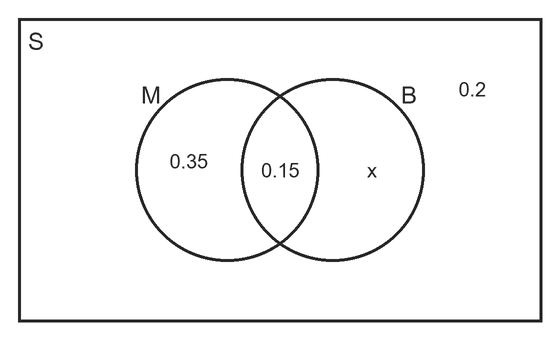
What is the probability that the commuter uses exactly one of the two services in that week?
- 281 mark
Question 28
Competency: Analysis & Evaluation
In a school election only one candidate can win the post of head student. For the candidates Tara and Kabir, the odds in favour of Tara winning are , and the odds in favour of Kabir winning are . (Hypothetical data.)
Assertion (A): The odds in favour of "Tara or Kabir wins" are .
Reason (R): For mutually exclusive events, the odds in favour of their union are found by adding the odds term by term, so and give .
- 291 mark
Question 29
Competency: Analysis
In a board game, a player throws a die with faces numbered 1 to 6. On a throw of 1 or 2 the token turns left, on 3 or 4 it moves straight ahead, and on 5 or 6 it turns right. Let , and be these three events.
Assertion (A): The events , and are mutually exclusive and exhaustive.
Reason (R): Each of the events , and has probability .
- 301 mark
Question 30
Competency: Understanding
A parking machine accepts only ₹5 and ₹10 coins, and a ticket costs ₹15. Neha takes coins one at a time at random from a purse holding plenty of both kinds and puts each into the machine. She stops as soon as the total put in is at least ₹15. An outcome is the list of coin values in rupees, in the order she puts them in; for example, . The machine returns change whenever the total is more than ₹15.
Which set is the event "the machine returns change"?
- 311 mark
Question 31
Competency: Evaluation & Analysis
At a school fete, Arnav may play one of two games.
Game I: he throws one die 4 times and wins if at least one throw shows a 6.
Game II: he throws a pair of dice 24 times and wins if at least one throw shows a double six.
In each game every sequence of results is equally likely. Take .
Which game should Arnav choose to have the better chance of winning, and why?
- 322 marks
Question 32
Competency: Evaluation
Rhea () and Sana () play a best-of-three badminton match, which stops as soon as one of them has won two games. The result is recorded as the winners of the games in order, so the sample space is . Their coach says that the two players are equally strong: if a third game were always played, even after the match is decided, each of the patterns of three game-winners would be equally likely. (Hypothetical data.)
Sana's friend says: "The match ends after only two games in of the outcomes, so the probability is ."
(a) Explain why the friend's method is not valid.
(b) Find the correct probability that the match ends after only two games.
- 332 marks
Question 33
Competency: Application
For a stall at a school fete, the organisers will print scratch cards. Each card shows "Prize", "Free retry" or "Try again", and a visitor buys one card at random. The organisers want:
- the odds against winning a prize to be at least ;
- the odds in favour of getting a prize or a free retry to be exactly .
They also want as many prize cards as these conditions allow. (Hypothetical data.)
How many cards of each kind should they print?
- 342 marks
Question 34
Competency: Application & Analysis
A hospital's data centre has two power sources, the grid supply and a diesel generator. The servers stay on as long as at least one source is working. At a moment chosen at random, let be the event "the grid supply is working" and the event "the generator is ready to supply power". Records show that and , and that the probability that the servers are off, with neither source working, is . (Hypothetical data.)
(a) Find the probability that both sources are working.
(b) Find the probability that exactly one source is working.
- 352 marks
Question 35
Competency: Analysis
Kirti's home is at the street corner , and her school is at the corner , blocks east and blocks north of , as shown in the figure. A bakery is at the corner , block east and block north of . She always walks along a shortest route, moving only east or north along the streets, and each morning she picks one of the shortest routes at random, all of them being equally likely. (Hypothetical data.)

(a) How many shortest routes are there from to ?
(b) Find the probability that her route on a given morning passes the bakery at .
- 363 marks
Question 36
Competency: Application & Analysis
For a Diwali rangoli, six diyas , , , , and are placed at equal spacing on a circle, so that they are the vertices of a regular hexagon, as shown in the figure. A child picks of the diyas at random and joins them with a ribbon to form a triangle. (Hypothetical data.)
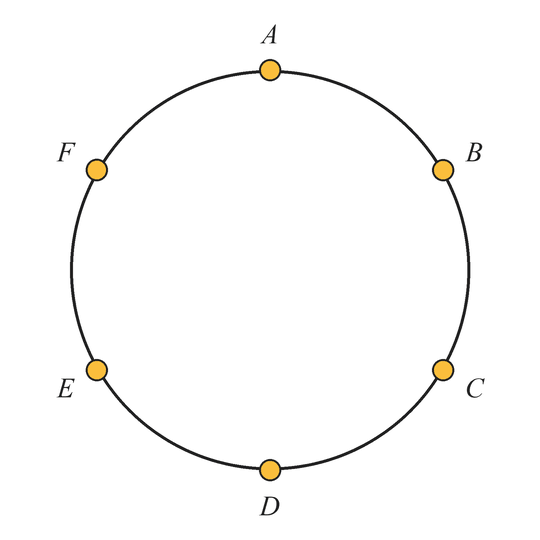
(a) How many different triangles can be formed?
(b) Find the probability that the triangle is equilateral.
(c) Find the probability that the triangle is right-angled.
- 373 marks
Question 37
Competency: Evaluation & Analysis
Ritu's playlist has songs, and of them are by her favourite singer. On shuffle, her phone plays a first song chosen at random from the and then a second song chosen at random from the other , so all ordered pairs of different songs are equally likely. Ritu wants the probability that at least one of the first two songs is by her favourite singer. (Hypothetical data.)
Her working is: "The first song is by the singer with probability , and the second song is by the singer with probability . So the answer is , which is ."
(a) Explain the error in Ritu's working.
(b) Use the addition rule to find the correct probability.
(c) Check your answer by counting the pairs in which neither song is by the singer.
- 383 marks
Question 38
Competency: Analysis
A shop's jar holds only red and green Holi colour sachets. When one sachet is taken at random, the odds in favour of its being red are . When two sachets are taken out together at random, the probability that both are red is . (Hypothetical data.)
(a) Taking the number of red sachets as , write the total number of sachets, and the probability that both sachets are red, in terms of .
(b) Find the numbers of red and green sachets in the jar.
(c) Find the odds against both of the two sachets being red.
- 394 marks
Question 39
Competency: Creativity & Evaluation
Megha is designing bonus rules for a board game played with one fair die whose faces are numbered 1 to 6. Each rule is a set of faces: a throw earns that bonus when it shows one of those faces. She wants rule to be met with probability and rule with probability , and she wants the probability that a throw earns at least one of the two bonuses to be .
(a) Use the addition rule to find the probability that a throw earns both bonuses.
(b) Design rules and , as sets of faces, that meet all three conditions. Show that your design works.
(c) She also wants a rule , on the same die, that is met with probability . Explain why no rule on this die can do this, and suggest a change of equipment that allows all three rules.
- 405 marks
Question 40
Competency: Analysis & Evaluation
On a busy route, a railway records what happened to wait-listed tickets in one week. Each ticket either got a confirmed berth, got an RAC berth (Reservation Against Cancellation, a shared berth with which the passenger may travel), or stayed unconfirmed and was cancelled. The table shows the results by class of travel. (Hypothetical data.)
Class Confirmed RAC Cancelled Total Sleeper 54 26 40 120 3AC 36 14 30 80 Total 90 40 70 200 One of the tickets is picked at random. Let be the event "the ticket was confirmed" and the event "the ticket is a 3AC ticket".
(a) Find and , and use the addition rule to find .
(b) A passenger may travel with a confirmed or an RAC berth. Find the odds in favour of a ticket picked at random letting its passenger travel.
(c) Ravi says: "A wait-listed 3AC ticket has better odds of being confirmed than a wait-listed Sleeper ticket." Find the odds in favour of confirmation for a ticket picked at random from the Sleeper tickets, and for one picked from the 3AC tickets, and decide whether Ravi is right.