
Opening your dashboard
Class 10 Maths Chapter 5: Quadratic Equations Solutions
82 textbook questions with step-by-step answers, free to read, for ICSE 2026-27.
Get talked through Ch 5, not just shown the answer
Reading a finished solution is not the same as being able to do it. The AI tutor takes one question at a time and works it with you, in your own words, until you can.
- Ask it out loud, in your own words
- It gives you the next step, not the answer
- Stuck on part (ii)? Start there
82 questions with solutions
1–3 marks · Mixed difficulty
The first 14 solutions are on this page. This chapter is a long one, so the rest open on their own page to keep this one quick to load.
- 11 mark
Question 1
implies is equal to :
Solve with AIAnswer
(A)
(B)
(C)
- Correct
(D)
Answer: (D)
Concept: If with , then has two values, and , because the square of a negative number is also positive.
Step 1 — Make the subject.
We add 9 to both sides and then divide both sides by 4, so that stands alone on the left.
Step 2 — Take the square root of both sides.
When we take the square root we must keep both signs, since both and square to .
Step 3 — Check with the graph.
Putting either value back gives , which is 0. The graph of also meets the x-axis at two points, one on each side of the origin.
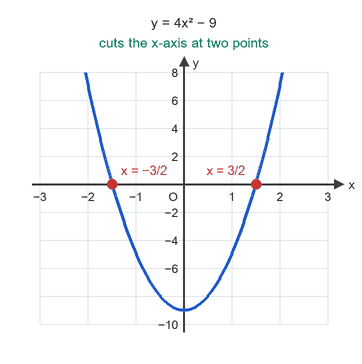
Watch out: Taking only the positive square root loses the root .
Why the other options are wrong:
- (A) : this is only the positive square root. It leaves out the second root, .
- (B) : this is the value of , not of . The square root has not been taken.
- (C) : this is only the negative square root. It leaves out the first root, .
Therefore, , option (D).
- 21 mark
Question 2
gives equals to :
Solve with AIAnswer
(A) 3
(B) 3 or 5
- Correct
(C) 3 or −5
(D) 3 and −5
Answer: (C) 3 or −5
Concept: A quadratic equation is solved by factorisation: bring every term to one side, factorise the left side, and use the Zero Product Rule: if a product of two factors is zero, then at least one of the factors is zero.
Step 1 — Use the Zero Product Rule.
The left side is already a product of two factors and the right side is 0, so one of the factors must be zero.
Step 2 — Solve each simple equation.
We add 3 to both sides of the first equation and subtract 5 from both sides of the second.
Step 3 — Check each value.
For the first factor is 0; for the second factor is 0. In each case the product is 0.
Watch out: Solving gives −5, not 5. Also, the two roots are joined by “or”: takes one value at a time, and each value on its own satisfies the equation. “and” would mean is both numbers at once, which is impossible.
Why the other options are wrong:
- (A) 3: 3 is only one of the roots. also makes the product zero, because then the factor is 0.
- (B) 3 or 5: this is a sign mistake: solving gives −5, not 5. At the product is , which is 20, not 0.
- (D) 3 and −5: the numbers are right, but they are joined by “and”. takes one value at a time, so the roots are written “3 or −5”.
Therefore, equals 3 or −5, option (C).
- 31 mark
Question 3
If 4 is a root of equation ; the value of is :
Solve with AIAnswer
(A) 3
- Correct
(B) −3
(C) 2
(D) −2
Answer: (B) −3
Concept: A root of an equation is a value of that makes the equation true. So if 4 is a root, putting in the equation must make the left side equal to 0.
Step 1 — Put in the equation.
Since 4 is a root, we replace every by 4.
Step 2 — Solve for .
We subtract 12 from both sides and then divide both sides by 4.
Step 3 — Check.
With , the equation becomes ; it factorises as , so 4 is indeed a root (and the other root is −1).
Watch out: When 12 is moved to the right side it becomes −12, so is negative.
Why the other options are wrong:
- (A) 3: this is a sign slip. Putting gives , which is 24, not 0.
- (C) 2: putting gives , which is 20, not 0.
- (D) −2: putting gives , which is 4, not 0.
Therefore, the value of is −3, option (B).
- 41 mark
Question 4
The equation is satisfied by ; the value of is :
Solve with AIAnswer
- Correct
(A) −2
(B) 2
(C) 4
(D) 3
Answer: (A) −2
Concept: If a value of satisfies an equation, putting that value in the equation makes both sides equal. Here the left side must become 0 when .
Step 1 — Put in the equation.
We replace every by 2 and simplify the numbers.
Step 2 — Solve for .
We subtract 2 from both sides.
Step 3 — Check.
With , the left side at is , which is 0, as required.
Watch out: is , which is 8. Do not square the 2 in front as well (that would give 16).
Why the other options are wrong:
- (B) 2: this is a sign slip. Putting gives , which is 4, not 0.
- (C) 4: putting gives , which is 6, not 0.
- (D) 3: putting gives , which is 5, not 0.
Therefore, the value of is −2, option (A).
- 51 mark
Question 5
If ; the value of is :
Solve with AIAnswer
(A) 0 and 7
(B) 7
(C) 0
- Correct
(D) 0 or 7
Answer: (D) 0 or 7
Concept: A quadratic equation is solved by factorisation: bring every term to one side, factorise the left side, and use the Zero Product Rule: if a product of two factors is zero, then at least one of the factors is zero. When there is no constant term, itself is a common factor.
Step 1 — Take out the common factor.
Both terms contain , so we take out as a common factor instead of dividing by it.
Step 2 — Use the Zero Product Rule.
The product is zero only when one of its factors is zero.
Adding 7 to both sides of the second equation:
Step 3 — Check each value.
For the left side is , and for it is ; both are 0.
The graph of meets the x-axis at these two points.

Watch out: Never divide both sides by . Dividing by throws away the root . Also, the two roots are joined by “or”: takes one value at a time, and each value on its own satisfies the equation. “and” would mean is both numbers at once, which is impossible.
Why the other options are wrong:
- (A) 0 and 7: the numbers are right, but they are joined by “and”. takes one value at a time, so we write “0 or 7”.
- (B) 7: this comes from dividing both sides by , which throws away the root .
- (C) 0: this gives only one root. The factor also gives .
Therefore, the value of is 0 or 7, option (D).
- 63 marks
Question 6
Find which of the following equations are quadratic :
(i)
(ii)
(iii)
Solve with AIWritten solution
Solution:
Concept: An equation is quadratic when, after removing brackets and bringing every term to one side, it takes the form with . In other words, the highest power of left after simplifying must be exactly 2.
Step 1 — Part (i): simplify .
We remove the bracket on the right by multiplying each term inside it by −3.
Now we bring every term to the left side and collect the terms.
The highest power of is 2 and the coefficient of is 5, which is not zero. So equation (i) is quadratic.
Step 2 — Part (ii): expand both sides of .
We multiply out each pair of brackets term by term.
Step 3 — Part (ii): bring every term to one side.
We subtract the right side from the left side. The terms cancel.
No term is left, so the highest power of is 1. Equation (ii) is a linear equation and is not quadratic.
Step 4 — Part (iii): simplify .
We expand the right side with .
Bringing every term to the left side and collecting like terms:
The highest power of is 3, so this is a cubic equation. Equation (iii) is not quadratic.
Watch out: Always simplify before deciding. Equation (ii) looks quadratic at first sight, but its terms cancel.
Therefore, only equation (i) is quadratic.
- 73 marks
Question 7
(i) Is a solution of the equation ?
(ii) Is a solution of the equation ?
Solve with AIWritten solution
Solution:
Concept: A value of is a solution (root) of an equation if putting it in the equation makes the left side equal to the right side. Here the right side is 0, so the left side must work out to 0.
Step 1 — Part (i): put in .
We replace every by 5 and simplify.
Step 2 — Part (i): compare with the right side.
The left side is 0, which equals the right side. So yes, is a solution of the equation.
Step 3 — Part (ii): put in .
We replace every by −3, using brackets so that the signs are handled correctly.
Step 4 — Part (ii): compare with the right side.
The left side is 48, which is not 0. So no, is not a solution of the equation.
Watch out: is and is . Put negative values in brackets before squaring or multiplying.
Therefore, (i) yes, is a solution; (ii) no, is not a solution.
- 83 marks
Question 8
If is a solution of equation , find the value of .
Solve with AIWritten solution
Solution:
Concept: A solution of an equation makes it true when it is put in place of . Squaring a square root removes the root sign: .
Given: One solution of is .
Step 1 — Put in the equation.
We replace by the given value; its square is .
Step 2 — Make the subject.
We subtract 4 from both sides and divide by . Dividing by is the same as multiplying by .
Step 3 — Rationalise the denominator.
We multiply the top and the bottom by , so that the denominator becomes the whole number 2.
Check: Putting back, the middle term becomes:
So the left side of the equation is:
Watch out: is , not . Squaring removes the root sign.
Therefore, .
- 93 marks
Question 9
and 1 are the solutions of equation . Find the values of and .
Solve with AIWritten solution
Solution:
Concept: Each solution of an equation satisfies it. Putting the two given solutions in the equation gives two equations in and , which we solve as simultaneous linear equations.
Given: The solutions of are and 1.
Step 1 — Put in the equation.
Since is a solution, the left side is 0 when .
We call this equation (1).
Step 2 — Put in the equation.
Since is also a solution, the left side is 0 for this value too. Its square is .
Here we multiplied every term by 9 to clear the fractions, and then divided by 2. We call this equation (2).
Step 3 — Find .
Equation (1) gives . We put this into (2), so that only is left.
Step 4 — Find .
We put the value of back into .
Check: With and , the equation is ; for , the left side is , which is 0; for it is , which is also 0.
Watch out: is ; square the top and the bottom.
Therefore, and .
- 101 mark
Question 10
The roots of the quadratic equation are :
Solve with AIAnswer
(A) −1 and 7
(B) 1 and 7
- Correct
(C) −1 or 7
(D) 1 and −7
Answer: (C) −1 or 7
Concept: A quadratic equation is solved by factorisation: bring every term to one side, factorise the left side, and use the Zero Product Rule: if a product of two factors is zero, then at least one of the factors is zero.
Step 1 — Write the equation in standard form.
The equation already has every term on the left side, with , , .
Step 2 — Factorise by splitting the middle term.
To factorise we split the middle term. We need two numbers whose product is (here ) and whose sum is (here ). They are and .
Writing the middle term as these two parts and taking out the common factor of each pair of terms:
Step 3 — Use the Zero Product Rule.
A product is zero only when at least one of its factors is zero, so we set each factor equal to zero and solve.
Step 4 — Check with the graph.
For , the left side is , which is 0; for , it is , which is also 0. The graph of cuts the x-axis at these two points.
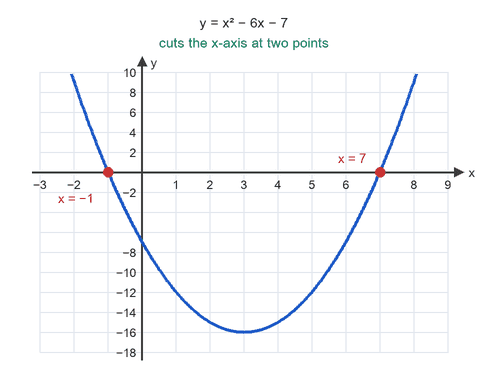
Watch out: The two roots are joined by “or”: takes one value at a time, and each value on its own satisfies the equation. “and” would mean is both numbers at once, which is impossible.
Why the other options are wrong:
- (A) −1 and 7: the numbers are right, but they are joined by “and”. cannot be −1 and 7 at the same time, so we write “−1 or 7”.
- (B) 1 and 7: 1 is not a root. For , the left side is , which is −12, not 0.
- (D) 1 and −7: both signs are reversed. For , the left side is −12, and for , it is , which is 84. Neither is 0.
Therefore, the roots are −1 or 7, option (C).
- 111 mark
Question 11
The roots of quadratic equation are :
Solve with AIAnswer
(A) 6 or 2
- Correct
(B) −6 or −2
(C) 6 and −2
(D) −6 and −2
Answer: (B) −6 or −2
Concept: A quadratic equation is solved by factorisation: bring every term to one side, factorise the left side, and use the Zero Product Rule: if a product of two factors is zero, then at least one of the factors is zero.
Step 1 — Remove the bracket.
We multiply into the bracket, so that the equation is in the standard form .
Step 2 — Factorise by splitting the middle term.
To factorise we split the middle term. We need two numbers whose product is (here ) and whose sum is (here ). They are and .
Writing the middle term as these two parts and taking out the common factor of each pair of terms:
Step 3 — Use the Zero Product Rule.
A product is zero only when at least one of its factors is zero, so we set each factor equal to zero and solve.
Step 4 — Check.
For , the left side is , which is 0; for , it is , which is also 0.
Watch out: Both roots are negative here. When every term of is positive, a positive can never make it zero.
Why the other options are wrong:
- (A) 6 or 2: the signs are wrong. For , the left side is , which is 96, not 0.
- (C) 6 and −2: 6 is not a root (the left side is 96 there), and the roots are joined by “and” instead of “or”.
- (D) −6 and −2: the numbers are right, but takes one value at a time, so we write “or”, not “and”.
Therefore, the roots are −6 or −2, option (B).
- 121 mark
Question 12
If one root of equation is 2, the value of is :
Solve with AIAnswer
(A) −2
- Correct
(B) 2
(C)
(D) 1 and 2
Answer: (B) 2
Concept: A root of an equation makes the equation true. Putting in the equation gives an equation in alone, which we solve.
Step 1 — Put in the equation.
Since 2 is a root, we replace every by 2.
Step 2 — Solve for .
We add 10 to both sides and divide by 5.
Step 3 — Check.
With , the equation is , or ; it factorises as , so 2 is indeed a root.
Watch out: The equation in is linear (), so has only one value.
Why the other options are wrong:
- (A) −2: putting gives , which is −20, not 0.
- (C) : the equation is linear, so it has only one solution. gives −20, not 0.
- (D) 1 and 2: has a single value. Putting gives , which is −5, not 0.
Therefore, the value of is 2, option (B).
- 131 mark
Question 13
If , the value of is :
Solve with AIAnswer
(A) 4
(B) 5 and
- Correct
(C) 2 or
(D) 2 and
Answer: (C) 2 or
Concept: An equation with becomes a quadratic equation when every term is multiplied by (and by any other number needed to clear fractions). Here .
Step 1 — Clear the fractions.
We write 2.5 as and multiply every term by .
Step 2 — Factorise by splitting the middle term.
To factorise we split the middle term. We need two numbers whose product is (here ) and whose sum is (here ). They are and .
Writing the middle term as these two parts and taking out the common factor of each pair of terms:
Step 3 — Use the Zero Product Rule.
A product is zero only when at least one of its factors is zero, so we set each factor equal to zero and solve.
Step 4 — Check.
For , the left side is , which is 2.5; for , it is , which is also 2.5.
Watch out: The two roots are reciprocals of each other ( and ), since swapping and does not change the equation. Also, the two roots are joined by “or”: takes one value at a time, and each value on its own satisfies the equation. “and” would mean is both numbers at once, which is impossible.
Why the other options are wrong:
- (A) 4: is 4.25, not 2.5.
- (B) 5 and : is 5.2, not 2.5. This option mixes up 2.5 with 5.
- (D) 2 and : the numbers are right, but takes one value at a time, so we write “or”, not “and”.
Therefore, the value of is 2 or , option (C).
- 141 mark
Question 14
For quadratic equation :
Solve with AIAnswer
- Correct
(A)
(B)
(C)
(D)
Answer: (A)
Concept: A fraction is not defined when its denominator is zero. So in any equation containing , the value is not allowed.
Step 1 — Find the value cannot take.
The term has in the denominator, and division by zero is not defined. So is true for this equation.
Step 2 — Test the other options.
We put each value in the left side and see whether it gives 5.
None of these is 5.
Step 3 — See why no value works.
Multiplying every term by gives . Its discriminant is negative, so it has no real root at all.
So the only true statement among the options is .
Watch out: The stem calls this a quadratic equation, but it becomes only after multiplying by . That step is allowed only because .
Why the other options are wrong:
- (B) : at this value the left side is 7, not 5.
- (C) : at this value the left side is 11, not 5.
- (D) : at this value the left side is , or 6.5, not 5.
Therefore, the correct statement is , option (A).
- 153 marks
Question 15
Solve, using factorisation method :
- 163 marks
Question 16
Solve, using factorisation method :
- 173 marks
Question 17
Solve, using factorisation method :
- 183 marks
Question 18
Solve, using factorisation method : , when :
(i) (ii) .
- 193 marks
Question 19
Solve, using factorisation method :
- 203 marks
Question 20
Solve, using factorisation method :
- 213 marks
Question 21
Solve, using factorisation method :
- 223 marks
Question 22
Solve, using factorisation method :
- 233 marks
Question 23
Find the quadratic equation, whose solution set is :
(i) {3, 5} (ii) {−2, 3}
- 243 marks
Question 24
(i) Solve : ;
(ii) Solve the equation , if possible, for real values of .
- 253 marks
Question 25
Find the value of , if ; and .
- 263 marks
Question 26
Use the substitution to solve for , if .
- 273 marks
Question 27
If and , solve : .
- 283 marks
Question 28
Solve : .
- 291 mark
Question 29
If , value(s) of correct to one decimal place is/are :
- 301 mark
Question 30
If , value(s) of correct to two decimal places is/are :
- 311 mark
Question 31
If ; value(s) of correct to one significant figure is/are :
- 321 mark
Question 32
If ; value(s) of correct to two significant figures is/are :
- 331 mark
Question 33
The value(s) of satisfying the equation is/are :
- 343 marks
Question 34
Solve each of the following equations for and give, in each case, your answer correct to one decimal place :
(i)
(ii)
- 353 marks
Question 35
Solve each of the following equations for and give, in each case, your answer correct to 2 decimal places :
(i)
(ii)
(iii)
- 363 marks
Question 36
Solve each of the following equations for , giving your answer correct to 3 decimal places:
(i)
(ii)
(iii)
- 373 marks
Question 37
Solve the following equation and give your answer correct to 3 significant figures :
- 383 marks
Question 38
Solve for using the quadratic formula. Write your answer correct to two significant figures. .
- 391 mark
Question 39
Equation has :
- 401 mark
Question 40
Which of the following equations has two real and distinct roots ?
- 411 mark
Question 41
If the roots of are equal, the value (values) of is/are :
- 421 mark
Question 42
Which of the following equations has imaginary roots ?
- 431 mark
Question 43
One root of equation is 1, the value of is :
- 443 marks
Question 44
Without solving, comment upon the nature of roots of each of the following equations:
(i)
(ii)
(iii)
(iv)
- 453 marks
Question 45
The equation has equal roots. Find the value of .
- 463 marks
Question 46
Find the value of '', if the following equation has equal roots :
- 473 marks
Question 47
Find the value of for which the equation has distinct and real roots.
- 483 marks
Question 48
Given that 2 is a root of the equation and that the equation has equal roots, find the values of and .
- 491 mark
Question 49
If ; the values of are :
- 501 mark
Question 50
For equation ; one value of is :
- 511 mark
Question 51
Which of the following is correct for the equation ?
- 521 mark
Question 52
The product of two integers is −18; the integers are :
- 533 marks
Question 53
Solve : (Take )
- 543 marks
Question 54
Solve :
- 553 marks
Question 55
Solve :
(i)
(ii)
- 563 marks
Question 56
Solve :
(i)
(ii)
(iii)
- 573 marks
Question 57
Solve :
- 583 marks
Question 58
Solve :
- 593 marks
Question 59
Solve : (Take )
- 603 marks
Question 60
Solve : ;
- 613 marks
Question 61
Solve : .
- 621 mark
Question 62
If , the value of is :
- 631 mark
Question 63
If the quadratic equation has real and equal roots, the value of is:
- 641 mark
Question 64
If , the value of is :
- 651 mark
Question 65
If , the value of is :
- 661 mark
Question 66
If is a root of equation ; the value of is :
- 671 mark
Question 67
The equation .
Assertion (A) : .
Reason (R) :
or
- 681 mark
Question 68
A quadratic equation ; where , and are real numbers and .
Assertion (A) : The roots of equation are real and unequal.
Reason (R) : For the equation , the roots are real and unequal if .
- 691 mark
Question 69
One root of a quadratic equation is .
Statement (1) : The other root of the given quadratic equation is .
Statement (2) : If one root of the given quadratic equation is in the form of a surd, the other root is its conjugate.
- 701 mark
Question 70
The quadratic equation .
Statement (1) : Sum of the roots of the equation .
Statement (2) : In a quadratic equation , sum of roots .
- 713 marks
Question 71
If and ; find the values of .
- 723 marks
Question 72
Solve :
Take :
- 733 marks
Question 73
Solve the quadratic equation
(i) When (integers)
(ii) When (rational numbers)
- 743 marks
Question 74
Solve, using formula :
- 753 marks
Question 75
If and are roots of the equation : ; where and ; find .
- 763 marks
Question 76
One root of the quadratic equation is . Find the value of . Also, find the other root of the equation.
- 773 marks
Question 77
Show that one root of the quadratic equation is −3. Hence, find its other root.
- 783 marks
Question 78
Find the solution of the quadratic equation ; if and .
- 793 marks
Question 79
Solve : ; .
- 803 marks
Question 80
Without solving the following quadratic equation, find the value of '' for which the given equation has real and equal roots.
- 813 marks
Question 81
Find the value of for which equation has real roots.
- 823 marks
Question 82
If −2 is a root of the equation , find the value of . Now find the value of so that the roots of the equation are equal.
What Class 10 Maths Ch 5 covers
The sections of the chapter, in the order the book takes them. Every question above comes from one of these.
- 01Solving Quadratic Equations by Factorisation
- 02Solving Quadratic Equations Using the Formula
- 03Examining the Nature of the Roots of a Quadratic Equation
- 04Equations Reducible to Quadratic Equations
More ways to study this chapter
The same chapter asked three other ways. Practise it, revise it, and see what the board has set on Ch 5 before.
- Competency-Based Questions (CBQ)Case study questions: a situation, and the part of the chapter that answers it.40questionsOpen
- Previous Year QuestionsQuestions that have actually appeared in board papers, each tagged with its year.20questionsOpen
- Practice QuestionsExtra questions per chapter, for when one attempt at a method is not enough.42questionsOpen
Ch 5 in past ICSE papers
The same chapter as the board has actually asked it. These are worded differently from the textbook exercise, which is the point of reading them.
- 13 marks
Board paper question 1
Solve the quadratic equation ; Give your answer correct to two significant figures.
Solve with AIWritten solution
Solution:
Concept: For the equation , with , the roots are given by the quadratic formula: . The quantity is called the discriminant. Significant figures are counted from the first non-zero digit; zeros in front of it (as in 0.564) do not count, but zeros after it do.
Step 1 — Write the equation in standard form.
We open the bracket, multiplying both terms inside by , so that every term is on the left and the right side is 0.
Step 2 — Write down , , and the discriminant.
Comparing with , we have , and . We first work out the discriminant .
The discriminant is not a perfect square, so we use its square root to 4 decimal places (more places than the answer needs, so the rounding at the end is safe).
Step 3 — Put the values into the formula.
We substitute , and the discriminant into the quadratic formula.
Step 4 — Take the + sign and the − sign.
The sign gives two roots: first we add the square root, then we subtract it.
Step 5 — Round each root to two significant figures.
We round only now, at the very end, so that no rounding error builds up in the working. 4.8541 rounds to 4.9 (the next digit, 5, is 5 or more, so we round up); −1.8541 rounds to −1.9 (the next digit, 5, is 5 or more, so we round up).
Step 6 — See it on the graph.
The graph of meets the x-axis at the two roots, because on the x-axis the value of is zero:

Check: The sum of the two roots of a quadratic equation is . Here this is , and the rounded roots add up to exactly this value:
Watch out: The multiplies both terms in the bracket: , not .
Therefore, or (correct to two significant figures).
- 24 marks
Board paper question 2
Solve the equation and give your answer correct to two decimal places.
Solve with AIWritten solution
Solution:
Concept: For the equation , with , the roots are given by the quadratic formula: . The quantity is called the discriminant. “Correct to two decimal places” means exactly two digits after the decimal point.
Step 1 — Write down , , and the discriminant.
Comparing with , we have , and . We first work out the discriminant .
The discriminant is not a perfect square, so we use its square root to 4 decimal places (more places than the answer needs, so the rounding at the end is safe).
Step 2 — Put the values into the formula.
We substitute , and the discriminant into the quadratic formula.
Step 3 — Take the + sign and the − sign.
The sign gives two roots: first we add the square root, then we subtract it.
Step 4 — Round each root to two decimal places.
We round only now, at the very end, so that no rounding error builds up in the working. 1.6930 rounds to 1.69 (the next digit, 3, is less than 5, so we round down); −0.4430 rounds to −0.44 (the next digit, 3, is less than 5, so we round down).
Step 5 — See it on the graph.
The graph of meets the x-axis at the two roots, because on the x-axis the value of is zero:
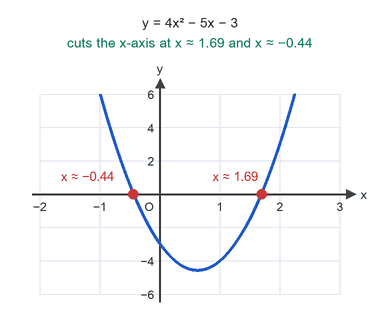
Check: The sum of the two roots of a quadratic equation is . Here this is , and the rounded roots add up to exactly this value:
Watch out: The denominator is , not 2. Divide the whole numerator by 8.
Therefore, or (correct to two decimal places).
- 34 marks
Board paper question 3
Solve and give your answer correct to two decimal places.
Solve with AIWritten solution
Solution:
Concept: For the equation , with , the roots are given by the quadratic formula: . The quantity is called the discriminant. “Correct to two decimal places” means exactly two digits after the decimal point.
Step 1 — Write the equation in standard form.
The formula needs the form , so we subtract 7 from both sides.
Step 2 — Write down , , and the discriminant.
Comparing with , we have , and . We first work out the discriminant .
The discriminant is not a perfect square, so we use its square root to 4 decimal places (more places than the answer needs, so the rounding at the end is safe).
Step 3 — Put the values into the formula.
We substitute , and the discriminant into the quadratic formula.
Step 4 — Take the + sign and the − sign.
The sign gives two roots: first we add the square root, then we subtract it.
Step 5 — Round each root to two decimal places.
We round only now, at the very end, so that no rounding error builds up in the working. 0.8875 rounds to 0.89 (the next digit, 7, is 5 or more, so we round up); −7.8875 rounds to −7.89 (the next digit, 7, is 5 or more, so we round up).
Step 6 — See it on the graph.
The graph of meets the x-axis at the two roots, because on the x-axis the value of is zero:
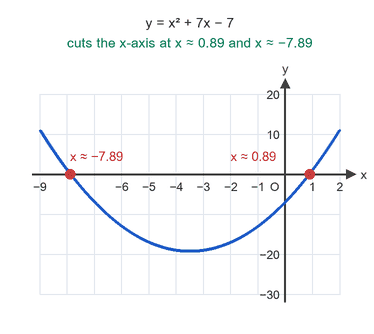
Check: The sum of the two roots of a quadratic equation is . Here this is , and the rounded roots add up to exactly this value:
Watch out: First move the 7 to the left side. Reading as straight from the question gives the wrong discriminant; after the move, is .
Therefore, or (correct to two decimal places).
- 43 marks
Board paper question 4
Find the value of for which the following equation has equal roots.
Solve with AIWritten solution
Solution:
Concept: The nature of the roots of a quadratic equation , with , depends on its discriminant, : if , the roots are real and unequal (distinct); if , the roots are real and equal; if , there are no real roots (the roots are imaginary). So for equal roots we set , which gives an equation in .
Given: has equal roots.
Step 1 — Write down , and .
We compare the equation with the standard form ; here , and (the whole bracket is the constant term, because it has no in it).
Step 2 — Put the discriminant equal to zero.
Equal roots need . We substitute, open the brackets and collect the like terms.
Step 3 — Simplify.
Every term is divisible by 4, so we divide both sides by 4 to get smaller numbers.
Step 4 — Factorise by splitting the middle term.
To factorise we split the middle term. We need two numbers whose product is (here ) and whose sum is (here ). They are and .
Writing the middle term as these two parts and taking out the common factor of each pair of terms:
Step 5 — Use the Zero Product Rule.
A product is zero only when at least one of its factors is zero, so we set each factor equal to zero and solve.
Check: We put each value of back into the equation. Each time the left side is a perfect square, so the two roots are equal.
Watch out: When you open , every sign inside changes: it is .
Therefore, or .
- 53 marks
Board paper question 5
Solve for the quadratic equation .
Give your answer correct to three significant figures.
Solve with AIWritten solution
Solution:
Concept: For the equation , with , the roots are given by the quadratic formula: . The quantity is called the discriminant. Significant figures are counted from the first non-zero digit; zeros in front of it (as in 0.564) do not count, but zeros after it do.
Step 1 — Write down , , and the discriminant.
Comparing with , we have , and . We first work out the discriminant .
The discriminant is not a perfect square, so we use its square root to 5 decimal places (more places than the answer needs, so the rounding at the end is safe).
Step 2 — Put the values into the formula.
We substitute , and the discriminant into the quadratic formula.
Step 3 — Take the + sign and the − sign.
The sign gives two roots: first we add the square root, then we subtract it.
Step 4 — Round each root to three significant figures.
We round only now, at the very end, so that no rounding error builds up in the working. 5.46410 rounds to 5.46 (the next digit, 4, is less than 5, so we round down); −1.46410 rounds to −1.46 (the next digit, 4, is less than 5, so we round down).
Step 5 — See it on the graph.
The graph of meets the x-axis at the two roots, because on the x-axis the value of is zero:

Check: The sum of the two roots of a quadratic equation is . Here this is , and the rounded roots add up to exactly this value:
Watch out: is here, because . Also, and .
Therefore, or (correct to three significant figures).
- 63 marks
Board paper question 6
Solve the following Quadratic Equation :
Give your answer correct to two decimal places.
Solve with AIWritten solution
Solution:
Concept: For the equation , with , the roots are given by the quadratic formula: . The quantity is called the discriminant. “Correct to two decimal places” means exactly two digits after the decimal point.
Step 1 — Write down , , and the discriminant.
Comparing with , we have , and . We first work out the discriminant .
The discriminant is not a perfect square, so we use its square root to 4 decimal places (more places than the answer needs, so the rounding at the end is safe).
Step 2 — Put the values into the formula.
We substitute , and the discriminant into the quadratic formula.
Step 3 — Take the + sign and the − sign.
The sign gives two roots: first we add the square root, then we subtract it.
Step 4 — Round each root to two decimal places.
We round only now, at the very end, so that no rounding error builds up in the working. 6.5414 rounds to 6.54 (the next digit, 1, is less than 5, so we round down); 0.4586 rounds to 0.46 (the next digit, 8, is 5 or more, so we round up).
Step 5 — See it on the graph.
The graph of meets the x-axis at the two roots, because on the x-axis the value of is zero:
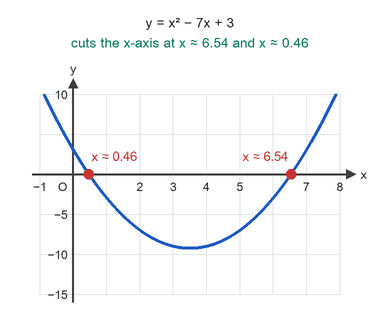
Check: The sum of the two roots of a quadratic equation is . Here this is , and the rounded roots add up to exactly this value:
Watch out: Both roots are positive here, since their product and their sum are positive.
Therefore, or (correct to two decimal places).
All 20 board paper questions for this chapter, solved the same way.
Class 10 Maths Ch 5 questions students ask
How many questions are there in Class 10 Maths Ch 5?
82 questions. Every one is solved step by step on this page.
Are these Class 10 Maths solutions free?
Yes. Every question and its full working is free to read, with no account needed.
Can I download the Class 10 Maths Ch 5 solutions as a PDF?
There is no PDF to download. Every solution is on this page instead, which means it is searchable, always the current syllabus, and readable on a phone. Use your browser's print option if you want it on paper.