
Question 183 marksEasy
Solve, using factorisation method : , when :
(i) (ii) .
Confirming your payment
Sign up now and get 250 free tokens.
Quadratic Equations · Question 18 of 82
Solve, using factorisation method : , when :
(i) (ii) .
Solution:
Concept: A quadratic equation is solved by factorisation: bring every term to one side, factorise the left side, and use the Zero Product Rule: if a product of two factors is zero, then at least one of the factors is zero. The set named after tells us which roots to keep: = natural numbers ; = rational numbers, the numbers that can be written as with integers , and .
Step 1 — Factorise by splitting the middle term.
To factorise we split the middle term. We need two numbers whose product is (here ) and whose sum is (here ). They are and .
Writing the middle term as these two parts and taking out the common factor of each pair of terms:
Step 2 — Use the Zero Product Rule.
A product is zero only when at least one of its factors is zero, so we set each factor equal to zero and solve.
Step 3 — Part (i): keep the roots that are natural numbers.
2 is a natural number, but (which is 2.5) is not, because natural numbers are whole counting numbers.
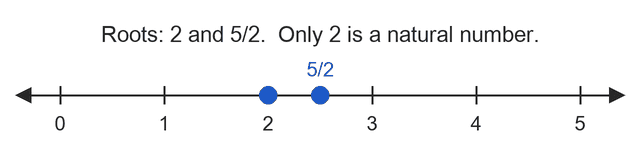
So when , the solution set is .
Step 4 — Part (ii): keep the roots that are rational numbers.
Both 2 (it can be written as ) and are fractions of two integers, so both are rational. When , the solution set is .
Check: For , the left side is , which is 0; for , it is , which is also 0.
Watch out: Solve the equation completely first, then pick the roots that belong to the given set.
Therefore, (i) when , the solution set is ; (ii) when , the solution set is .