
Opening your dashboard
Class 10 Maths Chapter 5 Quadratic Equations: Previous Year Questions
20 questions on Chapter 5, each solved step by step. Class 10 Maths, ICSE 2026-27.
20 questions with solutions
1–4 marks · Mixed difficulty
The first 11 solutions are on this page. This chapter is a long one, so the rest open on their own page to keep this one quick to load.
- 13 marks
Question 1
Solve the quadratic equation ; Give your answer correct to two significant figures.
Solve with AIWritten solution
Solution:
Concept: For the equation , with , the roots are given by the quadratic formula: . The quantity is called the discriminant. Significant figures are counted from the first non-zero digit; zeros in front of it (as in 0.564) do not count, but zeros after it do.
Step 1 — Write the equation in standard form.
We open the bracket, multiplying both terms inside by , so that every term is on the left and the right side is 0.
Step 2 — Write down , , and the discriminant.
Comparing with , we have , and . We first work out the discriminant .
The discriminant is not a perfect square, so we use its square root to 4 decimal places (more places than the answer needs, so the rounding at the end is safe).
Step 3 — Put the values into the formula.
We substitute , and the discriminant into the quadratic formula.
Step 4 — Take the + sign and the − sign.
The sign gives two roots: first we add the square root, then we subtract it.
Step 5 — Round each root to two significant figures.
We round only now, at the very end, so that no rounding error builds up in the working. 4.8541 rounds to 4.9 (the next digit, 5, is 5 or more, so we round up); −1.8541 rounds to −1.9 (the next digit, 5, is 5 or more, so we round up).
Step 6 — See it on the graph.
The graph of meets the x-axis at the two roots, because on the x-axis the value of is zero:

Check: The sum of the two roots of a quadratic equation is . Here this is , and the rounded roots add up to exactly this value:
Watch out: The multiplies both terms in the bracket: , not .
Therefore, or (correct to two significant figures).
- 24 marks
Question 2
Solve the equation and give your answer correct to two decimal places.
Solve with AIWritten solution
Solution:
Concept: For the equation , with , the roots are given by the quadratic formula: . The quantity is called the discriminant. “Correct to two decimal places” means exactly two digits after the decimal point.
Step 1 — Write down , , and the discriminant.
Comparing with , we have , and . We first work out the discriminant .
The discriminant is not a perfect square, so we use its square root to 4 decimal places (more places than the answer needs, so the rounding at the end is safe).
Step 2 — Put the values into the formula.
We substitute , and the discriminant into the quadratic formula.
Step 3 — Take the + sign and the − sign.
The sign gives two roots: first we add the square root, then we subtract it.
Step 4 — Round each root to two decimal places.
We round only now, at the very end, so that no rounding error builds up in the working. 1.6930 rounds to 1.69 (the next digit, 3, is less than 5, so we round down); −0.4430 rounds to −0.44 (the next digit, 3, is less than 5, so we round down).
Step 5 — See it on the graph.
The graph of meets the x-axis at the two roots, because on the x-axis the value of is zero:
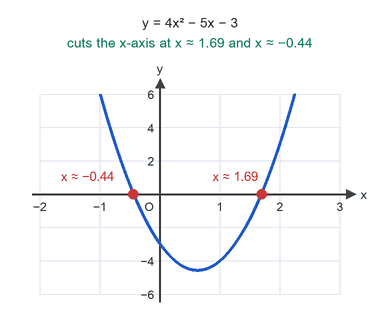
Check: The sum of the two roots of a quadratic equation is . Here this is , and the rounded roots add up to exactly this value:
Watch out: The denominator is , not 2. Divide the whole numerator by 8.
Therefore, or (correct to two decimal places).
- 34 marks
Question 3
Solve and give your answer correct to two decimal places.
Solve with AIWritten solution
Solution:
Concept: For the equation , with , the roots are given by the quadratic formula: . The quantity is called the discriminant. “Correct to two decimal places” means exactly two digits after the decimal point.
Step 1 — Write the equation in standard form.
The formula needs the form , so we subtract 7 from both sides.
Step 2 — Write down , , and the discriminant.
Comparing with , we have , and . We first work out the discriminant .
The discriminant is not a perfect square, so we use its square root to 4 decimal places (more places than the answer needs, so the rounding at the end is safe).
Step 3 — Put the values into the formula.
We substitute , and the discriminant into the quadratic formula.
Step 4 — Take the + sign and the − sign.
The sign gives two roots: first we add the square root, then we subtract it.
Step 5 — Round each root to two decimal places.
We round only now, at the very end, so that no rounding error builds up in the working. 0.8875 rounds to 0.89 (the next digit, 7, is 5 or more, so we round up); −7.8875 rounds to −7.89 (the next digit, 7, is 5 or more, so we round up).
Step 6 — See it on the graph.
The graph of meets the x-axis at the two roots, because on the x-axis the value of is zero:
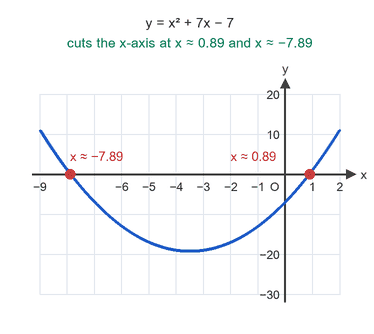
Check: The sum of the two roots of a quadratic equation is . Here this is , and the rounded roots add up to exactly this value:
Watch out: First move the 7 to the left side. Reading as straight from the question gives the wrong discriminant; after the move, is .
Therefore, or (correct to two decimal places).
- 43 marks
Question 4
Find the value of for which the following equation has equal roots.
Solve with AIWritten solution
Solution:
Concept: The nature of the roots of a quadratic equation , with , depends on its discriminant, : if , the roots are real and unequal (distinct); if , the roots are real and equal; if , there are no real roots (the roots are imaginary). So for equal roots we set , which gives an equation in .
Given: has equal roots.
Step 1 — Write down , and .
We compare the equation with the standard form ; here , and (the whole bracket is the constant term, because it has no in it).
Step 2 — Put the discriminant equal to zero.
Equal roots need . We substitute, open the brackets and collect the like terms.
Step 3 — Simplify.
Every term is divisible by 4, so we divide both sides by 4 to get smaller numbers.
Step 4 — Factorise by splitting the middle term.
To factorise we split the middle term. We need two numbers whose product is (here ) and whose sum is (here ). They are and .
Writing the middle term as these two parts and taking out the common factor of each pair of terms:
Step 5 — Use the Zero Product Rule.
A product is zero only when at least one of its factors is zero, so we set each factor equal to zero and solve.
Check: We put each value of back into the equation. Each time the left side is a perfect square, so the two roots are equal.
Watch out: When you open , every sign inside changes: it is .
Therefore, or .
- 53 marks
Question 5
Solve for the quadratic equation .
Give your answer correct to three significant figures.
Solve with AIWritten solution
Solution:
Concept: For the equation , with , the roots are given by the quadratic formula: . The quantity is called the discriminant. Significant figures are counted from the first non-zero digit; zeros in front of it (as in 0.564) do not count, but zeros after it do.
Step 1 — Write down , , and the discriminant.
Comparing with , we have , and . We first work out the discriminant .
The discriminant is not a perfect square, so we use its square root to 5 decimal places (more places than the answer needs, so the rounding at the end is safe).
Step 2 — Put the values into the formula.
We substitute , and the discriminant into the quadratic formula.
Step 3 — Take the + sign and the − sign.
The sign gives two roots: first we add the square root, then we subtract it.
Step 4 — Round each root to three significant figures.
We round only now, at the very end, so that no rounding error builds up in the working. 5.46410 rounds to 5.46 (the next digit, 4, is less than 5, so we round down); −1.46410 rounds to −1.46 (the next digit, 4, is less than 5, so we round down).
Step 5 — See it on the graph.
The graph of meets the x-axis at the two roots, because on the x-axis the value of is zero:

Check: The sum of the two roots of a quadratic equation is . Here this is , and the rounded roots add up to exactly this value:
Watch out: is here, because . Also, and .
Therefore, or (correct to three significant figures).
- 63 marks
Question 6
Solve the following Quadratic Equation :
Give your answer correct to two decimal places.
Solve with AIWritten solution
Solution:
Concept: For the equation , with , the roots are given by the quadratic formula: . The quantity is called the discriminant. “Correct to two decimal places” means exactly two digits after the decimal point.
Step 1 — Write down , , and the discriminant.
Comparing with , we have , and . We first work out the discriminant .
The discriminant is not a perfect square, so we use its square root to 4 decimal places (more places than the answer needs, so the rounding at the end is safe).
Step 2 — Put the values into the formula.
We substitute , and the discriminant into the quadratic formula.
Step 3 — Take the + sign and the − sign.
The sign gives two roots: first we add the square root, then we subtract it.
Step 4 — Round each root to two decimal places.
We round only now, at the very end, so that no rounding error builds up in the working. 6.5414 rounds to 6.54 (the next digit, 1, is less than 5, so we round down); 0.4586 rounds to 0.46 (the next digit, 8, is 5 or more, so we round up).
Step 5 — See it on the graph.
The graph of meets the x-axis at the two roots, because on the x-axis the value of is zero:
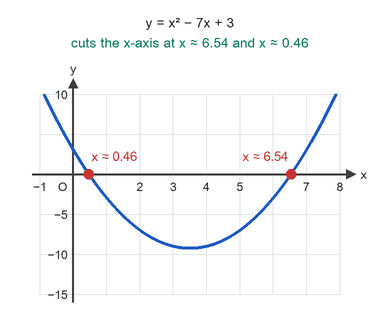
Check: The sum of the two roots of a quadratic equation is . Here this is , and the rounded roots add up to exactly this value:
Watch out: Both roots are positive here, since their product and their sum are positive.
Therefore, or (correct to two decimal places).
- 71 mark
Question 7
Which of the following quadratic equations has 2 and 3 as its roots?
Solve with AIAnswer
- Correct
(A)
(B)
(C)
(D)
Answer: (A)
Concept: If and are the roots, then and are factors, so the equation is , that is, .
Step 1 — Find the sum and the product of the roots.
We add and multiply the two given roots, 2 and 3.
Step 2 — Form the equation.
We put the sum and the product into .
Step 3 — Check by substitution.
Each root must make the left side zero.
The graph of cuts the x-axis at exactly these two points:
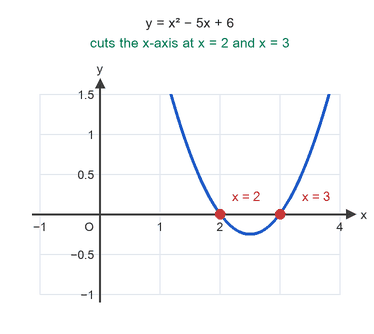
Watch out: The middle term carries a minus sign in front of the sum. A sum of gives .
Why the other options are wrong:
- (B) : its roots are and (it factorises as ); the middle term has the wrong sign.
- (C) : its roots are 6 and (it factorises as ); the product of its roots is , not 6.
- (D) : its roots are and 1 (it factorises as ); both the sum and the product are wrong.
Therefore, the equation with roots 2 and 3 is , option (A).
- 81 mark
Question 8
One of the roots of the quadratic equation is 7.3166. The root of the equation correct to 4 significant figures is
Solve with AIAnswer
(A) 7.3166
- Correct
(B) 7.317
(C) 7.316
(D) 7.32
Answer: (B) 7.317
Concept: Significant figures are counted from the first non-zero digit. To round to 4 significant figures, keep the first four digits and look at the fifth: if it is 5 or more, add 1 to the fourth digit; if it is less than 5, leave the fourth digit as it is.
Step 1 — Count the significant figures of 7.3166.
Its digits are 7, 3, 1, 6, 6, so it has five significant figures. The first four are 7, 3, 1 and 6.
Step 2 — Look at the fifth digit.
The fifth digit is 6, which is 5 or more, so we round up: the fourth digit 6 becomes 7.
Step 3 — Check with the exact root.
By the formula the roots of are , and , which also rounds to 7.317.
Watch out: Rounding is not the same as cutting off. Dropping the last digit of 7.3166 gives 7.316, which is wrong.
Why the other options are wrong:
- (A) 7.3166: this is the given value itself, with five significant figures; it has not been rounded.
- (C) 7.316: this just cuts off the fifth digit. Since that digit is 6, the fourth digit must be rounded up to 7.
- (D) 7.32: 7.32 has only three significant figures, not four.
Therefore, the root correct to 4 significant figures is 7.317, option (B).
- 91 mark
Question 9
If 3 is a root of the quadratic equation then is equal to :
Solve with AIAnswer
- Correct
(A)
(B)
(C)
(D)
Answer: (A)
Concept: A root of an equation is a value of that makes the equation true. So we substitute the root for and solve the resulting equation for the unknown coefficient.
Step 1 — Substitute .
Since 3 is a root, we put 3 in place of in ; the result must be a true statement.
Step 2 — Solve for .
We add to both sides and then divide by 3.
Step 3 — Check.
We put back and factorise. The roots are 1 and 3, so 3 is indeed a root.
Watch out: The term is , so at it becomes , not or .
Why the other options are wrong:
- (B) : with , the left side at 3 is , which is 3, not 0.
- (C) : with , the left side at 3 is , which is −3, not 0.
- (D) : with , the left side at 3 is , which is 6, not 0.
Therefore, , option (A).
- 104 marks
Question 10
Solve the following quadratic equation :
.
Give your answer correct to one decimal place.
(Use mathematical tables if necessary.)
Solve with AIWritten solution
Solution:
Concept: For the equation , with , the roots are given by the quadratic formula: . The quantity is called the discriminant. “Correct to one decimal places” means exactly one digits after the decimal point.
Step 1 — Write down , , and the discriminant.
Comparing with , we have , and . We first work out the discriminant .
The discriminant is not a perfect square, so we use its square root to 4 decimal places (more places than the answer needs, so the rounding at the end is safe).
Step 2 — Put the values into the formula.
We substitute , and the discriminant into the quadratic formula.
Step 3 — Take the + sign and the − sign.
The sign gives two roots: first we add the square root, then we subtract it.
Step 4 — Round each root to one decimal places.
We round only now, at the very end, so that no rounding error builds up in the working. 1.4641 rounds to 1.5 (the next digit, 6, is 5 or more, so we round up); −5.4641 rounds to −5.5 (the next digit, 6, is 5 or more, so we round up).
Step 5 — See it on the graph.
The graph of meets the x-axis at the two roots, because on the x-axis the value of is zero:
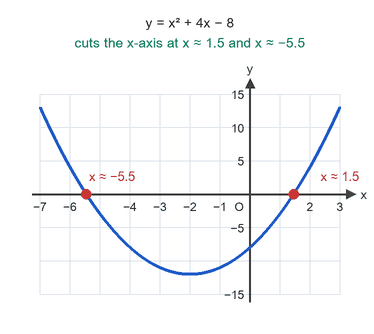
Check: The sum of the two roots of a quadratic equation is . Here this is , and the rounded roots add up to exactly this value:
Watch out: Round the final roots, not : rounding to 6.9 first would give , and an early rounding can change the last digit of the answer.
Therefore, or (correct to one decimal places).
- 111 mark
Question 11
The roots of the quadratic equation are real and equal if :
Solve with AIAnswer
(A)
- Correct
(B)
(C)
(D)
Answer: (B)
Concept: The nature of the roots of a quadratic equation , with , depends on its discriminant, : if , the roots are real and unequal (distinct); if , the roots are real and equal; if , there are no real roots (the roots are imaginary). Real and equal roots need .
Step 1 — Write down , and .
We compare with the standard form ; here , and . Notice that includes the minus sign.
Step 2 — Set the discriminant equal to zero.
For real and equal roots, ; since , this gives:
Watch out: Square the whole of , sign included: .
Why the other options are wrong:
- (A) : it puts , the coefficient of , in the place of . The squared letter must be the coefficient of , namely .
- (C) : it forgets that the square of is ; would be negative while need not be.
- (D) : an inequality cannot give equal roots (equal roots need exactly), and it again uses in the place of .
Therefore, the roots are real and equal if , option (B).
- 123 marks
Question 12
Solve the following quadratic equation for and give your answer correct to three significant figures :
- 131 mark
Question 13
The given quadratic equation has:
- 144 marks
Question 14
Solve the following quadratic equation . Give your answer correct to three significant figures.
(Use mathematical tables for this question)
- 151 mark
Question 15
The roots of the quadratic equation is:
- 163 marks
Question 16
Solve the following quadratic equation:
Give your answer correct to two places of decimals.
- 171 mark
Question 17
The nature of roots of quadratic equation are :
- 184 marks
Question 18
Solve the quadratic equation and give your answer correct to 3 significant figures.
- 191 mark
Question 19
The discriminant of the quadratic equation is 1. The value of is:
- 203 marks
Question 20
Solve the quadratic equation and give your answer correct to three significant figures.