
Question 171 markMCQAsked 2026Easy
The nature of roots of quadratic equation are :
Confirming your payment
Sign up now and get 250 free tokens.
Previous Year Questions · Question 17 of 20
The nature of roots of quadratic equation are :
(A) real and equal
(B) real, distinct and rational
(C) real, distinct and irrational
(D) no real roots
Answer: (C) real, distinct and irrational
Concept: The nature of the roots of a quadratic equation , with , depends on its discriminant, : if , the roots are real and unequal (distinct); if , the roots are real and equal; if , there are no real roots (the roots are imaginary). When and the coefficients are rational, the roots are rational if is a perfect square and irrational if it is not.
Step 1 — Write down , and .
We compare with the standard form ; here , and .
Step 2 — Find the discriminant.
We substitute in .
Step 3 — Decide the nature of the roots.
is positive, so the roots are real and distinct. 72 is not a perfect square ( and ), so is irrational and so are the roots. Indeed the roots are :
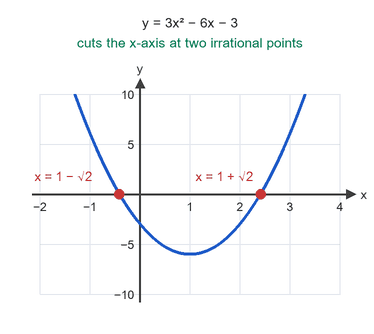
Watch out: The term works out to here (a minus times a minus is a plus), so the discriminant is , not .
Why the other options are wrong:
Therefore, the roots are real, distinct and irrational, option (C).