
Question 104 marksAsked 2023Easy
Solve the following quadratic equation :
.
Give your answer correct to one decimal place.
(Use mathematical tables if necessary.)
Confirming your payment
Sign up now and get 250 free tokens.
Previous Year Questions · Question 10 of 20
Solve the following quadratic equation :
.
Give your answer correct to one decimal place.
(Use mathematical tables if necessary.)
Solution:
Concept: For the equation , with , the roots are given by the quadratic formula: . The quantity is called the discriminant. “Correct to one decimal places” means exactly one digits after the decimal point.
Step 1 — Write down , , and the discriminant.
Comparing with , we have , and . We first work out the discriminant .
The discriminant is not a perfect square, so we use its square root to 4 decimal places (more places than the answer needs, so the rounding at the end is safe).
Step 2 — Put the values into the formula.
We substitute , and the discriminant into the quadratic formula.
Step 3 — Take the + sign and the − sign.
The sign gives two roots: first we add the square root, then we subtract it.
Step 4 — Round each root to one decimal places.
We round only now, at the very end, so that no rounding error builds up in the working. 1.4641 rounds to 1.5 (the next digit, 6, is 5 or more, so we round up); −5.4641 rounds to −5.5 (the next digit, 6, is 5 or more, so we round up).
Step 5 — See it on the graph.
The graph of meets the x-axis at the two roots, because on the x-axis the value of is zero:
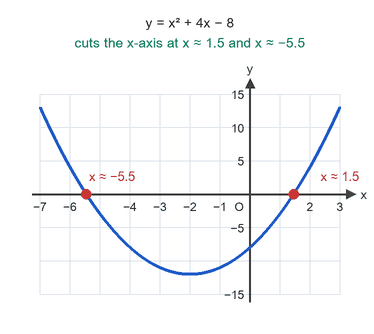
Check: The sum of the two roots of a quadratic equation is . Here this is , and the rounded roots add up to exactly this value:
Watch out: Round the final roots, not : rounding to 6.9 first would give , and an early rounding can change the last digit of the answer.
Therefore, or (correct to one decimal places).