
Question 553 marksMedium
Solve :
(i)
(ii)
Confirming your payment
Sign up now and get 250 free tokens.
Quadratic Equations · Question 55 of 82
Solve :
(i)
(ii)
Solution:
Concept: Some equations are not quadratic as they stand but become quadratic after a substitution: when an expression appears squared and also on its own (such as and ), we call it , solve the quadratic in , and then go back to . Every value found must be checked against the original equation. A quadratic with a negative discriminant has no real roots.
Step 1 — Part (i): substitute .
The expression appears squared and on its own, so we call it .
Step 2 — Factorise by splitting the middle term.
To factorise we split the middle term. We need two numbers whose product is (here ) and whose sum is (here ). They are and .
Writing the middle term as these two parts and taking out the common factor of each pair of terms:
Step 3 — Use the Zero Product Rule.
A product is zero only when at least one of its factors is zero, so we set each factor equal to zero and solve.
Step 4 — Part (i): go back to .
Each value of gives a quadratic in . We test each with its discriminant .
Both discriminants are negative, so neither equation has a real root. The graph of the left side stays above the x-axis.
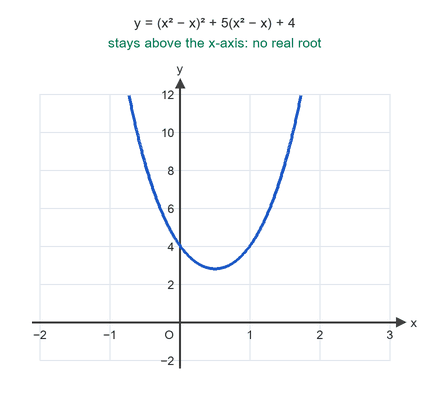
So equation (i) has no real solution.
Step 5 — Part (ii): substitute .
Here the repeated expression is , so we call it .
Step 6 — Factorise by splitting the middle term.
To factorise we split the middle term. We need two numbers whose product is (here ) and whose sum is (here ). They are and .
Writing the middle term as these two parts and taking out the common factor of each pair of terms:
Step 7 — Use the Zero Product Rule.
A product is zero only when at least one of its factors is zero, so we set each factor equal to zero and solve.
Step 8 — Part (ii): go back to when .
We bring 18 to the left side to get .
We need two numbers whose product is (here ) and whose sum is (here ). They are and .
By the Zero Product Rule, one of the factors is zero:
Step 9 — Part (ii): go back to when .
We bring −2 to the left side to get .
We need two numbers whose product is (here ) and whose sum is (here ). They are and .
By the Zero Product Rule, one of the factors is zero:
Check: In (ii), is 18 at and at , and is , or 0; it is −2 at and at , and is , or 0.
Watch out: A value of is only a step. Each one must be turned back into an equation in and solved, and that equation may have no real roots.
Therefore, (i) the equation has no real solution; (ii) or .