
Question 473 marksMedium
Find the value of for which the equation has distinct and real roots.
Confirming your payment
Sign up now and get 250 free tokens.
Quadratic Equations · Question 47 of 82
Find the value of for which the equation has distinct and real roots.
Solution:
Concept: The nature of the roots of a quadratic equation , with , depends on its discriminant, : if , the roots are real and unequal (distinct); if , the roots are real and equal; if , there are no real roots (the roots are imaginary). For distinct and real roots we need .
Given: has distinct and real roots.
Step 1 — Write down , and .
Comparing with , we have , and .
Step 2 — Write the condition .
Distinct real roots need the discriminant to be positive.
Step 3 — Solve the inequality.
We add to both sides and divide by 12. Dividing by a positive number keeps the inequality sign the same.
So can be any real number less than 3. On a number line, 3 itself is shown by an open circle because it is not included.
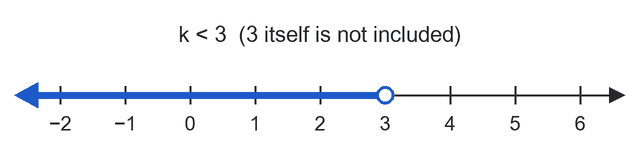
Check: For , is 36 (positive), so the roots are distinct and real; for , is 0 (equal roots), so 3 is not allowed; for , is −12 (no real roots).
Watch out: The condition is , not . At the roots are equal, not distinct.
Therefore, the equation has distinct and real roots when .