
Question 443 marksEasy
Without solving, comment upon the nature of roots of each of the following equations:
(i)
(ii)
(iii)
(iv)
Confirming your payment
Sign up now and get 250 free tokens.
Quadratic Equations · Question 44 of 82
Without solving, comment upon the nature of roots of each of the following equations:
(i)
(ii)
(iii)
(iv)
Solution:
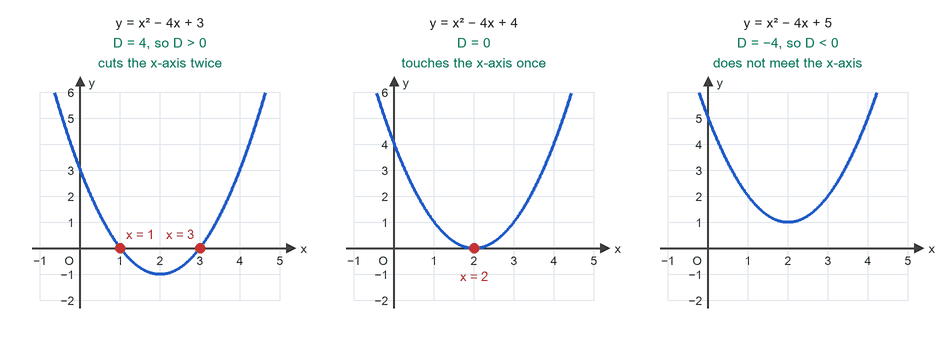
Concept: The nature of the roots of a quadratic equation , with , depends on its discriminant, : if , the roots are real and unequal (distinct); if , the roots are real and equal; if , there are no real roots (the roots are imaginary).
Step 1 — Part (i): .
Here , and . We work out the discriminant.
is positive, so the roots are real and unequal. (Since 25 is a perfect square, they are also rational.)
Step 2 — Part (ii): .
Here , and .
is positive, so the roots are real and unequal. (Since 73 is not a perfect square, they are irrational.)
Step 3 — Part (iii): .
Here , and .
, so the roots are real and equal. (Indeed, the equation is .)
Step 4 — Part (iv): .
Here , and . Note that is , or 12.
is positive, so the roots are real and unequal.
Step 5 — See the three cases on graphs.
The graphs below are for three other equations, , and . They show what each case looks like: cuts the x-axis twice, touches it once, and does not meet it.
Watch out: In (iv), makes equal to ; two minus signs give a plus.
Therefore, (i) real and unequal; (ii) real and unequal; (iii) real and equal; (iv) real and unequal.