
Question 343 marksMedium
Solve each of the following equations for and give, in each case, your answer correct to one decimal place :
(i)
(ii)
Confirming your payment
Sign up now and get 250 free tokens.
Quadratic Equations · Question 34 of 82
Solve each of the following equations for and give, in each case, your answer correct to one decimal place :
(i)
(ii)
Solution:
Concept: For the equation , with , the roots are given by the quadratic formula: . The quantity is called the discriminant. Keep extra decimal places while working and round once, at the end, to the accuracy asked for.
Step 1 — Part (i): Write down , , and the discriminant.
Comparing with , we have , and . We first work out the discriminant .
The discriminant is not a perfect square, so we use its square root to 4 decimal places (more places than the answer needs, so the rounding at the end is safe).
Step 2 — Part (i): Put the values into the formula.
We substitute , and the discriminant into the quadratic formula.
Step 3 — Part (i): Take the + sign and the − sign.
The sign gives two roots: first we add the square root, then we subtract it.
Step 4 — Part (i): round to one decimal place.
7.3166 rounds to 7.3 (the next digit, 1, is less than 5, so we round down); 0.6834 rounds to 0.7 (the next digit, 8, is 5 or more, so we round up). The graph of cuts the x-axis near these two values.
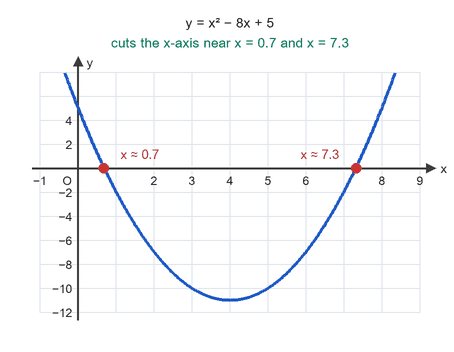
So the roots are or .
Step 5 — Part (ii): Write down , , and the discriminant.
Comparing with , we have , and . We first work out the discriminant .
The discriminant is not a perfect square, so we use its square root to 4 decimal places (more places than the answer needs, so the rounding at the end is safe).
Step 6 — Part (ii): Put the values into the formula.
We substitute , and the discriminant into the quadratic formula.
Step 7 — Part (ii): Take the + sign and the − sign.
The sign gives two roots: first we add the square root, then we subtract it.
Step 8 — Part (ii): round to one decimal place.
0.2649 rounds to 0.3 (the next digit, 6, is 5 or more, so we round up); −2.2649 rounds to −2.3 (the next digit, 6, is 5 or more, so we round up). So the roots are or .
Check: The sum of the roots must be . In (i), gives 8, the same as ; in (ii), gives −2, the same as .
Watch out: Round only at the very end. Rounding to 6.6 first can change the last digit of an answer.
Therefore, (i) or ; (ii) or .