
Question 243 marksMedium
(i) Solve : ;
(ii) Solve the equation , if possible, for real values of .
Confirming your payment
Sign up now and get 250 free tokens.
Quadratic Equations · Question 24 of 82
(i) Solve : ;
(ii) Solve the equation , if possible, for real values of .
Solution:
Concept: Clear the fractions by multiplying every term by the L.C.M. of the denominators, then factorise. A quadratic equation has no real solution when its discriminant is negative, because a negative number has no real square root.
Step 1 — Part (i): clear the fractions.
The L.C.M. of 3, and 15 is . We multiply every term by it.
Step 2 — Part (i): bring every term to one side.
We move every term to the right side, so the term is positive, and divide by 3.
Step 3 — Factorise by splitting the middle term.
To factorise we split the middle term. We need two numbers whose product is (here ) and whose sum is (here ). They are and .
Writing the middle term as these two parts and taking out the common factor of each pair of terms:
Step 4 — Use the Zero Product Rule.
A product is zero only when at least one of its factors is zero, so we set each factor equal to zero and solve.
Both values are allowed, since the only restriction is .
Check: For , both sides of the equation in part (i) work out to :
Step 5 — Part (ii): clear the fraction.
We multiply every term of by 4.
Step 6 — Part (ii): find the discriminant.
Here , and .
Step 7 — Part (ii): conclude.
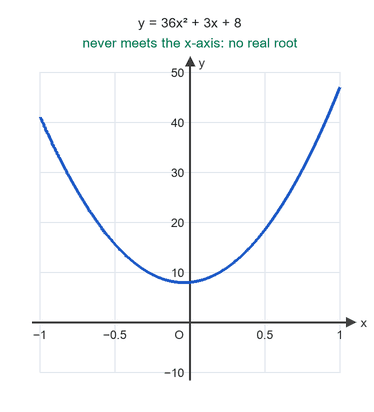
The discriminant is negative, so the equation has no real solution. The graph of confirms this: it stays above the x-axis and never meets it.
Watch out: In part (i), is ; keep the factor 2 in front when you expand.
Therefore, (i) or ; (ii) the equation has no real solution.