
Question 803 marksMedium
Without solving the following quadratic equation, find the value of '' for which the given equation has real and equal roots.
Confirming your payment
Sign up now and get 250 free tokens.
Quadratic Equations · Question 80 of 82
Without solving the following quadratic equation, find the value of '' for which the given equation has real and equal roots.
Solution:
Concept: The nature of the roots of a quadratic equation , with , depends on its discriminant, : if , the roots are real and unequal (distinct); if , the roots are real and equal; if , there are no real roots (the roots are imaginary). So real and equal roots need .
Step 1 — Write down , and .
Comparing with the standard form, we have , and .
Step 2 — Set the discriminant equal to zero.
We put equal to 0 and divide every term by 4.
Step 3 — Factorise by splitting the middle term.
To factorise we split the middle term. We need two numbers whose product is (here ) and whose sum is (here ). They are and .
Writing the middle term as these two parts and taking out the common factor of each pair of terms:
Step 4 — Use the Zero Product Rule.
A product is zero only when at least one of its factors is zero, so we set each factor equal to zero and solve.
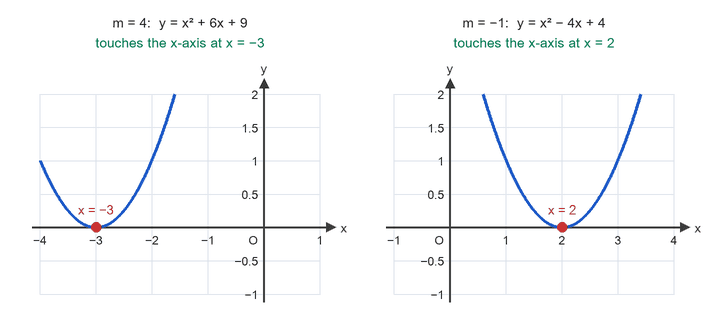
Check: With , the equation is , or ; with , it is , or . Each is a perfect square, so its two roots are equal, and each graph just touches the x-axis.
Watch out: is ; square the 2 as well.
Therefore, or .