
Opening your dashboard
Class 10 Maths Chapter 5 Quadratic Equations: Competency-Based Questions (CBQ)
40 questions on Chapter 5, each worked through on its own page with the AI tutor. Class 10 Maths, ICSE 2026-27.
40 questions
1–5 marks · Mixed difficulty
- 11 mark
Question 1
Competency: Understanding
A teacher gives four word problems. In each one the unknown is taken as and a single equation is formed. For which problem will the equation contain , so that two roots have to be found and examined?
- 21 mark
Question 2
Competency: Application
At the start of a meeting, every person shakes hands once with every other person. For persons the number of handshakes is . If there were 78 handshakes in all, the number of persons at the meeting was :
- 31 mark
Question 3
Competency: Analysis
The equation has equal roots when . If the value of is made a little more than 9 (say 9·5), the equation will have :
- 41 mark
Question 4
Competency: Analysis
Assertion (A) : For every real value of , the equation has two distinct real roots.
Reason (R) : In , if and have opposite signs, then is positive.
- 51 mark
Question 5
Competency: Analysis & Evaluation
Dev solves the equation like this : "Divide both sides by . So ." Which comment on his solution is correct?
- 61 mark
Question 6
Competency: Application & Analysis
A toy-seller notices that when he prices a toy at ₹ , he sells toys in a day. On two different days he fixed two different prices, and on both days the money he received from the toys was ₹ 800. The two prices were :
- 72 marks
Question 7
Competency: Application
A driving school uses this rule for a car on a dry road : if the speed is km/h, the car needs a distance of metres to stop. A driver sees a fallen tree 24 m ahead. Find the greatest speed at which the car can be going and still stop just in time.
- 82 marks
Question 8
Competency: Application
A square photograph is enlarged so that each side becomes 2 cm longer. The area of the enlarged photograph is exactly double the area of the original one. Find the side of the original photograph, correct to two decimal places.
- 92 marks
Question 9
Competency: Understanding & Evaluation
To solve , Maya squares both sides and gets and . Her friend says, "Both are roots, because both satisfy ." Is the friend right? Show the working and give the reason for your answer.
- 102 marks
Question 10
Competency: Analysis
A carpenter makes chairs a day. His daily profit, in hundreds of rupees, is given by . Using the discriminant, show that his daily profit can never be ₹ 3,000, but can be ₹ 2,500 for exactly one value of . Find that value.
- 113 marks
Question 11
Competency: Analysis
A teacher writes an equation of the form on the board. Asha copies the constant term wrongly and gets the roots 2 and 9. Bala copies the coefficient of wrongly and gets the roots and . Each of them copies everything else correctly. Find the equation on the board and its correct roots.
- 123 marks
Question 12
Competency: Application & Analysis
Solve by a suitable substitution. An equation of degree 4 can have four real roots. Explain why this one has only two.
- 133 marks
Question 13
Competency: Creativity
A game designer hides a two-part code in a quadratic equation. She wants an equation with integer coefficients, in which is not 1, and whose two roots are a positive fraction that is not a whole number, and a negative integer.
Design one such equation. Then solve it by the quadratic formula to show that it gives the roots you chose.
- 145 marks
Question 14
Competency: Analysis & Evaluation
Case study: The temperature (in °C) inside a cold-storage room, hours after midnight, follows the rule for the first five hours. The night guard notes the reading at every hour.
(hours after midnight) 0 1 2 3 4 5 (°C) 3 −1 −3 −3 −1 3 (a) The temperature was 0 °C at two moments. Using only the table, state between which readings each of these moments lies. Give a reason.
(b) Solve by the formula, correct to two decimal places, and check that your answers agree with (a).
(c) The guard says, "The lowest reading in my table is −3 °C, so the room never got colder than −3 °C." The owner says, "It must have touched −4 °C between two readings." Use the discriminant to test whether the room was ever at −4 °C and whether it was ever at −3·25 °C. Who is right?
- 154 marks
Question 15
Competency: Application & Analysis
Case study: A sweet shop makes open boxes from square sheets of card. A square of side 2 cm is cut from each corner of a sheet of side cm, and the four flaps are folded up to make a box 2 cm high.
(a) Write the length of the base of the box in terms of . Show that if the volume of the box is 392 cm³, then .
(b) Solve this equation and find the side of the sheet. Explain why one root is rejected.
(c) For a smaller box of volume 300 cm³, find the side of the sheet needed, correct to two decimal places.
- 161 mark
Question 16
Competency: Understanding & Analysis
Meena looks at the equation and says it is a quadratic equation because squares appear in it. After simplifying the equation, which statement is correct?
- 171 mark
Question 17
Competency: Application
A square notice board has side cm. A strip 3 cm wide is cut off along one edge, as shown in the figure, and the area of the board that is left is 70 cm².
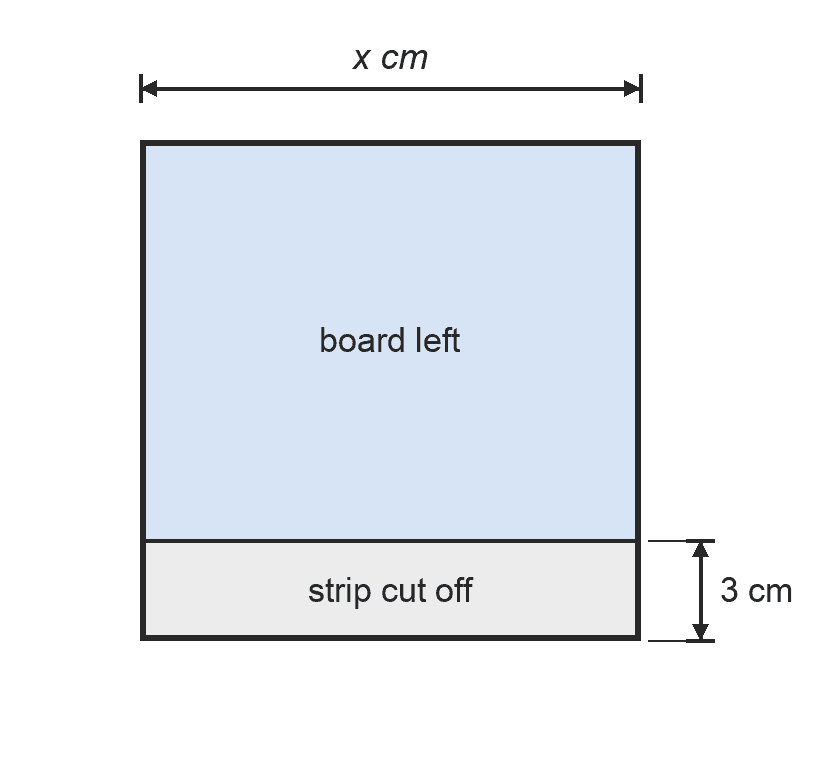
The side of the original board is :
- 181 mark
Question 18
Competency: Analysis
Isha solves with the formula . By mistake she takes instead of , but and are taken correctly. She gets the roots and . The correct roots of the equation are :
- 191 mark
Question 19
Competency: Analysis
Rohan wants to factorise into two brackets , where and are integers (positive or negative), by splitting the middle term. For which of the following values of is this not possible?
- 201 mark
Question 20
Competency: Analysis & Evaluation
Assertion (A) : is a root of the equation .
Reason (R) : A fraction is equal to zero only when its numerator is zero and its denominator is not zero.
- 211 mark
Question 21
Competency: Analysis
Assertion (A) : The equation has no real roots.
Reason (R) : The equation is a pure quadratic equation, that is, it has no term in .
- 221 mark
Question 22
Competency: Application
Kiran wants to solve by splitting the middle term. He must write as the sum of two terms so that the four terms can be grouped into common factors. Which split works?
- 231 mark
Question 23
Competency: Analysis
The table gives the value of for some integer values of .
−3 −2 −1 0 1 2 3 4 6 0 −4 −6 −6 −4 0 6 Using only the table, the roots of the equation are :
- 241 mark
Question 24
Competency: Application
The area of a square tile, in cm², is 3 more than 6 times its side, in cm. Using the quadratic formula, the side of the tile, correct to two decimal places, is :
- 251 mark
Question 25
Competency: Analysis & Evaluation
The quadratic equation has real roots. The values of for which this is possible are :
- 262 marks
Question 26
Competency: Application
The length of a rectangular hall is 5 m more than twice its breadth. The floor area of the hall is 100 m². Find the breadth of the hall, correct to two decimal places, and then its length.
- 272 marks
Question 27
Competency: Application
Solve by the quadratic formula. Give the roots in their simplest surd form, and check one root by substitution.
- 282 marks
Question 28
Competency: Analysis
The two equations and differ only in the constant term. Without solving them, find which of the two has rational roots. Then solve that equation to confirm your answer.
- 292 marks
Question 29
Competency: Understanding & Application
Solve by putting . Then explain why this substitution is quicker than expanding the brackets.
- 302 marks
Question 30
Competency: Analysis & Application
Solving a quadratic equation with whole-number coefficients by the formula, a student got the roots . Taking as the smallest possible positive whole number, find the equation.
- 312 marks
Question 31
Competency: Understanding & Analysis
Explain why cannot be solved by factorising into brackets with whole-number terms. Then solve it by the quadratic formula, correct to two decimal places.
- 323 marks
Question 32
Competency: Analysis & Evaluation
A designer wants the equation to have real roots, where is a positive whole number. For and , find the discriminant and state whether the roots are real and distinct, real and equal, or not real. Hence state the smallest positive whole-number value of that gives real roots, and find the root at that value.
- 333 marks
Question 33
Competency: Application & Analysis
Shreya has to solve by the quadratic formula, but she wants to avoid working with fractions.
(a) Write an equation with integer coefficients that has the same roots, and say why the roots do not change.
(b) Find its discriminant and state the nature of the roots.
(c) Solve the equation, giving the roots correct to two decimal places.
- 343 marks
Question 34
Competency: Creativity
Write a short word problem, not about the area of a rectangle, in which the equation is formed. Then solve the equation and say which root fits your problem and why.
- 353 marks
Question 35
Competency: Evaluation & Application
For each equation below, choose the quickest method from these three : taking the square root of both sides, taking out a common factor, or using the identity . Give a reason for your choice, and then solve the equation.
(a)
(b)
(c)
- 363 marks
Question 36
Competency: Analysis
By taking , find how many distinct real roots each equation has, and write the roots when they exist.
(a)
(b)
(c)
- 375 marks
Question 37
Competency: Analysis & Evaluation
Case study: A teacher wrote four quadratic equations on a worksheet. A student looked at each equation and noted, in the table below, what she thought about its roots. (Hypothetical data.)
Equation Student's claim E1 : two distinct real roots E2 : two equal real roots E3 : two distinct real roots E4 : no real roots (a) Find the discriminant of each equation.
(b) Say which of the claims are correct. Write the correct statement for every wrong claim.
(c) Solve the equations that have real roots. Give the irrational roots correct to two decimal places.
- 384 marks
Question 38
Competency: Application & Analysis
Case study: For a school art fair, a team makes square-tile patterns in stages. Each stage is a separate, complete pattern. The table shows the number of tiles in the first four stages, and the team notices that stage uses tiles. (Hypothetical data.)
Stage 1 2 3 4 Tiles 4 10 18 28 (a) Check the rule against the table. Then find, by factorisation, the stage that uses exactly 108 tiles.
(b) Use the discriminant to explain why no stage uses exactly 50 tiles.
(c) The team has 200 tiles for one pattern. Use the quadratic formula to find the highest stage it can make, and the number of tiles left over.
- 395 marks
Question 39
Competency: Analysis & Evaluation
Case study: In a maths quiz, the first card shows the equation . The second card shows , where the team chooses the number . A team wins the round if the two equations have a root in common.
(a) Solve the first equation by factorisation.
(b) Find every value of for which the two equations have a common root. For each such value, solve the second equation.
(c) A team member says, "For the equations also have a common root, and for some values of the second equation has no real roots at all." Check both parts of this claim.
- 404 marks
Question 40
Competency: Application & Analysis
Case study: Neha works out the value of an expression for four values of and records them in a table. Later she cannot read the numbers and in her notebook.
0 1 2 3 −15 −14 −9 0 (a) Use the table to find and , and check your values with one more column.
(b) Solve the equation by factorisation. Which column of the table confirms one of the roots?
(c) Find the values of for which .