
Opening your dashboard
Class 9 Physics Chapter 5: Upthrust in Fluids, Archimedes' Principle and Floatation Solutions
143 textbook questions with step-by-step answers, free to read, for ICSE 2026-27.
Get talked through Ch 5, not just shown the answer
Reading a finished solution is not the same as being able to do it. The AI tutor takes one question at a time and works it with you, in your own words, until you can.
- Ask it out loud, in your own words
- It gives you the next step, not the answer
- Stuck on part (ii)? Start there
143 questions with solutions
1–5 marks · Mixed difficulty
The first 46 solutions are on this page. This chapter is a long one, so the rest open on their own page to keep this one quick to load.
- 11 mark
Question 1
The property of a liquid to exert an upward force on a body immersed in it is called :
Solve with AIAnswer
- Correct
(A) buoyancy
(B) pressure
(C) friction
(D) viscosity
Answer: (A) buoyancy
Concept: When a body is immersed wholly or partly in a fluid (a liquid or a gas), the fluid pushes it upwards. This upward force is called the upthrust or buoyant force, and this property of the fluid is called buoyancy. Upthrust is a force, so its S.I. unit is the newton (N).
Step 1 — See what is described.
The question describes a property of a liquid: its ability to push upwards on a body placed in it.
Step 2 — Name the property.
The upward force itself is called the upthrust or buoyant force. The property of the liquid that produces this force is called buoyancy.
Watch out: Do not confuse the property (buoyancy) with the force it produces (upthrust).
Why the other options are wrong:
- (B) pressure: Pressure is thrust per unit area; at a point in a liquid it acts equally in all directions, not only upwards.
- (C) friction: Friction is a force that opposes the sliding of one surface over another; it is not an upward push of a liquid.
- (D) viscosity: Viscosity is the internal friction of a liquid that opposes the flow of its layers past each other.
Therefore, the property is called buoyancy, option (A).
- 21 mark
Question 2
If an empty can is pushed into water, we feel :
Solve with AIAnswer
(A) a downward force
- Correct
(B) an upward force
(C) it is easy to push the can into water
(D) both (a) and (c)
Answer: (B) an upward force
Concept: When a body is immersed wholly or partly in a fluid (a liquid or a gas), the fluid pushes it upwards. This upward force is called the upthrust or buoyant force, and this property of the fluid is called buoyancy. Upthrust is a force, so its S.I. unit is the newton (N).
Step 1 — Picture the experiment.
An empty can is mostly air, so it floats. When we press it into water, the water exerts an upthrust on the part of the can that is under water.
Step 2 — See how the push changes.
The deeper we push the can, the more water it displaces, so the upthrust grows. We feel this growing force pushing the can up against our hand.
Watch out: The force on the hand is felt as resistance to pushing down; that resistance is the upward upthrust.
Why the other options are wrong:
- (A) a downward force: The water pushes the can up, not down; a downward force would help us push it in.
- (C) it is easy to push the can into water: Pushing the can in gets harder, not easier, because the upthrust increases as more of the can goes under.
- (D) both (a) and (c): Both parts named in this option are wrong, so their combination is wrong too.
Therefore, we feel an upward force, option (B).
- 31 mark
Question 3
The effect of upthrust is that the weight of a body immersed in a liquid appears to be :
Solve with AIAnswer
(A) more than its actual weight
(B) the same as its weight outside the liquid
- Correct
(C) less than its actual weight
(D) None of these
Answer: (C) less than its actual weight
Concept: Upthrust acts upwards, against the weight. So a spring balance holding a body in a liquid shows the apparent weight, which is the true weight minus the upthrust. The loss in weight is therefore equal to the upthrust.
Step 1 — Name the forces.
A body in a liquid has its weight acting downwards and the upthrust acting upwards.
Step 2 — Find the apparent weight.
The upthrust supports part of the weight, so the net downward force (the apparent weight) is smaller than the true weight.
Watch out: Upthrust never adds to the weight; it always reduces the reading.
Why the other options are wrong:
- (A) more than its actual weight: Upthrust acts upwards, so it can only reduce the apparent weight, never increase it.
- (B) the same as its weight outside the liquid: The weight would seem unchanged only if there were no upthrust, but every liquid exerts one.
- (D) None of these: Option (C) is correct, so 'None of these' cannot be the answer.
Therefore, the weight appears less than the actual weight, option (C).
- 41 mark
Question 4
Which of the following are the correct characteristic properties of upthrust ?
(i) the smaller the volume of a body submerged in a liquid, the smaller is the upthrust
(ii) the upthrust acts on the body in an upward direction at the centre of buoyancy
(iii) for the same volume of a body inside a fluid, the less the density of the fluid, greater will be the upthrust
Solve with AIAnswer
- Correct
(A) (i) & (ii)
(B) (i) & (iii)
(C) (ii) & (iii)
(D) (i), (ii) & (iii)
Answer: (A) statements 1 and 2
Concept: The upthrust on a body is the weight of the fluid it displaces. If a volume of the body is under a fluid of density , the upthrust is . So the upthrust grows with the volume submerged and with the density of the fluid, and it does not depend on the material of the body.
Step 1 — Test statement 1.
A smaller submerged volume displaces less liquid, and the upthrust is the weight of the liquid displaced. So the upthrust is smaller. Statement 1 is true.
Step 2 — Test statement 2.
Upthrust acts vertically upwards through the centre of buoyancy, the centre of gravity of the displaced liquid. Statement 2 is true.
Step 3 — Test statement 3.
For the same submerged volume, the upthrust is proportional to the density of the fluid. A less dense fluid gives a smaller upthrust, not a greater one. Statement 3 is false.
Step 4 — Pick the option.
Only statements 1 and 2 are correct.
Watch out: Statement 3 sounds reasonable but is reversed: denser fluids push up harder.
Why the other options are wrong:
- (B) statements 1 and 3: It includes statement 3, which is false.
- (C) statements 2 and 3: It includes statement 3, which is false.
- (D) all three statements: Statement 3 is false, so all three cannot be correct.
Therefore, statements 1 and 2 are correct, option (A).
- 51 mark
Question 5
The S.I. unit of upthrust is :
Solve with AIAnswer
(A) Pa
- Correct
(B) N
(C) kg
(D) kg m
Answer: (B) N
Concept: When a body is immersed wholly or partly in a fluid (a liquid or a gas), the fluid pushes it upwards. This upward force is called the upthrust or buoyant force, and this property of the fluid is called buoyancy. Upthrust is a force, so its S.I. unit is the newton (N).
Step 1 — Decide what kind of quantity upthrust is.
Upthrust is an upward force exerted by a fluid.
Step 2 — Give its unit.
Every force is measured in newton in the S.I. system, so the unit of upthrust is the newton (N).
Why the other options are wrong:
- (A) Pa: The pascal (Pa) is the unit of pressure, which is force per unit area.
- (C) kg: The kilogram (kg) is the unit of mass, not of force.
- (D) kg m: kg m² is the unit of moment of inertia, not of force.
Therefore, the S.I. unit of upthrust is the newton, option (B).
- 61 mark
Question 6
The correct relation for upthrust on a solid of volume V immersed in a liquid of density ρ is :
Solve with AIAnswer
(A)
(B)
- Correct
(C)
(D)
Answer: (C) the product Vρg
Concept: Archimedes' principle: when a body is immersed wholly or partly in a fluid, it experiences an upthrust equal to the weight of the fluid displaced by it. Because of this upthrust the body seems to lose weight, and this apparent loss in weight equals the weight of the fluid displaced.
Step 1 — Find the volume displaced.
A solid of volume that is fully immersed pushes aside a volume of the liquid.
Step 2 — Find the mass of that liquid.
Mass is volume times density, so the displaced liquid has mass .
Step 3 — Find its weight.
Weight is mass times . By Archimedes' principle this weight is the upthrust.
Watch out: Upthrust grows with each of , and , so it must be their product; dividing by any of them is wrong.
Why the other options are wrong:
- (A) V_s divided by g: It divides by and uses no density, so it is not a force at all.
- (B) ρg divided by V: It divides by , which would make a bigger body get a smaller upthrust.
- (D) Vg divided by ρ: It divides by , which would make a denser liquid give a smaller upthrust.
Therefore, the upthrust is the product of V, ρ and g, option (C).
- 71 mark
Question 7
Archimedes' principle applies on :
Solve with AIAnswer
(A) solids and liquids
- Correct
(B) liquids and gases
(C) solids and gases
(D) solids, liquids and gases
Answer: (B) liquids and gases
Concept: Archimedes' principle: when a body is immersed wholly or partly in a fluid, it experiences an upthrust equal to the weight of the fluid displaced by it. Because of this upthrust the body seems to lose weight, and this apparent loss in weight equals the weight of the fluid displaced.
Step 1 — See where the principle applies.
Archimedes' principle is about the upthrust exerted by a fluid. Fluids are substances that can flow: liquids and gases.
Step 2 — Check gases too.
A body in air also loses a tiny weight, equal to the weight of the air it displaces. This is why a hydrogen balloon rises.
Watch out: The body itself may be a solid, but the principle is about the medium that surrounds it.
Why the other options are wrong:
- (A) solids and liquids: A solid cannot flow round a body and press on it from all sides, so it gives no upthrust.
- (C) solids and gases: It includes solids, which exert no upthrust, and leaves out liquids.
- (D) solids, liquids and gases: It includes solids, which exert no upthrust.
Therefore, Archimedes' principle applies to liquids and gases, option (B).
- 81 mark
Question 8
If a body is completely immersed in a liquid, the volume of the liquid displaced will be ................ its own volume and the upthrust will be .............
Solve with AIAnswer
(A) less than, minimum
(B) equal to, minimum
(C) more than, maximum
- Correct
(D) equal to, maximum
Answer: (D) equal to, maximum
Concept: The upthrust on a body is the weight of the fluid it displaces. If a volume of the body is under a fluid of density , the upthrust is . So the upthrust grows with the volume submerged and with the density of the fluid, and it does not depend on the material of the body.
Step 1 — Find the volume displaced.
A completely immersed body pushes aside liquid of exactly its own volume. So the volume displaced is equal to its own volume.
Step 2 — Compare the upthrust.
This is the largest volume the body can ever displace, so the upthrust is now the largest possible, that is maximum.
Why the other options are wrong:
- (A) less than, minimum: The volume displaced is less than the body's volume only while it is partly immersed.
- (B) equal to, minimum: The volume is equal, but the upthrust is then maximum, not minimum.
- (C) more than, maximum: A body can never displace more liquid than its own volume.
Therefore, the volume displaced is equal to its own volume and the upthrust is maximum, option (D).
- 91 mark
Question 9
The apparent loss in weight is equal to the upthrust on the body verifies :
Solve with AIAnswer
(A) Pascal's law
(B) Newton's third law
- Correct
(C) Archimedes' principle
(D) Newton's second law
Answer: (C) Archimedes' principle
Concept: Archimedes' principle: when a body is immersed wholly or partly in a fluid, it experiences an upthrust equal to the weight of the fluid displaced by it. Because of this upthrust the body seems to lose weight, and this apparent loss in weight equals the weight of the fluid displaced.
Step 1 — Match the statement to a law.
The statement links the apparent loss in weight of a body in a liquid to the upthrust on it. Archimedes' principle says exactly this: the loss in weight is equal to the upthrust, which is the weight of the liquid displaced.
Why the other options are wrong:
- (A) Pascal's law: Pascal's law is about pressure applied to an enclosed liquid being passed on equally in all directions.
- (B) Newton's third law: Newton's third law says that action and reaction are equal and opposite.
- (D) Newton's second law: Newton's second law relates force to the rate of change of momentum.
Therefore, the statement verifies Archimedes' principle, option (C).
- 101 mark
Question 10
A body weighed 'W' in air by a sensitive spring balance, will weigh ........... in vacuum.
Solve with AIAnswer
(A) the same
- Correct
(B) slightly more
(C) slightly less
(D) zero
Answer: (B) slightly more
Concept: Upthrust acts upwards, against the weight. So a spring balance holding a body in a liquid shows the apparent weight, which is the true weight minus the upthrust. The loss in weight is therefore equal to the upthrust. Air is also a fluid, so it too exerts a small upthrust.
Step 1 — Look at the reading in air.
In air the body displaces some air and gets a small upthrust from it. The spring balance shows the true weight minus this small upthrust.
Step 2 — Look at the reading in vacuum.
In vacuum there is no air, so there is no upthrust. The balance now shows the full true weight, which is slightly more than .
Watch out: The change is very small because air is very light, but it is an increase, not a decrease.
Note: The reading does not become 'slightly less'; with no upthrust in vacuum the reading increases (Short 5 of this exercise asks the same idea).
Why the other options are wrong:
- (A) the same: The reading changes because the upthrust of air is removed.
- (C) slightly less: Removing an upward force cannot make the reading smaller.
- (D) zero: The body still has weight in vacuum; only the upthrust of air is missing.
Therefore, the body weighs slightly more in vacuum, option (B).
- 111 mark
Question 11
Floating of a cork on the surface of water indicates that :
Solve with AIAnswer
- Correct
(A) the density of water is more than the density of cork.
(B) the density of water is less than the density of cork.
(C) the density of water is equal to the density of cork.
(D) the density of water plays no role in the floatation of cork.
Answer: (A) the density of water is more than the density of cork
Concept: When a body is let go inside a liquid, two forces act on it: its weight downwards and the upthrust upwards. If it sinks; if it rises and floats with a part above the surface; if the two are equal it stays wherever it is placed. For a fully immersed body this is the same as comparing its density with the density of the liquid.
Step 1 — Recall the floating condition.
A body floats on a liquid with a part above the surface when its density is less than the density of the liquid.
Step 2 — Apply it to cork.
Cork floats on water, so the density of cork is less than that of water. In other words, the density of water is more than that of cork.
Why the other options are wrong:
- (B) the density of water is less than the density of cork: If water were less dense than cork, the cork would sink.
- (C) the density of water is equal to the density of cork: With equal densities the cork would stay fully under the surface wherever it was placed, not float on top.
- (D) the density of water plays no role in the floatation of cork: Whether a body floats depends directly on the density of the liquid.
Therefore, the density of water is more than that of cork, option (A).
- 121 mark
Question 12
Sinking of an iron nail in water implies that :
Solve with AIAnswer
- Correct
(A) the density of nail is more than the density of water
(B) the density of nail is less than the density of water
(C) the density of nail is equal to the density of water
(D) the sinking of nail does not depend upon the density of water
Answer: (A) the density of nail is more than the density of water
Concept: When a body is let go inside a liquid, two forces act on it: its weight downwards and the upthrust upwards. If it sinks; if it rises and floats with a part above the surface; if the two are equal it stays wherever it is placed. For a fully immersed body this is the same as comparing its density with the density of the liquid.
Step 1 — Recall the sinking condition.
A body sinks when its weight is more than the largest upthrust the liquid can give, which happens when the body is denser than the liquid.
Step 2 — Apply it to the nail.
Iron has a density of about 7.8 g cm and water 1 g cm, so the iron nail is denser than water and sinks.
Why the other options are wrong:
- (B) the density of nail is less than the density of water: A body less dense than water floats.
- (C) the density of nail is equal to the density of water: A body as dense as water stays wherever it is placed inside the water; it does not sink.
- (D) the sinking of nail does not depend upon the density of water: Sinking depends on comparing the density of the nail with that of water.
Therefore, the density of the nail is more than that of water, option (A).
- 131 mark
Question 13
Bodies of density .............. than that of the liquid sink in it, while bodies of average density equal to or ............. than that of the liquid float on it.
Solve with AIAnswer
(A) smaller, greater
(B) greater, greater
- Correct
(C) greater, smaller
(D) smaller, smaller
Answer: (C) greater, smaller
Concept: When a body is let go inside a liquid, two forces act on it: its weight downwards and the upthrust upwards. If it sinks; if it rises and floats with a part above the surface; if the two are equal it stays wherever it is placed. For a fully immersed body this is the same as comparing its density with the density of the liquid.
Step 1 — Fill the first blank.
A body sinks when it is denser than the liquid, so the first blank is greater.
Step 2 — Fill the second blank.
A body floats when its average density is equal to or less than that of the liquid, so the second blank is smaller.
Why the other options are wrong:
- (A) smaller, greater: It reverses both conditions.
- (B) greater, greater: A body denser than the liquid cannot float, so 'greater' is wrong in the second blank.
- (D) smaller, smaller: A body less dense than the liquid cannot sink, so 'smaller' is wrong in the first blank.
Therefore, the blanks are 'greater' and 'smaller', option (C).
- 141 mark
Question 14
A body will experience minimum upthrust when it is completely immersed in :
Solve with AIAnswer
- Correct
(A) turpentine
(B) water
(C) glycerine
(D) mercury.
Answer: (A) turpentine
Concept: The upthrust on a body is the weight of the fluid it displaces. If a volume of the body is under a fluid of density , the upthrust is . So the upthrust grows with the volume submerged and with the density of the fluid, and it does not depend on the material of the body.
Step 1 — See what stays the same.
The body is completely immersed every time, so the volume displaced is the same in each liquid. The upthrust then depends only on the density of the liquid.
Step 2 — Compare the densities.
Approximate densities are: turpentine 0.87 g cm, water 1.0 g cm, glycerine 1.26 g cm and mercury 13.6 g cm. Turpentine is the least dense, so it gives the least upthrust.
Why the other options are wrong:
- (B) water: Water (1.0 g cm) is denser than turpentine, so it gives more upthrust.
- (C) glycerine: Glycerine (about 1.26 g cm) is denser still.
- (D) mercury: Mercury (13.6 g cm) is the densest of the four and gives the maximum upthrust.
Therefore, the minimum upthrust is in turpentine, option (A).
- 151 mark
Question 15
A body of density ρ sinks in a liquid of density . The densities ρ and are related as :
Solve with AIAnswer
(A)
(B)
- Correct
(C)
(D) nothing can be said.
Answer: (C) ρ greater than ρ_L
Concept: When a body is let go inside a liquid, two forces act on it: its weight downwards and the upthrust upwards. If it sinks; if it rises and floats with a part above the surface; if the two are equal it stays wherever it is placed. For a fully immersed body this is the same as comparing its density with the density of the liquid.
Step 1 — Use the sinking condition.
A body sinks when it is denser than the liquid, so the density of the body is greater than the density of the liquid.
Why the other options are wrong:
- (A) ρ equal to ρ_L: With equal densities the body stays wherever it is placed inside the liquid; it does not sink.
- (B) ρ less than ρ_L: A body less dense than the liquid floats.
- (D) nothing can be said: The fact that the body sinks tells us clearly which density is larger.
Therefore, ρ is greater than ρ_L, option (C).
- 161 mark
Question 16
In what direction and at what point does the buoyant force on a body due to a liquid, act ?
Solve with AIWritten solution
Solution:
Concept: The centre of buoyancy B is the point through which the upthrust acts. It is the centre of gravity of the displaced liquid, that is, of the submerged part of the body. The weight acts at the centre of gravity G of the whole body.
Step 1 — State the direction.
The buoyant force always acts against gravity, so it acts vertically upwards.
Step 2 — State the point.
It acts at the centre of buoyancy, which is the centre of gravity of the liquid displaced by the body.
Watch out: The centre of buoyancy is not always the centre of gravity of the body; it is the centre of the displaced liquid.
Therefore, the buoyant force acts vertically upwards, at the centre of buoyancy (the centre of gravity of the displaced liquid).
- 171 mark
Question 17
Define upthrust and state its S.I. unit.
Solve with AIWritten solution
Solution:
Concept: When a body is immersed wholly or partly in a fluid (a liquid or a gas), the fluid pushes it upwards. This upward force is called the upthrust or buoyant force, and this property of the fluid is called buoyancy. Upthrust is a force, so its S.I. unit is the newton (N).
Step 1 — Define upthrust.
Upthrust (buoyant force) is the upward force exerted by a fluid (a liquid or a gas) on a body wholly or partly immersed in it.
Step 2 — State its unit.
Upthrust is a force, so its S.I. unit is the newton (N).
Therefore, upthrust is the upward force exerted by a fluid on a body immersed in it, and its S.I. unit is the newton (N).
- 181 mark
Question 18
Why is a force needed to keep a block of wood inside water ?
Solve with AIWritten solution
Solution:
Concept: When a body is let go inside a liquid, two forces act on it: its weight downwards and the upthrust upwards. If it sinks; if it rises and floats with a part above the surface; if the two are equal it stays wherever it is placed. For a fully immersed body this is the same as comparing its density with the density of the liquid.
Step 1 — Compare the forces under water.
Wood is less dense than water. When the block is held completely under water, it displaces water of its own volume, and that water weighs more than the block. So the upthrust is more than the weight.
Step 2 — See what the extra force does.
The net force on the block is upwards and would push it to the surface. To keep it inside, we must apply an extra downward force equal to the upthrust minus the weight.
Therefore, a force is needed because the upthrust on the fully submerged wood is more than its weight.
- 192 marks
Question 19
A body experiences an upthrust in river water and in sea water when dipped up to the same level. Which is more or ? Give reason.
Solve with AIWritten solution
Solution:
Concept: The upthrust on a body is the weight of the fluid it displaces. If a volume of the body is under a fluid of density , the upthrust is . So the upthrust grows with the volume submerged and with the density of the fluid, and it does not depend on the material of the body.
Step 1 — See what is the same.
The body is dipped up to the same level in both, so the volume under the liquid is the same in both.
Step 2 — Compare the densities.
Sea water has salts dissolved in it, so it is denser than river water.
Step 3 — Compare the upthrusts.
Since the upthrust is and only differs, the denser sea water gives the greater upthrust.
Therefore, F₂ (in sea water) is more than F₁, because sea water is denser than river water.
- 202 marks
Question 20
A body of volume V and density ρ is kept completely immersed in a liquid of density . If g is the acceleration due to gravity, write expressions for the following :
(i) the weight of the body,
(ii) the upthrust on the body,
(iii) the apparent weight of the body in liquid,
(iv) the loss in weight of the body.
Solve with AIWritten solution
Solution:
Concept: Weight uses the density of the body; upthrust uses the density of the liquid. For a fully immersed body both use the same volume . Upthrust acts upwards, against the weight. So a spring balance holding a body in a liquid shows the apparent weight, which is the true weight minus the upthrust. The loss in weight is therefore equal to the upthrust.
(i)
Step 1 — Weight of the body.
The mass of the body is its volume times its density, , and weight is mass times .
(ii)
Step 2 — Upthrust on the body.
The body displaces a volume of liquid of density ; the weight of that liquid is the upthrust.
(iii)
Step 3 — Apparent weight.
The apparent weight is the weight minus the upthrust.
(iv)
Step 4 — Loss in weight.
The loss in weight is the weight minus the apparent weight, which is just the upthrust.
Watch out: Use ρ (the body) for the weight and ρ_L (the liquid) for the upthrust; mixing them up is the commonest slip.
Therefore, (i) W is Vρg, (ii) the upthrust is Vρ_L g, (iii) the apparent weight is V(ρ − ρ_L)g, and (iv) the loss in weight is Vρ_L g.
- 212 marks
Question 21
Complete the following sentences :
(a) Two balls, one of iron and the other of aluminium experience the same upthrust when dipped completely in water if ..........................
(b) An empty tin container with its mouth closed has an average density equal to that of a liquid. The container is taken 2 m below the surface of that liquid and is left there. Then the container will ........................
(c) A piece of wood is held under water. The upthrust on it will be ................. the weight of the wood piece.
Solve with AIWritten solution
Solution:
Concept: The upthrust on a body is the weight of the fluid it displaces. If a volume of the body is under a fluid of density , the upthrust is . So the upthrust grows with the volume submerged and with the density of the fluid, and it does not depend on the material of the body. When a body is let go inside a liquid, two forces act on it: its weight downwards and the upthrust upwards.
(a)
Step 1 — Two balls in water.
The upthrust depends only on the volume submerged and the liquid, not on the material. Iron and aluminium balls get the same upthrust when they are completely dipped in water if they have equal volumes.
(b)
Step 2 — Closed tin of the same average density.
Its weight equals the upthrust on it when fully immersed, so no net force acts on it. Left 2 m below the surface, the container stays where it is.
(c)
Step 3 — Wood held under water.
Wood is less dense than water, so the water it displaces when fully under weighs more than the wood. The upthrust is more than the weight of the wood piece; that is why it rises when released.
Therefore, (a) both balls have equal volumes, (b) it will remain at the same position 2 m below the surface, and (c) the upthrust is more than the weight of the wood.
- 221 mark
Question 22
A sphere of iron and another of wood of the same radius are held under water. Compare the upthrust on the two spheres.
[Hint : Both have equal volume inside water.]
Solve with AIWritten solution
Solution:
Concept: The upthrust on a body is the weight of the fluid it displaces. If a volume of the body is under a fluid of density , the upthrust is . So the upthrust grows with the volume submerged and with the density of the fluid, and it does not depend on the material of the body.
Step 1 — Compare the volumes.
Both spheres have the same radius , so both have the same volume .
Step 2 — Compare the water displaced.
Held completely under water, each sphere displaces water of its own volume, so both displace the same weight of water. The material (iron or wood) does not matter.
Step 3 — Write the ratio.
Equal weights of water displaced give equal upthrusts.
Watch out: The iron sphere is heavier, but weight does not decide the upthrust; volume does.
Therefore, the upthrust on the two spheres is the same, in the ratio 1 : 1.
- 232 marks
Question 23
A body of density ρ is immersed in a liquid of density . State condition when the body will (i) float, (ii) sink, in liquid.
Solve with AIWritten solution
Solution:
Concept: When a body is let go inside a liquid, two forces act on it: its weight downwards and the upthrust upwards. If it sinks; if it rises and floats with a part above the surface; if the two are equal it stays wherever it is placed. For a fully immersed body this is the same as comparing its density with the density of the liquid.
(i)
Step 1 — Condition to float.
The body floats when its density is less than or equal to the density of the liquid. If it is less, it floats with a part above the surface; if equal, it floats just fully submerged.
(ii)
Step 2 — Condition to sink.
The body sinks when its density is more than the density of the liquid.
Therefore, (i) the body floats if ρ ≤ ρ_L, and (ii) it sinks if ρ > ρ_L.
- 241 mark
Question 24
State Archimedes' principle.
Solve with AIWritten solution
Solution:
Concept: Archimedes' principle connects the upthrust on a body with the fluid it pushes aside.
Step 1 — State the principle.
When a body is immersed partially or wholly in a liquid (or any fluid), it experiences an upthrust which is equal to the weight of the liquid displaced by it.
Step 2 — Say what this means.
Because of this upthrust the body appears to lose weight, and this apparent loss in weight equals the weight of the liquid displaced.
Watch out: The principle compares the upthrust with the WEIGHT of the liquid displaced, not with its volume.
Therefore, a body immersed wholly or partly in a fluid experiences an upthrust equal to the weight of the fluid displaced by it.
- 252 marks
Question 25
What is meant by the term buoyancy ?
Solve with AIWritten solution
Solution:
Concept: When a body is immersed wholly or partly in a fluid (a liquid or a gas), the fluid pushes it upwards. This upward force is called the upthrust or buoyant force, and this property of the fluid is called buoyancy. Upthrust is a force, so its S.I. unit is the newton (N).
Step 1 — Define buoyancy.
Buoyancy is the property of a liquid (or any fluid) by which it exerts an upward force on a body wholly or partly immersed in it.
Step 2 — Name the force.
The upward force produced is called the upthrust or buoyant force.
Step 3 — Give an example.
A mug full of water feels lighter while it is still inside the water of a bucket than when it is lifted out; the water's buoyancy supports part of its weight.
Therefore, buoyancy is the property of a fluid to exert an upward force (upthrust) on a body immersed in it.
- 263 marks
Question 26
What is the cause of upthrust ? At which point it can be considered to act ?
Solve with AIWritten solution
Solution:
Concept: Pressure in a liquid increases with depth: at depth in a liquid of density it is . The bottom of an immersed body is deeper than its top, so the liquid pushes up on the bottom harder than it pushes down on the top. This difference is the upthrust.
Step 1 — Look at the sideways thrusts.
The liquid presses on every face of the immersed body. At any one depth the pushes on opposite sides are equal and opposite, so the sideways thrusts cancel.
Step 2 — Compare the top and the bottom.
The bottom face is deeper than the top face. Pressure grows with depth, so the liquid pushes up on the bottom face with a greater thrust than it pushes down on the top face.
Step 3 — Find the cause of upthrust.
The difference between these two thrusts is an upward force. This is the upthrust.
Step 4 — Point of action.
The upthrust acts at the centre of buoyancy, the centre of gravity of the liquid displaced by the body.
Therefore, upthrust is caused by the greater liquid pressure on the lower surface than on the upper surface, and it acts at the centre of buoyancy.
- 273 marks
Question 27
State three characteristic properties of upthrust.
Solve with AIWritten solution
Solution:
Concept: The upthrust on a body is the weight of the fluid it displaces. If a volume of the body is under a fluid of density , the upthrust is . So the upthrust grows with the volume submerged and with the density of the fluid, and it does not depend on the material of the body.
Step 1 — Property 1: it depends on the volume submerged.
The upthrust increases with the volume of the body submerged. It is greatest when the body is completely immersed.
Step 2 — Property 2: it depends on the density of the liquid.
For the same submerged volume, the upthrust increases with the density of the liquid. A body gets more upthrust in sea water than in fresh water, and much more in mercury.
Step 3 — Property 3: its direction and point.
The upthrust acts vertically upwards through the centre of buoyancy, the centre of gravity of the displaced liquid.
Watch out: For a fully immersed body the upthrust does not change with depth, and it does not depend on the material of the body.
Therefore, upthrust increases with the volume submerged, increases with the density of the liquid, and acts vertically upwards through the centre of buoyancy.
- 282 marks
Question 28
A piece of wood if left under water, comes to the surface. Explain the reason.
Solve with AIWritten solution
Solution:
Concept: When a body is let go inside a liquid, two forces act on it: its weight downwards and the upthrust upwards. If it sinks; if it rises and floats with a part above the surface; if the two are equal it stays wherever it is placed. For a fully immersed body this is the same as comparing its density with the density of the liquid.
Step 1 — Compare the forces under water.
Wood is less dense than water. Completely under water, the piece displaces its own volume of water, and that water weighs more than the wood. So the upthrust is more than the weight.
Step 2 — See the motion.
The net force is upwards, so the wood rises to the surface.
Step 3 — See where it stops.
As it comes out of the surface, less of it is under water, so the upthrust falls. It stops when the upthrust has fallen to equal its weight, and then floats with only part of it under water.
Therefore, the wood comes up because, when fully under water, the upthrust on it is more than its weight.
- 292 marks
Question 29
Will a body weigh more in air or in vacuum when weighed with a spring balance ? Give a reason for your answer.
Solve with AIWritten solution
Solution:
Concept: Upthrust acts upwards, against the weight. So a spring balance holding a body in a liquid shows the apparent weight, which is the true weight minus the upthrust. The loss in weight is therefore equal to the upthrust. Air is also a fluid, so it too exerts a small upthrust.
Step 1 — Reading in air.
In air the body displaces some air and gets an upthrust equal to the weight of that air. This small upward force lowers the spring balance reading a little.
Step 2 — Reading in vacuum.
In vacuum there is no air, so there is no upthrust, and the balance shows the full, true weight.
Step 3 — Compare.
So the reading is larger in vacuum. The difference is very small, because air is very light.
Therefore, the body weighs more in vacuum, because in air the upthrust of air reduces the reading.
- 303 marks
Question 30
A metal solid cylinder tied to a thread is hanging from the hook of a spring balance. The cylinder is gradually immersed into water contained in a jar.
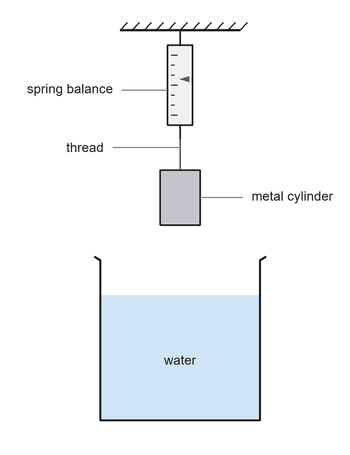
What changes do you expect in the readings of spring balance ? Explain your answer.
Solve with AIWritten solution
Solution:
Concept: Upthrust acts upwards, against the weight. So a spring balance holding a body in a liquid shows the apparent weight, which is the true weight minus the upthrust. The loss in weight is therefore equal to the upthrust. The upthrust on a body is the weight of the fluid it displaces. If a volume of the body is under a fluid of density , the upthrust is .
Step 1 — Observation while it goes in.
As the cylinder is lowered into the water, the reading of the spring balance gradually decreases.
Step 2 — Why the reading falls.
The more of the cylinder goes under water, the more water it displaces, so the upthrust increases. The reading is the weight minus the upthrust, so it decreases.
Step 3 — Observation once it is fully under.
Once the cylinder is completely immersed, the reading becomes least and then stays constant, even if the cylinder is lowered further.
Step 4 — Why it stays constant.
A fully immersed cylinder displaces its full volume of water, which cannot increase any more. So the upthrust, and the reading, no longer change with depth.
Therefore, the reading decreases gradually while the cylinder goes in, and stays constant at its least value once it is completely immersed.
- 312 marks
Question 31
A body dipped into a liquid experiences an upthrust. State two factors on which upthrust on the body depends.
Solve with AIWritten solution
Solution:
Concept: The upthrust on a body is the weight of the fluid it displaces. If a volume of the body is under a fluid of density , the upthrust is . So the upthrust grows with the volume submerged and with the density of the fluid, and it does not depend on the material of the body.
Step 1 — Factor 1.
The volume of the body submerged in the liquid: the more of the body is under the liquid, the more liquid it displaces and the greater the upthrust.
Step 2 — Factor 2.
The density of the liquid: the denser the liquid, the heavier the liquid displaced and the greater the upthrust.
Step 3 — A third factor.
The upthrust also depends on the acceleration due to gravity at that place.
Therefore, the upthrust depends on the volume of the body submerged and on the density of the liquid.
- 322 marks
Question 32
How is the upthrust related to the volume of the body submerged in a liquid ?
Solve with AIWritten solution
Solution:
Concept: The upthrust on a body is the weight of the fluid it displaces. If a volume of the body is under a fluid of density , the upthrust is . So the upthrust grows with the volume submerged and with the density of the fluid, and it does not depend on the material of the body.
Step 1 — Fix the liquid.
In a given liquid at a given place, and are constant.
Step 2 — Read off the relation.
So the upthrust changes only with the submerged volume, in direct proportion.
Step 3 — Say what it means.
Doubling the volume under the liquid doubles the upthrust. It is greatest when the body is completely immersed.
Therefore, the upthrust is directly proportional to the volume of the body submerged in the liquid.
- 333 marks
Question 33
A bunch of feathers and a stone of the same mass are released simultaneously in air. Which will fall faster and why ? How will your observation be different if they are released simultaneously in vacuum ?
Solve with AIWritten solution
Solution:
Concept: Air is a fluid, so it gives a body an upthrust equal to the weight of the air it displaces; a moving body also meets air resistance. Both are larger for a body of larger volume and surface. In vacuum there is no air, so every body falls freely with the same acceleration .
In air
Step 1 — Compare the volumes.
The bunch of feathers has the same mass as the stone but a much larger volume and surface.
Step 2 — Compare the upward forces.
The feathers displace more air, so they get a larger upthrust, and they meet much more air resistance. The net downward force on the feathers is therefore much smaller than on the stone.
Step 3 — Conclude.
The stone falls faster and reaches the ground first.
In vacuum
Step 4 — Remove the air.
With no air there is no upthrust and no air resistance. Both fall freely with the same acceleration , so they fall together and reach the ground at the same time.
Watch out: Most of the slowing of the feathers is due to air resistance; the upthrust of air on them is small but real.
Therefore, in air the stone falls faster, while in vacuum both fall together and reach the ground at the same time.
- 343 marks
Question 34
A small block of wood is held completely immersed in (i) water, (ii) glycerine and then released. In each case, what do you observe ? Explain the difference in your observation in the two cases.
Solve with AIWritten solution
Solution:
Concept: When a body is let go inside a liquid, two forces act on it: its weight downwards and the upthrust upwards. If it sinks; if it rises and floats with a part above the surface; if the two are equal it stays wherever it is placed. For a fully immersed body this is the same as comparing its density with the density of the liquid. Principle of floatation: a floating body is in equilibrium, so its weight is equal to the upthrust on it.
Step 1 — Observation.
In both liquids the block rises to the surface and floats, because wood is less dense than water and than glycerine.
Step 2 — Difference.
In water it floats with a larger part inside the liquid; in glycerine it floats with a smaller part inside (more of it stays above the surface).
Step 3 — Explain the difference.
While floating, the upthrust must equal the weight of the block in both. Glycerine (about 1.26 g cm) is denser than water (1 g cm), so a smaller volume of glycerine already weighs as much as the block.
Watch out: Glycerine is thick (viscous), so the block may rise more slowly in it, even though the upward push on release is larger.
Therefore, the block floats in both, but less of it is submerged in glycerine because glycerine is denser than water.
- 352 marks
Question 35
A sphere of iron and another of wood, both of same radius are placed on the surface of water. State which of the two will sink ? Give reason to your answer.
Solve with AIWritten solution
Solution:
Concept: When a body is let go inside a liquid, two forces act on it: its weight downwards and the upthrust upwards. If it sinks; if it rises and floats with a part above the surface; if the two are equal it stays wherever it is placed. For a fully immersed body this is the same as comparing its density with the density of the liquid.
Step 1 — Look at the iron sphere.
Iron (about 7.8 g cm) is denser than water. Even fully immersed, the water it displaces weighs less than the sphere, so it sinks.
Step 2 — Look at the wooden sphere.
Wood is less dense than water, so the wooden sphere floats with just enough of it submerged for the upthrust to balance its weight.
Step 3 — Note what is the same.
Both spheres have the same radius and so the same volume; the difference comes only from their densities.
Therefore, the iron sphere will sink, because iron is denser than water.
- 363 marks
Question 36
How does the density of material of a body determine whether it will float or sink in water ?
Solve with AIWritten solution
Solution:
Concept: When a body is let go inside a liquid, two forces act on it: its weight downwards and the upthrust upwards. If it sinks; if it rises and floats with a part above the surface; if the two are equal it stays wherever it is placed. For a fully immersed body this is the same as comparing its density with the density of the liquid.
Step 1 — Write the two forces for a fully immersed body.
If the body has volume and density , and water has density , then
Step 2 — Compare them.
Both forces contain the same and , so comparing the forces is the same as comparing the densities and .
Step 3 — Tabulate the cases.
The three possible cases are:
Density of body Comparison of forces Result weight > upthrust body sinks weight equals upthrust body floats fully submerged weight < upthrust body rises and floats partly above water Step 4 — Example.
Iron (7.8 g cm) sinks in water, while cork (about 0.25 g cm) floats.
Therefore, a body sinks if its density is more than that of water and floats if its density is equal to or less than that of water.
- 372 marks
Question 37
It is easier to lift a heavy stone under water than in air. Explain.
Solve with AIWritten solution
Solution:
Concept: Upthrust acts upwards, against the weight. So a spring balance holding a body in a liquid shows the apparent weight, which is the true weight minus the upthrust. The loss in weight is therefore equal to the upthrust.
Step 1 — Under water.
Under water the stone gets an upthrust equal to the weight of water it displaces. Water is dense, so this upthrust is large.
Step 2 — Force needed.
The upthrust supports part of the weight, so we only need to lift the apparent weight.
Step 3 — In air.
The upthrust of air is negligible, so in air we must lift the full weight of the stone.
Therefore, the stone is easier to lift under water, because the upthrust of water supports part of its weight.
- 384 marks
Question 38
What do you understand by the term upthrust of a fluid ? Describe an experiment to show its existence.
Solve with AIWritten solution
Solution:
Concept: When a body is immersed wholly or partly in a fluid (a liquid or a gas), the fluid pushes it upwards. This upward force is called the upthrust or buoyant force, and this property of the fluid is called buoyancy. Upthrust is a force, so its S.I. unit is the newton (N).
Step 1 — Meaning of upthrust.
When a body is immersed wholly or partly in a fluid (liquid or gas), the fluid exerts an upward force on it. This upward force is the upthrust or buoyant force, measured in newton (N).
Experiment to show that upthrust exists
Step 2 — Set up.
Take an empty, closed tin can (or a cork) and a bucket full of water. Place the can on the water; it floats.
Step 3 — Press it down.
Press the can slowly into the water with your hand. You feel an upward push on your hand, and the further the can is pushed in, the greater the push becomes.
Step 4 — Let it go.
Release the can when it is fully under water. It jumps up to the surface.
Step 5 — Conclusion.
The water exerts an upward force (upthrust) on the can, and this force grows as more of the can is submerged.
Step 6 — Another way.
Hang a stone from a spring balance and note the reading. Lower the stone into water: the reading falls, which shows that the water pushes the stone upwards.
Therefore, upthrust is the upward force a fluid exerts on an immersed body, and pressing a closed can into water (it pushes back up and jumps up when released) shows that it exists.
- 394 marks
Question 39
Describe an experiment to show that a body immersed in a liquid appears lighter than it really is.
Solve with AIWritten solution
Solution:
Concept: Upthrust acts upwards, against the weight. So a spring balance holding a body in a liquid shows the apparent weight, which is the true weight minus the upthrust. The loss in weight is therefore equal to the upthrust.
Step 1 — Apparatus.
Take a spring balance, a stone tied to a thread, and a beaker of water.
Step 2 — Weigh in air.
Hang the stone from the hook of the spring balance in air and note the reading , its weight in air.
Step 3 — Weigh in water.
Lower the stone slowly until it is completely immersed in water, without touching the sides or the bottom of the beaker. Note the reading .
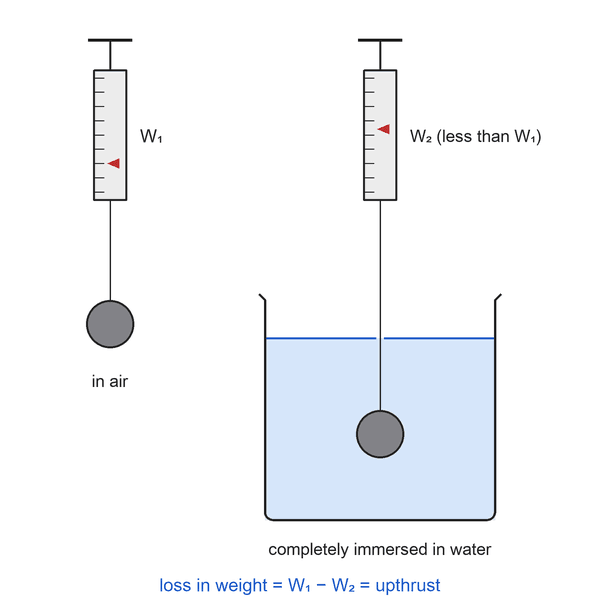
Step 4 — Observation.
is less than . While the stone goes into the water the reading keeps falling; once it is fully immersed the reading stays at .
Step 5 — Conclusion.
The stone appears lighter in water because the water pushes it up. The apparent loss in weight is the upthrust.
Therefore, the spring balance reads less (W₂ < W₁) when the stone is in water, which shows that a body in a liquid appears lighter than it really is.
- 405 marks
Question 40
A body held completely immersed inside a liquid experiences two forces : (i) , the force due to gravity and (ii) , the buoyant force. Draw a diagram showing the direction of these forces acting on the body and state the conditions when the body will float or sink.
Solve with AIWritten solution
Solution:
Concept: When a body is let go inside a liquid, two forces act on it: its weight downwards and the upthrust upwards. If it sinks; if it rises and floats with a part above the surface; if the two are equal it stays wherever it is placed. For a fully immersed body this is the same as comparing its density with the density of the liquid.
Step 1 — Draw the forces.
The weight acts vertically downwards through the centre of gravity G. The buoyant force acts vertically upwards through the centre of buoyancy B. For a uniform body held fully under the liquid, B and G are at the same point.
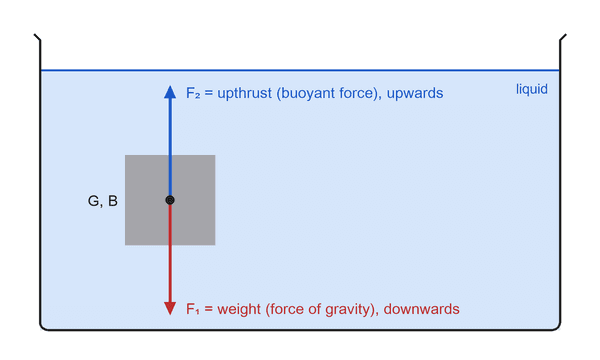
Step 2 — Write the two forces.
For a body of volume and density in a liquid of density :
Step 3 — Body sinks.
If (that is, ), the net force is downwards and the body sinks.
Step 4 — Body floats inside.
If equals ( equal to ), there is no net force; the body floats fully submerged wherever it is placed.
Step 5 — Body rises and floats.
If (), the net force is upwards; the body rises and floats with part of it above the surface, where the upthrust on the submerged part equals its weight.
Therefore, F₁ acts downwards and F₂ upwards; the body sinks if F₁ > F₂, and floats if F₁ ≤ F₂ (fully submerged when they are equal, partly above the surface when F₁ < F₂).
- 415 marks
Question 41
Prove that the loss in weight of a body when immersed wholly or partially in a liquid is equal to the buoyant force (or upthrust) and this loss is because of the difference in pressure exerted by liquid on the upper and lower surfaces of the submerged part of the body.
Solve with AIWritten solution
Solution:
Concept: Pressure in a liquid increases with depth: at depth in a liquid of density it is . The bottom of an immersed body is deeper than its top, so the liquid pushes up on the bottom harder than it pushes down on the top. This difference is the upthrust.
Step 1 — Set up the body.
Take a cylinder of cross-section area and height held in a liquid of density . Its top face is at depth and its bottom face at depth , so the height is the difference of the two depths.
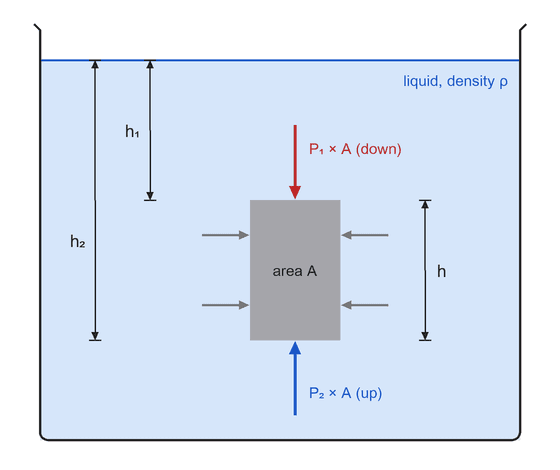
Step 2 — Sideways thrusts.
At any depth the liquid pushes on opposite sides of the curved surface equally and in opposite directions, so the sideways thrusts cancel.
Step 3 — Thrust on the top face.
The pressure on the top face is ; it pushes the face downwards. Atmospheric pressure acts on both faces and cancels, so it is left out.
Step 4 — Thrust on the bottom face.
The pressure on the bottom face is ; it pushes the face upwards.
Step 5 — Net upward force.
Since , the upward thrust is larger, and the difference is the upthrust.
Step 6 — Compare with the displaced liquid.
is the volume of the cylinder, which is also the volume of liquid displaced; is the weight of that liquid.
Step 7 — Loss in weight.
The upthrust acts against the weight , so the apparent weight is . The loss in weight is the difference between the two readings.
Step 8 — Partly immersed body.
If the body is only partly immersed, its top face is in air ( is zero), and the same working gives as the weight of liquid displaced by the submerged part.
Therefore, the loss in weight equals the upthrust (the weight of liquid displaced), and it arises because the liquid presses harder on the lower surface than on the upper surface.
- 425 marks
Question 42
Describe an experiment to verify Archimedes' principle.
Solve with AIWritten solution
Solution:
Concept: Archimedes' principle: when a body is immersed wholly or partly in a fluid, it experiences an upthrust equal to the weight of the fluid displaced by it. Because of this upthrust the body seems to lose weight, and this apparent loss in weight equals the weight of the fluid displaced. A mass of 1 g has a weight of 1 gf, and 1 cm of water has a mass of 1 g (density of water 1 g cm). So a body that displaces cm of water gets an upthrust of gf.
Step 1 — Apparatus.
Take a spring balance, a solid (for example a stone) tied with a thread, a eureka (overflow) can, water and a measuring cylinder.
Step 2 — Weigh in air.
Hang the solid from the spring balance and note its weight in air, gf.
Step 3 — Fill the can.
Fill the eureka can with water up to its spout, until water just stops dripping. Place the empty measuring cylinder under the spout.
Step 4 — Immerse the solid.
Lower the solid slowly until it is completely immersed, without touching the can. Water overflows into the cylinder. Note the new reading gf.

Step 5 — Measure the water displaced.
Read the volume cm of water collected. Since 1 cm of water weighs 1 gf, the weight of water displaced is gf.
Step 6 — Compare.
The loss in weight is found to be equal to the weight of the water displaced.
Watch out: Fill the can only up to the spout before starting, and let no drops stick to the solid or the thread, or the volume collected will be wrong.
Therefore, since the loss in weight (W₁ − W₂) equals the weight of water displaced, Archimedes' principle is verified.
- 434 marks
Question 43
A body of volume 100 cm weighs 5 kgf in air. It is completely immersed in a liquid of density kg m. Find : (i) the upthrust due to liquid and (ii) the weight of the body in liquid.
Solve with AIWritten solution
Solution:
Concept: Archimedes' principle: when a body is immersed wholly or partly in a fluid, it experiences an upthrust equal to the weight of the fluid displaced by it. Because of this upthrust the body seems to lose weight, and this apparent loss in weight equals the weight of the fluid displaced. Upthrust acts upwards, against the weight. So a spring balance holding a body in a liquid shows the apparent weight, which is the true weight minus the upthrust. The loss in weight is therefore equal to the upthrust.
Given: cm, kgf, kg m.
Step 1 — Change the volume into m³.
The density is in kg m, so the volume must be in m. Since 1 cm is m:
Step 2 — Find the mass of liquid displaced.
The body is fully immersed, so it displaces its own volume of liquid. Mass is volume times density.
Step 3 — Find the upthrust.
The upthrust is the weight of this liquid, that is, the weight of 0.18 kg.
Step 4 — Find the weight in the liquid.
The weight in the liquid is the weight in air minus the upthrust.
Watch out: Change cm³ into m³ (multiply by 10⁻⁶) before using a density in kg m⁻³.
Therefore, (i) the upthrust is 0.18 kgf and (ii) the weight of the body in the liquid is 4.82 kgf.
- 444 marks
Question 44
A body weighs 450 gf in air and 310 gf when completely immersed in water. Find :
(i) the volume of the body,
(ii) the loss in weight of the body, and
(iii) the upthrust on the body.
State the assumption made in part (i).
Solve with AIWritten solution
Solution:
Concept: Archimedes' principle: when a body is immersed wholly or partly in a fluid, it experiences an upthrust equal to the weight of the fluid displaced by it. Because of this upthrust the body seems to lose weight, and this apparent loss in weight equals the weight of the fluid displaced. A mass of 1 g has a weight of 1 gf, and 1 cm of water has a mass of 1 g (density of water 1 g cm). So a body that displaces cm of water gets an upthrust of gf.
Given: Weight in air gf, weight in water gf.
(ii)
Step 1 — Loss in weight.
The loss in weight is the weight in air minus the weight in water.
(iii)
Step 2 — Upthrust.
By Archimedes' principle the upthrust equals the loss in weight.
(i)
Step 3 — Volume of the body.
The upthrust is the weight of water displaced, so 140 g of water is displaced. The body is completely immersed, so its volume equals the volume of this water.
Step 4 — State the assumption.
In part (i) the density of water is taken as 1 g cm, so that 1 cm of water weighs 1 gf.
Therefore, (i) the volume is 140 cm³ (assuming the density of water is 1 g cm⁻³), (ii) the loss in weight is 140 gf, and (iii) the upthrust is 140 gf.
- 454 marks
Question 45
You are provided with a hollow iron ball A of volume 15 cm and mass 12 g and a solid iron ball B of mass 12 g. Both are placed on the surface of water contained in a large tub. (a) Find upthrust on each ball. (b) Which ball will sink ? Give reason for your answer. (Density of iron = 8.0 g cm)
Solve with AIWritten solution
Solution:
Concept: When a body is let go inside a liquid, two forces act on it: its weight downwards and the upthrust upwards. If it sinks; if it rises and floats with a part above the surface; if the two are equal it stays wherever it is placed. For a fully immersed body this is the same as comparing its density with the density of the liquid. Principle of floatation: a floating body is in equilibrium, so its weight is equal to the upthrust on it.
Given: Ball A: volume 15 cm, mass 12 g; ball B: mass 12 g, solid iron of density 8.0 g cm.
Step 1 — Volume of ball B.
Ball B is solid iron, so its volume is its mass divided by the density of iron.
Step 2 — Test ball A.
If ball A were fully under water it would displace 15 cm of water, an upthrust of 15 gf. This is more than its weight of 12 gf, so A floats. While floating, the upthrust equals its weight.
Step 3 — Test ball B.
Fully under water, ball B displaces only 1.5 cm of water, so the upthrust on it is 1.5 gf. This is much less than its weight of 12 gf.
Step 4 — Decide which sinks.
Ball B's weight (12 gf) is more than its upthrust (1.5 gf), so B sinks. Ball A is hollow; its average density is g cm, less than that of water, so it floats with 12 cm of it under water.
Watch out: Both balls have the same mass, but the hollow ball has ten times the volume, and volume decides the upthrust.
Therefore, (a) the upthrust is 12 gf on A and 1.5 gf on B, and (b) ball B sinks, because its weight is more than the upthrust on it.
- 463 marks
Question 46
A solid of density 5000 kg m weighs 0.5 kgf in air. It is completely immersed in water of density 1000 kg m. Calculate the apparent weight of the solid in water.
Solve with AIWritten solution
Solution:
Concept: Archimedes' principle: when a body is immersed wholly or partly in a fluid, it experiences an upthrust equal to the weight of the fluid displaced by it. Because of this upthrust the body seems to lose weight, and this apparent loss in weight equals the weight of the fluid displaced. Upthrust acts upwards, against the weight. So a spring balance holding a body in a liquid shows the apparent weight, which is the true weight minus the upthrust. The loss in weight is therefore equal to the upthrust.
Given: kg m, kgf, kg m.
Step 1 — Find the mass.
A weight of 0.5 kgf is the weight of a mass of 0.5 kg.
Step 2 — Find the volume.
Volume is mass divided by density.
Step 3 — Find the upthrust.
The solid displaces its own volume of water. The mass of that water is volume times the density of water, and its weight is the upthrust.
Step 4 — Find the apparent weight.
Subtract the upthrust from the weight in air.
Therefore, the apparent weight of the solid in water is 0.4 kgf.
- 474 marks
Question 47
Two spheres A and B, each of volume 100 cm are placed on water (density = 1.0 g cm). The sphere A is made of wood of density 0.3 g cm and the sphere B is made of iron of density 8.9 g cm.
(a) Find : (i) the weight of each sphere, and (ii) the upthrust on each sphere.
(b) Which sphere will float ? Give reason.
- 484 marks
Question 48
The mass of a block made of a certain material is 13.5 kg and its volume is m.
(a) Calculate upthrust on the block if it is held fully immersed in water.
(b) Will the block float or sink in water when released ? Give reason for your answer.
(c) What will be the upthrust on block while floating?
Take density of water = 1000 kg m.
- 493 marks
Question 49
A piece of brass weighs 175 gf in air and 150 gf when fully immersed in water. The density of water is 1.0 g cm. (i) What is the volume of the brass piece ? (ii) Why does the brass piece weigh less in water ?
- 504 marks
Question 50
A metal cube of edge 5 cm and density 9.0 g cm is suspended by a thread so as to be completely immersed in a liquid of density 1.2 g cm. Find the tension in thread. (Take g = 10 m s)
[Hint: Tension in thread = Apparent weight of the cube in liquid]
- 513 marks
Question 51
A block of wood is floating on water with its dimensions 50 cm × 50 cm × 50 cm inside water. Calculate the buoyant force acting on the block. Take g = 9.8 N kg.
- 524 marks
Question 52
A body of mass 3.5 kg displaces 1000 cm of water when fully immersed inside it. Calculate : (i) the volume of body, (ii) the upthrust on body and (iii) the apparent weight of body in water.
- 531 mark
Question 53
The effect of temperature on density is that it :
- 541 mark
Question 54
The density of copper is :
- 551 mark
Question 55
The mass of 1 cm of iron is 7.8 g, its density in S.I. unit is :
- 561 mark
Question 56
The density of water is maximum at ..... °C and is ........ kg/m :
- 571 mark
Question 57
Relative density of a substance is expressed by comparing the density of that substance with the density of :
- 581 mark
Question 58
The unit of relative density is :
- 591 mark
Question 59
The correct relation between density and relative density is :
- 601 mark
Question 60
The relative density of silver is :
- 611 mark
Question 61
The correct expression for relative density when the weight of a body in air is and in water is is given by :
- 621 mark
Question 62
If the weight of a body in air is , in a liquid is and in water is , then :
- 631 mark
Question 63
Define the term density.
- 642 marks
Question 64
What are the units of density in (i) C.G.S. and (ii) S.I. system ?
- 651 mark
Question 65
Express the relationship between the C.G.S. and S.I. units of density.
- 661 mark
Question 66
'The density of iron is 7800 kg m'. What do you understand by this statement ?
- 671 mark
Question 67
Write the density of water at 4°C in S.I. unit.
- 682 marks
Question 68
How are the (i) mass, (ii) volume, and (iii) density of a metallic piece affected, if at all, with increase in temperature ?
- 692 marks
Question 69
Complete the following sentences :
(i) Mass = ........ × density
(ii) S.I. unit of density is .......
(iii) Density of water is ... kg m.
(iv) Density in kg m = ... × density in g cm
- 701 mark
Question 70
What is the unit of relative density ?
- 712 marks
Question 71
A body weighs W gf in air and gf when it is completely immersed in water. Find : (i) volume of the body, (ii) upthrust on the body, (iii) relative density of material of the body.
- 722 marks
Question 72
Water is heated from 0°C to 10°C. How does the density of water change with temperature ?
- 732 marks
Question 73
What do you understand by the term relative density of a substance ?
- 742 marks
Question 74
Define relative density as a ratio of mass ?
- 753 marks
Question 75
Differentiate between density and relative density of a substance.
- 765 marks
Question 76
With the use of Archimedes' principle, state how you will find relative density of a solid denser than water and insoluble in it. How will you modify your experiment if the solid is soluble in water ?
- 775 marks
Question 77
Describe an experiment, using Archimedes' principle, to find relative density of a liquid.
- 785 marks
Question 78
A body weighs gf in air and when immersed in a liquid, it weighs gf, while it weighs gf on immersing it in water. Find : (i) volume of the body (ii) upthrust due to liquid (iii) relative density of the solid and (iv) relative density of the liquid.
- 793 marks
Question 79
The density of copper is 8.83 g cm. Express it in kg m.
- 803 marks
Question 80
The relative density of mercury is 13.6. State its density in (i) C.G.S. unit, (ii) S.I. unit.
- 813 marks
Question 81
The density of iron is kg m. What is its relative density ?
- 823 marks
Question 82
The relative density of silver is 10.8. Find its density.
- 833 marks
Question 83
Calculate the mass of a body whose volume is 2 m and relative density is 0.52.
- 843 marks
Question 84
Calculate the mass of air in a room of dimensions 4.5 m × 3.5 m × 2.5 m if the density of air at N.T.P. is 1.3 kg m.
- 853 marks
Question 85
A piece of stone of mass 113 g sinks to the bottom in water contained in a measuring cylinder and water level in cylinder rises from 30 ml to 40 ml. Calculate R.D. of stone.
- 864 marks
Question 86
A body of volume 100 cm weighs 1 kgf in air. Find : (i) its weight in water and (ii) its relative density.
- 874 marks
Question 87
A body of mass 70 kg, when completely immersed in water, displaces 20,000 cm of water. Find : (i) the weight of body in water and (ii) the relative density of material of body.
- 883 marks
Question 88
A solid weighs 120 gf in air and and 105 gf when it is completely immersed in water. Calculate the relative density of solid.
- 894 marks
Question 89
A solid weighs 32 gf in air and 28.8 gf in water. Find : (i) the volume of solid, (ii) R.D. of solid, and (iii) the weight of solid in a liquid of density 0.9 g cm.
- 903 marks
Question 90
A body weighs 20 gf in air and 18.0 gf in water. Calculate relative density of the material of body.
- 914 marks
Question 91
A solid weighs 1.5 kgf in air and 0.9 kgf in a liquid of density kg m. Calculate R.D. of solid.
- 924 marks
Question 92
A jeweller claims that he makes ornaments of pure gold of relative density 19.3. He sells a bangle weighing 25.25 gf to a person. The clever customer weighs the bangle when immersed in water and finds that it weighs 23.075 gf in water. With the help of suitable calculations find out whether the ornament is made of pure gold or not.
[Hint : Calculate R.D. of material of bangle which comes out to be 11.6].
- 934 marks
Question 93
A piece of iron weighs 44.5 gf in air. If the density of iron is kg m, find the weight of iron piece when immersed in water.
- 944 marks
Question 94
A piece of stone of mass 15.1 g is first immersed in a liquid and it weighs 10.9 gf. Then on immersing the piece of stone in water, it weighs 9.7 gf. Calculate :
(a) the weight of the piece of stone in air,
(b) the volume of the piece of stone,
(c) the relative density of stone,
(d) the relative density of the liquid.
- 951 mark
Question 95
For a floating body, its weight W and upthrust on it are related as :
- 961 mark
Question 96
The upthrust is maximum (= ) when the body is:
- 971 mark
Question 97
When the weight of a body is greater than the weight of the liquid displaced, the body will :
- 981 mark
Question 98
A body weighing W floats partially above and partially below the liquid when ( denotes maximum upthrust) :
- 991 mark
Question 99
A body of weight W is floating in a liquid. Its apparent weight will be :
- 1001 mark
Question 100
For a floating body of volume V, the relation between the volume of its submerged part v, the densities of liquid () and the body () is :
- 1011 mark
Question 101
A body floats in a liquid A of density with a part of it submerged inside liquid while in liquid B of density totally submerged inside liquid. The densities and are related as :
- 1021 mark
Question 102
Every ship has a white line painted on its side known as :
- 1031 mark
Question 103
Which of the following statements is correct ?
(i) A loaded ship is submerged more while an unloaded ship is submerged less.
(ii) A ship begins to be less submerged as it sails from sea water to river water.
- 1041 mark
Question 104
An unloaded ship is filled with sand at its bottom to ........ its centre of gravity and make its equilibrium ......... .
- 1051 mark
Question 105
It is easier for humans to swim in sea water than in river water as :
- 1061 mark
Question 106
If a submarine is to dive, its ballast tanks are .........., so that the average density of the submarine becomes .................. than the density of sea water.
- 1071 mark
Question 107
Ice bergs float on the surface of water with their .......... portion inside the water surface and ......... portion above the water surface.
- 1081 mark
Question 108
A balloon does not rise indefinitely because :
- 1091 mark
Question 109
When a fish has to rise up in water, it diffuses oxygen gas from its blood into the bladder, so its volume .......... and its average density ........... .
- 1101 mark
Question 110
State the principle of floatation.
- 1111 mark
Question 111
When a piece of wood is suspended from the hook of a spring balance, it reads 70 gf. The wood is now lowered into water. What reading do you expect on the scale of spring balance ?
[Hint : The piece of wood will float on water and while floating, apparent weight = 0].
- 1122 marks
Question 112
How does the density of a substance determine whether a solid piece of that substance will float or sink in a given liquid of density ?
- 1131 mark
Question 113
A body floats in a liquid with a part of it submerged inside liquid. Is the weight of floating body greater than, equal to or less than upthrust ?
- 1141 mark
Question 114
What can you say about the average density of a ship floating on water in relation to the density of water ?
- 1152 marks
Question 115
Two identical pieces, one of ice (density = 900 kg m) and other of wood (density = 300 kg m) float on water.
(a) Which of the two will have more volume submerged inside water ?
(b) Which of the two will experience more upthrust due to water ?
- 1162 marks
Question 116
A piece of ice floating in a glass of water melts, but the level of water in glass does not change. Give reason.
[Hint : Ice contracts on melting.]
- 1171 mark
Question 117
What can you say about the average density of a ship floating on water in relation to the density of water ?
- 1182 marks
Question 118
A buoy is held inside water contained in a vessel by tying it with a thread to the base of the vessel.
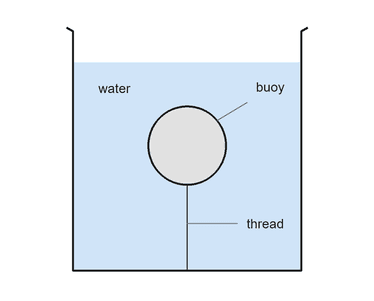
Name the three forces that keep the buoy in equilibrium and state the direction in which each force acts.
- 1192 marks
Question 119
A piece of ice floating in a glass of water melts, but the level of water in glass does not change. Give reason.
[Hint : Ice contracts on melting.]
- 1203 marks
Question 120
A solid iron ball of mass 500 g is dropped in mercury contained in a beaker. (a) Will the ball float or sink ? Give reason. (b) What will be the apparent weight of ball ? Give reason.
- 1212 marks
Question 121
Explain why an iron nail floats on mercury, but it sinks in water.
[Hint : Density of iron is less than that of mercury, but more than that of water]
- 1222 marks
Question 122
A homogeneous block floats on water (a) partly immersed (b) completely immersed.

In each case state the position of centre of buoyancy B with respect to the centre of gravity G of the block.
- 1233 marks
Question 123
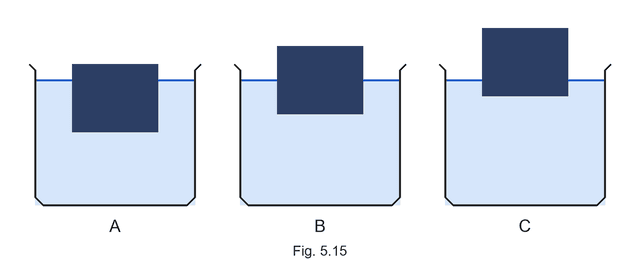
Fig. 5.15 shows the same block of wood floating in three different liquids A, B and C of densities , and respectively. Which liquid has the highest density ? Give reason for your answer.
- 1243 marks
Question 124
What is centre of buoyancy ? State its position for a floating body with respect to the centre of gravity of body.
- 1253 marks
Question 125
A balloon filled with helium gas floats in a big closed jar which is connected to an evacuating pump. What will be your observation, if air from jar is pumped out ? Explain your answer.
- 1263 marks
Question 126
A block of wood is so loaded that it just floats in water at room temperature. What change will occur in the state of floatation, if
(a) some salt is added to water,
(b) water is heated ?
Give reason.
- 1272 marks
Question 127
Why is floating ice less submerged in brine than in water ?
- 1283 marks
Question 128
A man first swims in sea water and then in river water.
(i) Compare the weights of sea water and river water displaced by him.
(ii) Where does he find it easier to swim and why?
- 1293 marks
Question 129
An iron nail sinks in water while an iron ship floats on water. Explain the reason.
- 1303 marks
Question 130
A loaded cargo ship sails from sea water to river water ? State and explain your observation.
- 1315 marks
Question 131
A body is held immersed in a liquid. (i) Name the two forces acting on body and draw a diagram to show these forces. (ii) State how do the magnitudes of two forces mentioned in part (i) determine whether the body will float or sink in liquid when it is released. (iii) What is the net force on body if it (a) sinks, (b) floats ?
- 1325 marks
Question 132
Draw a diagram to show the forces acting on a body floating in water with its some part submerged. Name the forces and show their points of application. How is the weight of water displaced by the floating body related to the weight of the body itself ?
- 1334 marks
Question 133
A body of volume V and density , floats with volume v inside a liquid of density . Show that .
- 1345 marks
Question 134
Explain the following :
(a) Icebergs floating in sea are dangerous for ships.
(b) An egg sinks in fresh water, but floats in a strong salt solution.
(c) A toy balloon filled with hydrogen rises to the ceiling, but if filled with carbon dioxide sinks to the floor.
(d) As a ship in harbour is being unloaded, it slowly rises higher in water.
(e) A balloon filled with hydrogen rises to a certain height and then stops rising further.
(f) A ship submerges more as it sails from sea water to river water.
- 1353 marks
Question 135
A rubber ball floats on water with its 1/3 volume outside water. What is the density of rubber ?
- 1364 marks
Question 136
A block of wood of mass 24 kg floats on water. The volume of wood is 0.032 m. Find :
(a) the volume of block below the surface of water,
(b) the density of wood.
(Density of water = 1000 kg m)
- 1374 marks
Question 137
A wooden cube of side 10 cm has mass 700 g. What part of it remains above the water surface while floating vertically on the water surface ?
- 1383 marks
Question 138
A piece of wax floats on brine. What fraction of its volume is immersed ?
Density of wax = 0.95 g cm, Density of brine = 1.1 g cm.
- 1393 marks
Question 139
If the density of ice is 0.9 g cm, what portion of an iceberg will remain below the surface of water in a sea ? (Density of sea water = 1.1 g cm)
- 1404 marks
Question 140
A piece of wood of uniform cross section and height 15 cm floats vertically with its height 10 cm in water and 12 cm in spirit. Find the density of (i) wood and (ii) spirit.
- 1414 marks
Question 141
A wooden block floats in water with two-third of its volume submerged. (a) Calculate the density of wood. (b) When the same block is placed in oil, three-quarter of its volume is immersed in oil. Calculate the density of oil.
- 1424 marks
Question 142
The density of ice is 0.92 g cm and that of sea water is 1.025 g cm. Find the total volume of an iceberg which floats with its volume 800 cm above water.
- 1434 marks
Question 143
A weather forecasting plastic balloon of volume 15 m contains hydrogen of density 0.09 kg m. The volume of an equipment carried by the balloon is negligible compared to its own volume. The mass of empty balloon alone is 7.15 kg. The balloon is floating in air of density 1.3 kg m. Calculate : (i) the mass of hydrogen in the balloon, (ii) the mass of hydrogen and balloon, (iii) the total mass of hydrogen, balloon and equipment if the mass of equipment is x kg, (iv) the mass of air displaced by balloon and (v) the mass of equipment using the law of floatation.
What Class 9 Physics Ch 5 covers
The sections of the chapter, in the order the book takes them. Every question above comes from one of these.
- 01Buoyancy and Upthrust
- 02Reason for Upthrust
- 03Archimedes' Principle
- 04Density
- 05Relative Density
- 06Determination of Relative Density of a Solid
More ways to study this chapter
The same chapter asked three other ways. Practise it, revise it, and see what the board has set on Ch 5 before.
Class 9 Physics Ch 5 questions students ask
How many questions are there in Class 9 Physics Ch 5?
143 questions. Every one is solved step by step on this page.
Are these Class 9 Physics solutions free?
Yes. Every question and its full working is free to read, with no account needed.
Can I download the Class 9 Physics Ch 5 solutions as a PDF?
There is no PDF to download. Every solution is on this page instead, which means it is searchable, always the current syllabus, and readable on a phone. Use your browser's print option if you want it on paper.