Solution:
Concept: Principle of floatation: a floating body is in equilibrium, so its weight is equal to the upthrust on it. That upthrust is the weight of the liquid displaced by the submerged part. A floating body therefore displaces a weight of liquid equal to its own weight, and its apparent weight is zero. The centre of buoyancy B is the point through which the upthrust acts. It is the centre of gravity of the displaced liquid, that is, of the submerged part of the body. The weight acts at the centre of gravity G of the whole body.
Step 1 — Draw the diagram.
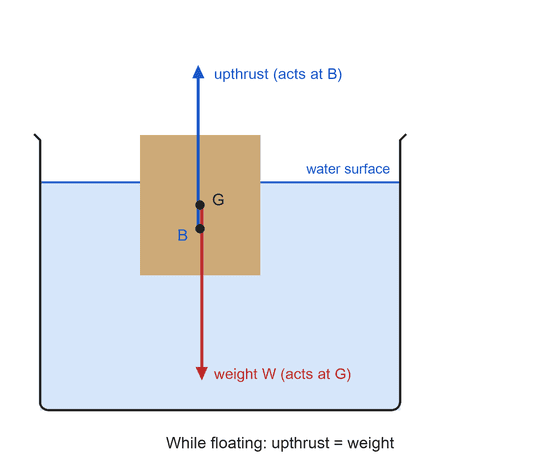
The figure shows a block floating with part of it under water.
Step 2 — Weight.
The weight W of the body acts vertically downwards at its centre of gravity G.
Step 3 — Upthrust.
The upthrust FB of water acts vertically upwards at the centre of buoyancy B, the centre of gravity of the submerged part. B lies below G, on the same vertical line.
Step 4 — Relation.
The floating body is in equilibrium, so
weight of water displaced=upthrust=weight of the body
Therefore, the weight acts down at G, the upthrust acts up at B, and the weight of water displaced by the floating body is equal to the weight of the body.
