Solution:
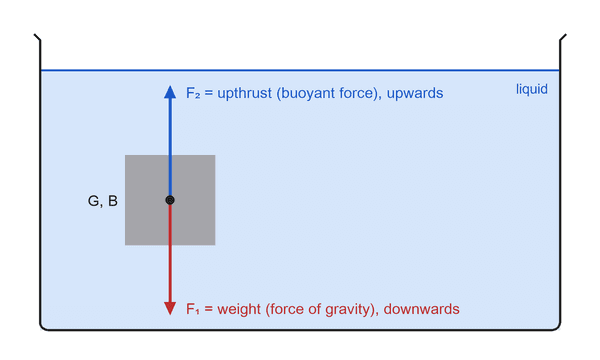
Concept: When a body is let go inside a liquid, two forces act on it: its weight W downwards and the upthrust FB upwards. If W>FB it sinks; if W<FB it rises and floats with a part above the surface; if the two are equal it stays wherever it is placed. For a fully immersed body this is the same as comparing its density ρ with the density ρL of the liquid.
(i)
Step 1 — Name the forces.
The two forces are the weight of the body W (force of gravity), acting vertically downwards, and the upthrust FB (buoyant force) of the liquid, acting vertically upwards. In the diagram, F1 is the weight and F2 the upthrust.
(ii)
Step 2 — Sinks.
If W>FB, the body sinks.
Step 3 — Floats inside.
If W equals FB, the body floats fully immersed wherever it is left.
Step 4 — Rises.
If W<FB, the body rises and floats with part of it above the surface.
(iii)
Step 5 — Net force when it sinks.
The net force is the weight minus the upthrust, acting vertically downwards.
Fnet=W−FB
Step 6 — Net force when it floats.
While floating, the upthrust on the submerged part equals the weight, so the net force is zero.
Therefore, (i) the forces are the weight (down) and the upthrust (up); (ii) the body sinks if W > F_B and floats if W ≤ F_B; (iii) the net force is (W − F_B) downwards if it sinks and zero if it floats.
