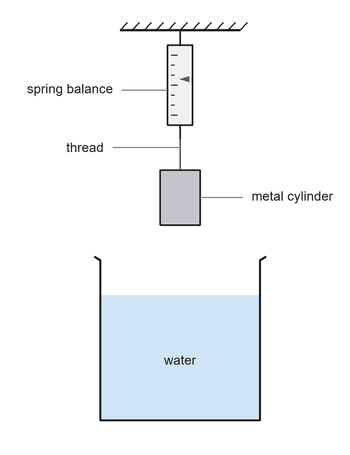
Solution:
Concept: Upthrust acts upwards, against the weight. So a spring balance holding a body in a liquid shows the apparent weight, which is the true weight minus the upthrust. The loss in weight is therefore equal to the upthrust. The upthrust on a body is the weight of the fluid it displaces. If a volume V of the body is under a fluid of density ρL, the upthrust is FB=VρLg.
Step 1 — Observation while it goes in.
As the cylinder is lowered into the water, the reading of the spring balance gradually decreases.
Step 2 — Why the reading falls.
The more of the cylinder goes under water, the more water it displaces, so the upthrust increases. The reading is the weight minus the upthrust, so it decreases.
reading=W−FB
Step 3 — Observation once it is fully under.
Once the cylinder is completely immersed, the reading becomes least and then stays constant, even if the cylinder is lowered further.
Step 4 — Why it stays constant.
A fully immersed cylinder displaces its full volume of water, which cannot increase any more. So the upthrust, and the reading, no longer change with depth.
Therefore, the reading decreases gradually while the cylinder goes in, and stays constant at its least value once it is completely immersed.