
Opening your dashboard
Class 9 Physics Chapter 5 Upthrust in Fluids, Archimedes' Principle and Floatation: Competency-Based Questions (CBQ)
40 questions on Chapter 5, each worked through on its own page with the AI tutor. Class 9 Physics, ICSE 2026-27.
40 questions
1–5 marks · Mixed difficulty
- 11 mark
Question 1
Competency: Application
A stone hanging from a spring balance weighs 150 gf in air. An overflow can is filled with water up to its spout.
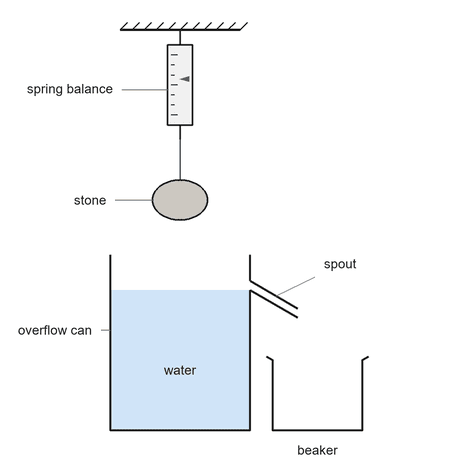
The stone, still hanging from the balance, is lowered into the can until it is completely under water without touching the bottom. The water that flows out of the spout is collected, and its mass is found to be 60 g. The reading of the spring balance is now :
- 21 mark
Question 2
Competency: Analysis & Application
A rectangular block hangs by a thread and is completely immersed in water, as shown in the figure. The top face and the bottom face of the block are horizontal, and each has an area of 20 cm. (Density of water = 1000 kg m; = 10 m s)

The upthrust of the water on the block is :
- 31 mark
Question 3
Competency: Application & Analysis
The tank of a tanker lorry has a volume of 16 m. The lorry is allowed to carry a load of at most 12000 kg. The densities of four liquids are : milk 1030 kg m, water 1000 kg m, petrol 740 kg m and kerosene 800 kg m. With which of these liquids can the tank be filled completely without the load going above the limit ?
- 41 mark
Question 4
Competency: Understanding & Application
The average density of the body of a person who cannot swim is slightly greater than the density of water. When the same person wears a life jacket filled with a very light foam, he floats with his head above the water. The life jacket helps because it :
- 51 mark
Question 5
Competency: Understanding
Assertion (A): When a bucket full of water is pulled up from a well, it feels much heavier as soon as it rises out of the water in the well.
Reason (R): A body immersed in water experiences an upthrust, which makes its weight appear less.
- 61 mark
Question 6
Competency: Analysis
Assertion (A): A boat floating on a lake displaces a greater weight of water than the same boat does when it floats on the sea.
Reason (R): Sea water is denser than the fresh water of a lake.
- 72 marks
Question 7
Competency: Application & Evaluation
The relative density of pure honey is about 1.4. A food inspector tests the honey sold by a shop as 'pure honey'. She finds that 250 cm of it has a mass of 300 g. (Density of water = 1 g cm)
(a) Calculate the relative density of the sample.
(b) Is the shopkeeper's claim acceptable ? Give your reason. If water had been mixed with the honey, would this raise or lower its relative density ?
- 82 marks
Question 8
Competency: Analysis
To find the relative density of granite, a student hangs a piece of granite from a spring balance. The balance reads 62.5 gf in air and 37.5 gf when the piece is completely immersed in water.
(a) Calculate the relative density of granite from these readings.
(b) The student then notices that a few air bubbles were sticking to the granite while it was in water. Will the relative density calculated in (a) be more or less than the true value ? Explain.
- 92 marks
Question 9
Competency: Application
A mechanic checks the acid of a car battery. The battery is taken to be fully charged if the relative density of its acid is not less than 1.25. He uses a glass sinker, which weighs 90 gf in air, 70 gf when completely immersed in water and 65 gf when completely immersed in the acid.
(a) Calculate the relative density of the acid.
(b) Is the battery fully charged ? Give your reason.
- 102 marks
Question 10
Competency: Analysis & Application
The table gives the density of water at four temperatures.
Temperature 0 °C 4 °C 10 °C 20 °C Density of water (kg m) 999.8 1000.0 999.7 998.2 (a) At which of these temperatures does 1 kg of water occupy the least volume ? Give a reason.
(b) A tank holds exactly 1000 kg of water when it is filled to the brim with water at 4 °C. Find the mass of water at 20 °C that fills the same tank to the brim. (Neglect any change in the volume of the tank.)
- 114 marks
Question 11
Competency: Analysis & Application
Case study: A solid metal cylinder hangs from a spring balance with its axis vertical. It is lowered slowly into a tall jar of water. The graph shows the reading of the spring balance against the depth of the lower face of the cylinder below the water surface. The cylinder does not touch the bottom of the jar. (Density of water = 1000 kg m; = 10 m s)

(a) From the graph, state the weight of the cylinder in air and the upthrust on it when it is completely immersed. What is the height of the cylinder ? Give a reason.
(b) Calculate the volume of the cylinder and the density of its material.
(c) The experiment is repeated with another liquid in place of water. The steady reading with the cylinder completely immersed is now 3.4 N. Find the relative density of this liquid.
- 124 marks
Question 12
Competency: Analysis & Evaluation
Case study: A stone statue of mass 500 kg and volume 0.2 m lies at the bottom of a deep lake. A salvage team plans to raise it slowly with a crane. The cable of the crane can safely bear a pull of 400 kgf. (Density of the lake water = 1000 kg m)
(a) Calculate the upthrust on the statue, in kgf, while it is completely under water. Hence find the pull in the cable needed to raise it slowly through the water.
(b) The team leader says, "The cable is strong enough, so we can lift the statue straight out of the lake with it." Judge this plan, giving your reasons.
(c) A diver suggests tying air-filled lifting bags to the statue, so that no pull at all is needed from the cable while the statue is under water. Find the least total volume of the bags. (Neglect the weight of the bags and of the air in them.)
- 134 marks
Question 13
Competency: Analysis & Evaluation
Case study: A tourist has a mass of 63 kg. After breathing out, the volume of his body is 0.060 m. He first enters a swimming pool of fresh water (density 1000 kg m) and later a salt lake whose water is very salty (density 1250 kg m). In both he lies still, without swimming.
(a) Calculate the average density of his body. Show that he cannot float in the swimming pool.
(b) Show that he floats in the salt lake, and find the percentage of the volume of his body that is under the water.
(c) A guide tells him, "A heavier person with the same body density as yours would float with more of the body under the water." Judge this statement, giving your reason.
- 144 marks
Question 14
Competency: Application & Creation
For a school science fair, you have to design a raft that can carry two children of total mass 90 kg on a pond. You are given a number of empty, sealed plastic cans, each of volume 20 litres and mass 1 kg, and a light bamboo frame of mass 9 kg on which the children will sit. The cans are tied below the frame. For safety, not more than half of the volume of each can should be under water when the raft is loaded, and the frame must stay above the water. (1 litre of water has a mass of 1 kg.)
(a) Find the upthrust, in kgf, on one can when half of its volume is under water.
(b) Work out the least number of cans that your raft needs. Show your reasoning.
(c) Describe two features of your design that will make the raft steady and safe, giving the reason for each.
- 154 marks
Question 15
Competency: Analysis & Evaluation
Case study: A flat-bottomed barge used to carry sand on a river has the shape of a rectangular box, 20 m long and 5 m wide, with vertical sides 1.5 m high. The empty barge has a mass of 30000 kg. (Density of river water = 1000 kg m)
(a) Find the depth to which the empty barge sinks in the water.
(b) Sand is loaded until the bottom of the barge is 1.2 m below the water surface. Find the mass of the sand.
(c) A safety rule says that at least 0.4 m of the sides must remain above the water. Find the greatest mass of sand that the barge is allowed to carry, and judge whether the load in (b) is within the rule.
- 161 mark
Question 16
Competency: Analysis
A beaker with some water stands on a platform balance, which reads 500 g. A stone of mass 250 g and volume 100 cm hangs from a thread tied to a fixed stand. The thread is lowered until the stone is completely under water, as shown in the figure. The stone does not touch the beaker, and no water spills. (Density of water = 1 g cm)
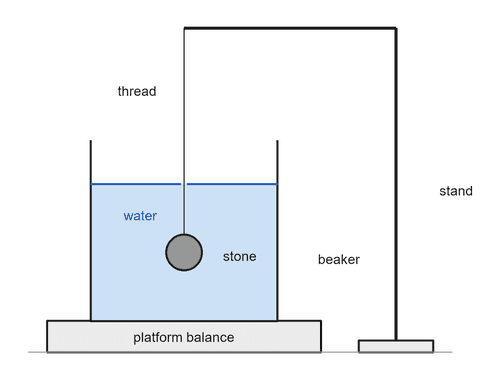
The reading of the balance is now :
- 171 mark
Question 17
Competency: Application
In a swimming pool, a child plays with a hollow plastic ball of volume 4000 cm and mass 300 g. The ball floats on the water. She pushes it down with her palm until it is completely under water and holds it there, at rest. (Density of water = 1 g cm) (Hypothetical data.)
What downward force must she apply on the ball?
- 181 mark
Question 18
Competency: Analysis
A boatman rows a small boat across a large village pond. The boat carries a rock of mass 30 kg and relative density 3, as shown in the figure.
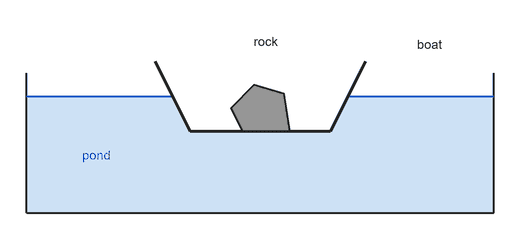
He lifts the rock and drops it into the pond, where it sinks to the bottom. The boat keeps floating. (Hypothetical data.)
What happens to the level of water in the pond?
- 191 mark
Question 19
Competency: Understanding
Assertion (A): When a block of ice at 0 °C melts completely into water at 0 °C, its mass stays the same, but its volume becomes smaller.
Reason (R): The density of water at 0 °C is greater than the density of ice.
- 201 mark
Question 20
Competency: Analysis
In a science club, Dev floats the same uniform block upright in three liquids. He measures the fraction of the block's volume that is below the liquid surface each time. (Hypothetical data.)
Liquid Density (g cm) Fraction of the block below the surface P 0.80 0.75 Q 1.00 0.60 R 1.20 0.50 He now floats the block in a fourth liquid of density 1.50 g cm. What fraction of the block will be below the surface?
- 211 mark
Question 21
Competency: Analysis
The graph shows the mass of different volumes of three solid materials X, Y and Z, each of which is insoluble in water. (Density of water = 1 g cm) (Hypothetical data.)

Which of the following is correct?
- 221 mark
Question 22
Competency: Understanding
Assertion (A): A submarine whose average density is equal to the density of the sea water around it hangs at rest at that depth, neither rising nor sinking.
Reason (R): When the average density of a submarine equals the density of sea water, the upthrust on the submarine is zero.
- 231 mark
Question 23
Competency: Analysis
In a school laboratory a sensitive beam balance has a piece of iron of mass 1 kg in the left pan and a loose bundle of cotton wool in the right pan. The two pans balance exactly in air. The whole balance is then placed under a bell jar, and the air is pumped out. (The iron has a volume of about 130 cm. The fibres of the cotton wool, not counting the air between them, have a volume of about 650 cm. The density of air is about 0.0012 g cm.) (Hypothetical data.)
What will be seen as the air is removed?
- 241 mark
Question 24
Competency: Evaluation
A thin polythene bag of negligible weight is filled with 500 cm of sugar solution of relative density 1.10 and tied tightly at the neck. It is hung from a spring balance, and then lowered until the bag is completely under the water of a bucket, without touching the bucket. (Density of water = 1 g cm) (Hypothetical data.)
The reading of the spring balance with the bag completely under water is :
- 251 mark
Question 25
Competency: Evaluation
A fisherman wants a small float of uniform material that floats upright in fresh water with 30 % to 40 % of its volume above the surface, so that it is easy to see. A shop has four floats, made of materials P, Q, R and S, of relative densities 0.45, 0.65, 0.80 and 0.95 respectively. (Hypothetical data.)
Which material should the fisherman choose?
- 262 marks
Question 26
Competency: Application
A pharmacist prepares the base of a skin lotion by mixing 300 cm of glycerine (density 1.26 g cm) with 200 cm of water (density 1.00 g cm). Assume that the volumes simply add up. (Hypothetical data.)
(a) Find the density of the mixture in g cm.
(b) A small plastic bead of density 1.20 g cm is dropped into the mixture. Will it float or sink? Give a reason.
- 272 marks
Question 27
Competency: Application
A hollow plastic ball has an outer volume of 200 cm and a mass of 120 g. It is used as a toy in a water tank. (Density of water = 1 g cm) (Hypothetical data.)
(a) Find the average density of the ball and say whether it floats or sinks in water.
(b) How much sand, in g, must be put inside the ball so that it just floats with its top level with the water surface?
- 282 marks
Question 28
Competency: Analysis
A swimming instructor of weight 60 kgf has a body volume of 0.060 m. She stands on the floor of a pool of water (density 1000 kg m). When the water reaches her waist, 40 % of her body volume is under water. When it reaches her chest, 80 % is under water. (Hypothetical data.)
(a) How much does she push down on the floor of the pool when the water is waist-deep?
(b) How much when it is chest-deep? Explain why she feels lighter as she walks into deeper water.
- 292 marks
Question 29
Competency: Analysis
Two glasses are on a table. One has water and the other has methylated spirit of relative density 0.80. The relative density of ice is 0.92. An ice cube is dropped into each glass. (Ignore the melting of the ice.) (Hypothetical data.)
(a) What will you observe in each glass? Give a reason.
(b) For the glass in which the ice cube floats, what fraction of the volume of the cube is below the surface?
- 302 marks
Question 30
Competency: Application
A laboratory technician has three unlabelled bottles, which contain water, kerosene (relative density 0.80) and glycerine (relative density 1.26). She has a stone of volume 250 cm that weighs 600 gf in air. She suspends the stone from a spring balance, lowers it completely into bottle X and finds that the balance reads 400 gf. (Density of water = 1 g cm) (Hypothetical data.)
(a) Find the upthrust of the liquid in bottle X on the stone.
(b) Find the density of the liquid in bottle X and say which liquid it is.
- 312 marks
Question 31
Competency: Application
A foundry reports that a metal casting has a relative density of 7.5 and loses 18 gf of weight when completely immersed in water. (Density of water = 1 g cm) (Hypothetical data.)
(a) Find the weight of the casting in air and its weight in water.
(b) A casting of the same volume, made of aluminium (relative density 2.7), is weighed in air. What does it weigh?
- 323 marks
Question 32
Competency: Application
To find the relative density of a piece of light wood, a student ties a heavy metal sinker to it. He takes three readings with a spring balance. (Density of water = 1 g cm) (Hypothetical data.)
Reading Weight (gf) Wood alone, in air 24 Sinker alone, completely in water 36 Wood and sinker tied together, both completely in water 20 (a) Find the loss in weight of the wood when it is completely immersed in water.
(b) Find the relative density of the wood.
(c) Why is the sinker needed?
- 333 marks
Question 33
Competency: Evaluation
A wooden block of mass 600 g and volume 1000 cm floats in a tank of water. A small brass piece of mass 90 g and relative density 9 is first placed on top of the block, as in figure (i), and the block floats. The brass piece is then removed and tied by a thread to the bottom of the same block, where it hangs completely under water, as in figure (ii), and the block floats again. (Density of water = 1 g cm) (Hypothetical data.)
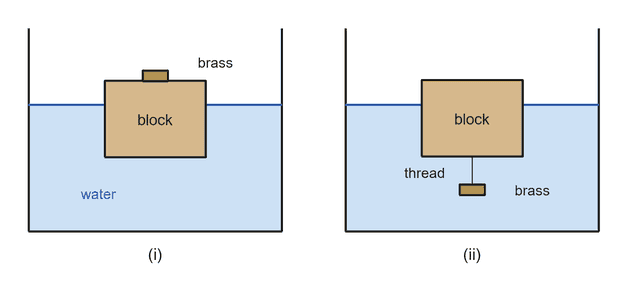
Ria says, "In figure (ii) the block floats higher out of the water than in (i), and the level of water in the tank is also lower."
Evaluate each part of Ria's statement.
- 343 marks
Question 34
Competency: Evaluation
A student verifies Archimedes' principle with an overflow (eureka) can that is filled with water up to its spout. She hangs a solid from a spring balance, which reads 100 gf in air. She lowers it completely into the can, and the balance now reads 60 gf. The water that overflows is collected in a measuring cylinder, as shown in the figure, and its volume is 37 cm. (Density of water = 1 g cm) (Hypothetical data.)
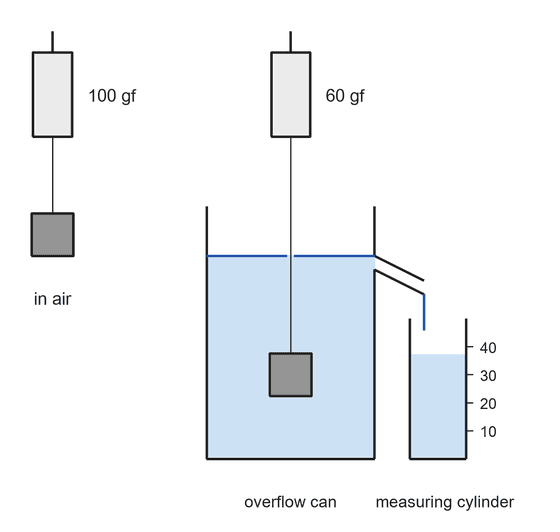
(a) Find the upthrust on the solid.
(b) Compare it with the weight of the water collected, and say whether the readings support Archimedes' principle.
(c) Give one possible reason why the two values are not exactly equal.
- 353 marks
Question 35
Competency: Analysis
A student measures the mass of a beaker holding different volumes of a liquid sample. (Hypothetical data.)
Volume of liquid (cm) 20 40 60 80 Mass of beaker and liquid (g) 74 98 122 146 (a) Find the density of the liquid in g cm.
(b) Find the mass of the empty beaker.
(c) A plastic piece has a relative density of 1.1. Will it float or sink in this liquid? Give a reason.
- 363 marks
Question 36
Competency: Creativity
You have a block of wood that floats in water, a wide measuring cylinder partly filled with water, a heavy iron nail, and a thread. You have no balance and no spring balance.
Design a method to find the relative density of the wood. In your answer:
(a) Say how you will find the mass of the wooden block.
(b) Say how you will find the volume of the wooden block.
(c) Show with sample readings of your own how you will calculate the relative density.
- 374 marks
Question 37
Competency: Analysis
Case study: A small river ferry carries motorbikes across a river. Its hull has vertical sides, so the area of the hull at the water level is the same at every depth. Each motorbike has a mass of 120 kg. The operator measures the draught, the depth of the keel (bottom) below the water surface, for different numbers of motorbikes on board. The river water has a density of 1000 kg m. (Hypothetical data.)
Number of motorbikes 0 4 8 12 Draught (cm) 40 42 44 46 (a) From the table, find the rise in draught caused by one motorbike, and use it to find the area of the hull at the water level.
(b) Find the mass of the empty ferry.
(c) The operator says, "If I double the number of motorbikes on board, the draught doubles." Use the table and your answers to judge his statement.
- 384 marks
Question 38
Competency: Application
Case study: In a science club, Meera tests how much common salt is needed to make an egg float. She dissolves different amounts of salt in 500 cm of water and measures the density of each solution. The egg has a mass of 64.2 g and a volume of 60 cm. The egg does not take in any salt or water during the test, and it does not touch the sides of the jar. (Hypothetical data.)
Salt dissolved (g) 0 20 40 60 80 Density of solution (g cm) 1.00 1.03 1.05 1.08 1.10 (a) Find the density of the egg.
(b) Using the table, find the least amount of salt for which the egg floats, and say what the egg does in the solution with 40 g of salt.
(c) In the solution with 80 g of salt, what volume of the egg stays above the surface?
- 395 marks
Question 39
Competency: Analysis
Case study: A geologist on a field trip has a spring balance and a bucket of water. She weighs four rock samples, A, B, C and D, in air and then completely under water. All four samples are solid pieces that sink in water and do not dissolve in it. She has a list of the relative densities of three ores: bauxite 2.5, hematite 5.0 and galena 7.5. (Density of water = 1 g cm.) (Hypothetical data.)
Sample A B C D Weight in air (gf) 120 100 150 90 Weight in water (gf) 72 80 130 60 (a) Find the loss in weight of each sample in water.
(b) Find the relative density of each sample.
(c) Identify the samples that match the list, and explain what she can say about the sample that does not.
- 404 marks
Question 40
Competency: Evaluation
Case study: At a fair, a balloon vendor fills latex balloons with helium. The air has a density of 1.2 g per litre and the helium inside the balloons has a density of 0.17 g per litre. A balloon feels an upthrust equal to the weight of the air it displaces. The table gives the volume and the weight of the rubber skin of each size. The weight of the string is negligible. (Hypothetical data.)
Size Volume (litres) Weight of rubber skin (gf) Small 3 2.0 Medium 5 3.0 Large 8 4.5 (a) Find the upthrust and the net upward force (lift) on one medium balloon.
(b) Find the lift of one small balloon and one large balloon, and say which size needs the fewest balloons to lift a toy of weight 12 gf.
(c) The vendor says, "Three large balloons will lift the 12 gf toy." Evaluate his claim.