Solution:
Concept: When a body is let go inside a liquid, two forces act on it: its weight W downwards and the upthrust FB upwards. If W>FB it sinks; if W<FB it rises and floats with a part above the surface; if the two are equal it stays wherever it is placed. For a fully immersed body this is the same as comparing its density ρ with the density ρL of the liquid.
Step 1 — Draw the forces.
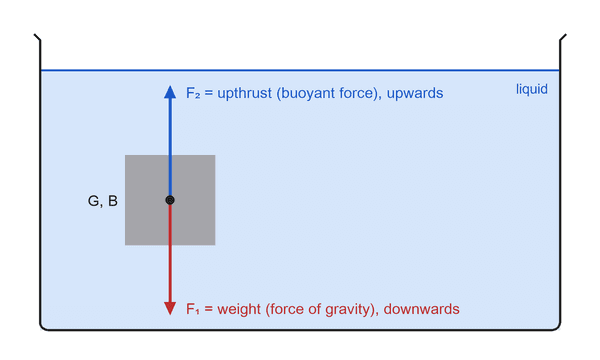
The weight F1 acts vertically downwards through the centre of gravity G. The buoyant force F2 acts vertically upwards through the centre of buoyancy B. For a uniform body held fully under the liquid, B and G are at the same point.
Step 2 — Write the two forces.
For a body of volume V and density ρ in a liquid of density ρL:
F1=Vρg
F2=VρLg
Step 3 — Body sinks.
If F1>F2 (that is, ρ>ρL), the net force is downwards and the body sinks.
Step 4 — Body floats inside.
If F1 equals F2 (ρ equal to ρL), there is no net force; the body floats fully submerged wherever it is placed.
Step 5 — Body rises and floats.
If F1<F2 (ρ<ρL), the net force is upwards; the body rises and floats with part of it above the surface, where the upthrust on the submerged part equals its weight.
Therefore, F₁ acts downwards and F₂ upwards; the body sinks if F₁ > F₂, and floats if F₁ ≤ F₂ (fully submerged when they are equal, partly above the surface when F₁ < F₂).
