Solution:
Concept: Pressure in a liquid increases with depth: at depth h in a liquid of density ρ it is P=hρg. The bottom of an immersed body is deeper than its top, so the liquid pushes up on the bottom harder than it pushes down on the top. This difference is the upthrust.
Step 1 — Set up the body.
Take a cylinder of cross-section area A and height h held in a liquid of density ρ. Its top face is at depth h1 and its bottom face at depth h2, so the height is the difference of the two depths.
h=h2−h1
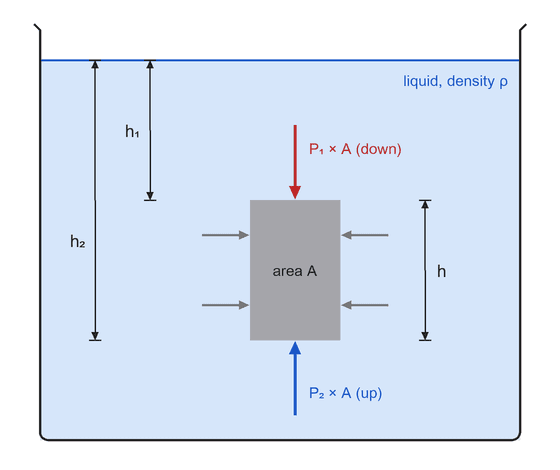
Step 2 — Sideways thrusts.
At any depth the liquid pushes on opposite sides of the curved surface equally and in opposite directions, so the sideways thrusts cancel.
Step 3 — Thrust on the top face.
The pressure on the top face is P1=h1ρg; it pushes the face downwards. Atmospheric pressure acts on both faces and cancels, so it is left out.
F1=P1A=h1ρgA
Step 4 — Thrust on the bottom face.
The pressure on the bottom face is P2=h2ρg; it pushes the face upwards.
F2=P2A=h2ρgA
Step 5 — Net upward force.
Since h2>h1, the upward thrust is larger, and the difference is the upthrust.
FB=F2−F1=(h2−h1)ρgA=Ahρg
Step 6 — Compare with the displaced liquid.
Ah is the volume V of the cylinder, which is also the volume of liquid displaced; Vρg is the weight of that liquid.
FB=Vρg=weight of liquid displaced
Step 7 — Loss in weight.
The upthrust acts against the weight W, so the apparent weight is W−FB. The loss in weight is the difference between the two readings.
loss in weight=W−(W−FB)=FB
Step 8 — Partly immersed body.
If the body is only partly immersed, its top face is in air (h1 is zero), and the same working gives FB as the weight of liquid displaced by the submerged part.
Therefore, the loss in weight equals the upthrust (the weight of liquid displaced), and it arises because the liquid presses harder on the lower surface than on the upper surface.
