
Question 394 marksMedium
Describe an experiment to show that a body immersed in a liquid appears lighter than it really is.
Confirming your payment
Sign up now and get 250 free tokens.
Upthrust in Fluids, Archimedes' Principle and Floatation · Question 39 of 143
Describe an experiment to show that a body immersed in a liquid appears lighter than it really is.
Solution:
Concept: Upthrust acts upwards, against the weight. So a spring balance holding a body in a liquid shows the apparent weight, which is the true weight minus the upthrust. The loss in weight is therefore equal to the upthrust.
Step 1 — Apparatus.
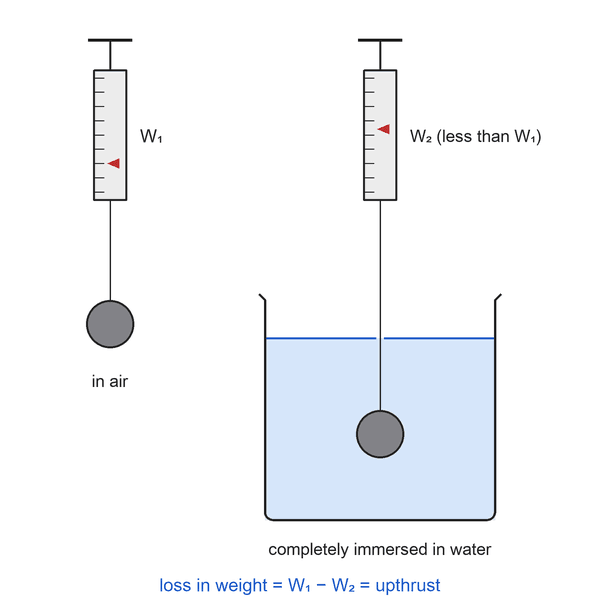
Take a spring balance, a stone tied to a thread, and a beaker of water.
Step 2 — Weigh in air.
Hang the stone from the hook of the spring balance in air and note the reading , its weight in air.
Step 3 — Weigh in water.
Lower the stone slowly until it is completely immersed in water, without touching the sides or the bottom of the beaker. Note the reading .
Step 4 — Observation.
is less than . While the stone goes into the water the reading keeps falling; once it is fully immersed the reading stays at .
Step 5 — Conclusion.
The stone appears lighter in water because the water pushes it up. The apparent loss in weight is the upthrust.
Therefore, the spring balance reads less (W₂ < W₁) when the stone is in water, which shows that a body in a liquid appears lighter than it really is.